Museum-quality giclée or canvas print with fast production and flexible finish options. ( Buy Hand Made Painting Switch to Digital Image)
Pick from our preset sizes that match the artwork's original proportions.

Type the width and the height you need, to fit your frame or your wall. A print can only be cut, never made bigger than the picture, so a size with a different shape loses a part of the image. We send you a digital mockup to approve before we print anything. The picture shown on this page does not show the real cut — only the mockup does.
Worldwide Delivery () in 2 weeks instead of standard 4/5 weeks. (21 November)
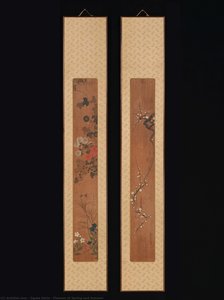
Rough Waves
Reproduction Size
"Rough Waves" by Ogata Kōrin can be downloaded from the artwork's Download page, as a high-resolution digital image download.
A Stats page exists for "Rough Waves". It charts the monthly visits of the artwork and of the artist's other works, with country and language breakdowns.
A print of "Rough Waves" by Ogata Kōrin can be ordered directly on its Fine Art Print page: a fine art print on cotton canvas or archival canvas paper.

Ogata Kōrin (1658-1716) stands as a pivotal figure in Japanese art history, a master whose vibrant paintings and innovative designs profoundly shaped the Rinpa school. Born into a wealthy merchant family dedicated to textiles in Kyoto, Kōrin’s artistic journey was one of late blossoming, transforming him from a youthful dilettante into a celebrated artist renowned for his breathtaking byōbu folding screens and exquisite depictions of nature. His legacy endures not only through his iconic works but also through his influence on generations of artists, most notably Sakai Hōitsu, who championed and popularized Kōrin’s distinctive style.
Kōrin's early life was steeped in the traditions of Kyoto’s elite. His father, Ogata Sōken, a respected calligrapher and patron of Noh theater, instilled in his sons an appreciation for the arts. While initially more inclined towards social pursuits, Kōrin received a formal artistic education, likely influenced by the teachings of the Kanō school, though definitive proof remains elusive. Crucially, he was deeply impacted by the works of his great-granduncle, Hon'ami Kōetsu, and the painter Tawaraya Sōtatsu – the foundational figures of the Rinpa school itself. These predecessors’ emphasis on naturalism, meticulous detail, and a revolutionary approach to color theory served as the bedrock for Kōrin’s own artistic development.
Kōrin's emergence as a significant artist occurred later in life, around 1701-1705. This period witnessed the creation of his most celebrated works, including the iconic “Irises” (a pair of six-panel byōbu screens now designated a National Treasure). These paintings are not merely representations of nature; they are meticulously constructed compositions brimming with symbolism and demonstrating Kōrin’s mastery of color, texture, and perspective. The vibrant hues, achieved through the skillful use of mineral pigments and organic materials on silk or paper, were revolutionary for their time, moving away from the more restrained palettes favored by earlier schools.
Beyond “Irises,” Kōrin's oeuvre encompasses a diverse range of subjects – plum blossoms, cranes and pine trees (a traditional symbol of longevity), and even scenes depicting everyday life. However, it is his folding screens that truly define his artistic legacy. The “Red and White Plum Blossoms” screens (painted circa 1714-1715) exemplify this mastery, showcasing a dynamic interplay of color and form within a carefully orchestrated composition. These works are not simply decorative; they represent a sophisticated understanding of aesthetics and symbolism, reflecting the values of the Edo period.
Kōrin’s artistic technique was characterized by an extraordinary attention to detail and a profound understanding of materials. He employed a unique approach to color mixing, utilizing mineral pigments – such as safflower red, ultramarine blue, and malachite green – alongside organic dyes to achieve astonishingly rich and luminous effects. His use of gold leaf, meticulously applied to the paper, added an ethereal quality to his paintings, creating a shimmering depth that captivated viewers.
Furthermore, Kōrin’s mastery extended beyond painting; he was also a skilled lacquerer and designer of decorative objects like *makie* (relief designs) and *inrō* (medicine cases). These works demonstrate his versatility and his ability to seamlessly integrate artistic principles across various mediums. His innovative approach to design—particularly in the realm of textiles—influenced fashion trends throughout the Edo period.
Ogata Kōrin’s impact on Japanese art is immeasurable. He didn't merely continue a tradition; he revitalized and consolidated the Rinpa school, establishing it as a dominant force in the artistic landscape of his time. His work served as a model for subsequent generations of artists, most notably Sakai Hōitsu, who meticulously copied Kōrin’s paintings and disseminated his style throughout Japan. Hōitsu's efforts ensured that Kōrin’s legacy would endure long after the artist’s death.
Today, Kōrin’s masterpieces are housed primarily at the Museum of Art in Atami, Shizuoka Prefecture, a testament to their enduring value and significance. His work continues to inspire artists and art enthusiasts alike, offering a glimpse into the vibrant world of Edo-period Japan and the genius of one of its most celebrated painters.

1658 - 1716 , Japan

Embark on a profound journey through the soul of Chinese calligraphy. Explore the historical mastery of ink, brush, and script, from ancient Zhuanshu to elegant running script, and discover how this timeless art form reflects the enduring spirit of classical East Asian aesthetics.

Embark on a visual journey through The Met's most iconic artworks. From Renaissance classics to Impressionist gems, discover the stories and techniques that define history. Elevate your space with museum-quality art reproductions and curated decor ideas. Explore the full collection online at WahooArt.com.

Journey through the soul of Japan with our curated guide to the 25 greatest works by Katsushika Hokusai. From The Great Wave to iconic ukiyo-e landscapes, explore the stories behind these timeless masterpieces and find museum-quality art reproductions on WahooArt.com.

Explore the technical evolution of maritime art from Hokusai to Monet. Trace the power of the waves with our expert guide.

Discover the serene beauty of Japanese landscape painting. From Hokusai's iconic woodblock prints to meditative sumi-e ink washes, explore a visual journey through the 'floating world' and learn how to bring this timeless Zen aesthetic into your modern home decor.
 Preview
 Send
Send Share
Share
 Details
 Guide
Guide

 Download
 Similars
 X-Ray
X-Ray Diaporama
 Q&A
Q&A
 Stats
Stats

 Read More






































 Glass option is only available in size under 110 CM