
Preview AR preview Switch to Print Buy Hand Made Painting Send
Details Add to favorites Download Similars X-Ray Diaporama Stats

The Wounded Philoctetes

Explore Nicolai Abraham Abildgaard’s monumental Romantic masterpiece, ‘The Wounded Philoctetes,’ capturing profound pain and classical influence through dramatic chiaroscuro and symbolic references.

Discover Nicolai Abraham Abildgaard (1743-1809), a Danish master of Neoclassical and Royal history painting! Explore his art, blending classicism with Romantic influences – sculptor, architect & professor.

Purchase a high-resolution, enhanced digital image, far superior to the online preview.

Each file is meticulously prepared by our in-house specialists using advanced tools and expert manual retouching. We ensure every image has exceptional clarity, precise color accuracy, and fine detail.

The final file is delivered via email within 72 hours, optimized for immediate use in professional, editorial, and print environments. This is the same quality trusted by top-tier design studios, publishers, and galleries.

Digital Image

Download a high-resolution file for personal display, printing, and creative projects. ( Switch to Print Buy Hand Made Painting)

Total Price

$ 24.90

Included in Every Digital Image Order

Expert Digital Delivery, Guaranteed

When you choose WahooArt.com, you're not just getting an image - you're receiving a professionally enhanced digital artwork, crafted with precision and backed by a satisfaction guarantee. Here's everything that comes with your order, automatically:

shipping_icon
Fast Email Delivery

Your high-resolution digital image file will be emailed to you within 72 hours of ordering - ready for immediate use.

canvas_icon
AI-Enhanced Digital File

Your artwork is professionally optimized using advanced AI tools and manual editing, ensuring maximum detail, clarity, and color accuracy.

insurance_icon
Free Lifetime Re-Delivery

Accidentally deleted or lost your file? No worries - we'll resend it to you anytime, free of charge.

tax_icon
No Import Fees - Ever

Enjoy your artwork instantly with zero customs, duties, or delivery fees - digital downloads are always tax-free.

color_icon
Color Accuracy Guarantee

We ensure your digital image reflects the original colors as closely as possible using professional tools and color management.

return_icon
100-Day Satisfaction Guarantee

If you're not satisfied with your digital image, we'll revise it or refund 100% within 100 days - no questions asked.

guarantee_icon
100% Money-Back Guarantee

Not satisfied? Get a full refund within 100 days of receiving your digital file - no questions asked.

discount_icon
Bulk Order Discounts

Buy 3 images, save 10% - Buy 5, save 15% - Buy 10+, save 20%. Great for creative projects, galleries, and agencies.

Quick Facts

  • Year: 1775
  • Dimensions: 175 x 123 cm
  • Artistic style: Avantgarde, pathos and Weltschmerz
  • Title: The Wounded Philoctetes
  • Medium: Oil on canvas
  • Subject or theme: Mythology
  • Movement: Neoclassicism

A Symphony of Agony and Classical Grandeur

In the quiet intensity of Nicolai Abraham Abildgaard’s 1775 masterpiece, The Wounded Philoctetes, we encounter more than a mere mythological tableau; we witness a profound psychological rupture. The painting serves as a defiant departure from the rigid, idealized restraint of Neoclassicism, stepping instead into the raw, emotive territory that would soon define the Romantic era. Abildgaard does not simply depict the legendary Greek hero; he invites us to inhabit his suffering. As Philoctetes sits exiled on the desolate Lemnos Island, the viewer is confronted with a visceral study of Weltschmerz—that pervasive sense of world-weariness and existential melancholy that haunted the intellectual landscape of Northern Europe during this transformative period.

The subject matter draws deeply from the well of Homeric legend, portraying the hero following his abandonment by the Greeks due to a festering wound. Through Abildgaard’s lens, the physical trauma of the snakebite becomes a metaphor for the deeper, more insidious wounds of betrayal and isolation. The composition is anchored by the hero's contorted posture, where every strained muscle and twisted limb speaks to an unbearable physical and emotional burden. This narrative depth transforms the canvas from a historical illustration into a timeless exploration of human vulnerability and the resilience required to endure profound abandonment.

Mastery of Light and Anatomical Precision

Technically, Abildgaard achieves a breathtaking tension through his masterful use of chiaroscuro. Drawing inspiration from the dramatic shadows of Caravaggio, the artist employs sharp contrasts between light and dark to sculpt the figure out of the gloom. This technique does more than create depth; it directs the eye toward the hero's wounded flesh and the rugged textures of his surroundings, heightening the sense of immediate, tactile pain. The play of light across the musculature is nothing short of sculptural, reminiscent of Michelangelo’s Torso Belvedere, lending the figure a monumental presence that commands the space.

The artist's approach to anatomy is both precise and expressive. Rather than seeking an unattainable perfection, Abild gaard focuses on the physicality of distress. The way the man holds himself up with a single hand, the tension in his back, and the visible scars across his skin all contribute to a sense of lived experience and survival. This anatomical realism serves the emotional purpose of the work, ensuring that the viewer feels the weight of the hero's plight. For the discerning collector or designer, this level of technical sophistication offers a piece that is both intellectually stimulating and visually arresting.

Symbolism and the Aesthetic of Resilience

Beyond the central figure, the subtle details within the scene enrich the painting’s symbolic tapestry. The presence of scattered books suggests a reservoir of wisdom or perhaps the heavy burden of knowledge gained through hardship, while the bow and arrow serve as poignant reminders of his lost glory and his identity as a warrior. Even the leopard skin rug upon which he rests adds a layer of primal, untamed energy to the composition, contrasting with the intellectual weight of the surrounding elements. These details create a rich, layered environment that rewards prolonged contemplation.

For those looking to integrate such a powerful work into a curated interior, The Wounded Philoctetes offers an unparalleled opportunity to introduce drama and historical gravity. As a high-quality reproduction, it brings the brooding elegance of the late 18th century into a modern setting, acting as a focal point that sparks conversation and evokes deep emotion. It is a piece for those who appreciate art that does not merely decorate a room but breathes life, history, and a profound sense of human truth into its surroundings.

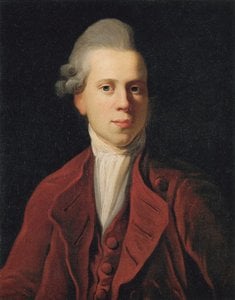
Artist Biography

Early Life and Artistic Foundations

Nicolai Abraham Abildgaard, born in Copenhagen on September 11th, 1743, emerged from a family deeply immersed in the world of art and scholarship. His father, Søren Abildgaard, was a respected antiquarian draughtsman, instilling in young Nicolai an early appreciation for classical forms and meticulous observation. This familial influence proved foundational as Abildgaard embarked on his artistic journey, receiving initial training with a local painting master before formally enrolling at the New Royal Danish Academy of Art in 1764. His talent quickly became apparent; from 1764 to 1767, he consistently earned accolades and medallions recognizing his burgeoning skill. These early successes culminated in a travel stipend awarded in 1767 – a pivotal opportunity that would shape the course of his artistic development, though it was five years before he could finally utilize it. During these formative years at the Academy, Abildgaard benefited from the tutelage of Johan Edvard Mandelberg and Johannes Wiedewelt, absorbing their techniques and perspectives while simultaneously forging his own unique path.

The Roman Awakening: A Shift in Perspective

In 1772, Nicolai Abildgaard finally realized his long-awaited dream of traveling to Rome. This five-year sojourn proved transformative, marking a crucial turning point in his artistic evolution. Immersed in the heart of classical antiquity, he dedicated himself to studying not only sculpture but also architecture, decoration, and the magnificent frescoes adorning Palazzo Farnese. A visit to Naples in 1776 with fellow artist Jens Juel further broadened his horizons. Rome wasn’t merely a place for technical study; it was an intellectual awakening. Abildgaard delved into history painting, seeking to master its complexities and narrative power. He drew inspiration from the masters – Annibale Carracci, Raphael, Titian, and Michelangelo – absorbing their compositional strategies, dramatic use of light, and profound understanding of human anatomy. However, his exposure wasn’t limited to strict classicism. The influence of artists like Johan Tobias Sergel and Johann Heinrich Füssli began to subtly shift his aesthetic sensibilities, introducing a nascent Romantic sensibility into his work. Simultaneously, Abildgaard cultivated a deep appreciation for literature, finding inspiration in the works of Shakespeare, Homer, and Ossian – narratives that would later permeate his canvases with layers of meaning and emotional resonance.

Royal Commissions and National Narratives

Returning to Copenhagen in December 1777, Abildgaard was immediately recognized as a rising star. He swiftly secured a professorship at the Academy in 1778 and soon after, around 1780, ascended to the prestigious position of royal historical painter. This appointment brought with it a monumental commission from the Danish government: to create a series of paintings depicting the history of Denmark for the Knights' Room (Riddersal) at Christiansborg Palace. This project became the defining undertaking of his career. These weren’t simply historical illustrations; they were carefully constructed narratives designed to glorify the monarchy and instill a sense of national pride. Abildgaard masterfully combined accurate historical depictions with allegorical elements and mythological references, creating visually stunning and intellectually stimulating compositions. He also collaborated with Johan Edvard Mandelberg on decorative schemes for Fredensborg Palace, further solidifying his position as Denmark’s leading artistic figure.

A Synthesis of Styles: Neoclassicism and Romanticism

Nicolai Abildgaard's artistic style represents a fascinating synthesis of Neoclassical rigor and emerging Romantic sensibilities. While grounded in the principles of classical composition, clarity, and anatomical accuracy, his works are infused with dramatic lighting, rich color palettes, and meticulous attention to detail that hint at a deeper emotional undercurrent. Notable paintings such as “Christian I Elevates Holstein to a Duchy in 1474” exemplify this blend – a stately historical scene rendered with classical precision yet imbued with a sense of grandeur and theatricality. Other works, like the haunting “The Nightmare,” demonstrate his willingness to explore darker psychological themes, foreshadowing the full-blown Romanticism that would soon dominate European art. His exploration extended beyond history painting; "Culmin's Ghost Appears to his Mother" showcases his skill in portraying supernatural events with dramatic intensity, while pieces like “The Wounded Philoctetes” reveal a sensitivity to human suffering and vulnerability. He wasn’t merely replicating historical or mythological scenes; he was interpreting them through the lens of his own artistic vision, imbuing them with layers of symbolic meaning accessible to a refined audience. His pictorial allegory became a hallmark of his style, using symbols as visual shorthand for complex ideas and emotions.

Legacy and Enduring Influence

Abildgaard served as director of the Academy during 1789–1791 and again from 1801 until his death in Copenhagen on November 14th, 1809. Throughout his career, he nurtured a generation of talented artists, including Asmus Jacob Carstens, Bertel Thorvaldsen, J. L. Lund, and perhaps most significantly, Christoffer Wilhelm Eckersberg. Eckersberg, often hailed as the “father of Danish painting,” would lay the foundation for the Golden Age of Danish Painting, building upon the principles Abildgaard had instilled in him. Abildgaard’s influence extended beyond his direct students; he fundamentally shaped the artistic landscape of Denmark, bridging the gap between Neoclassicism and Romanticism. His work not only reflected the cultural values of his time but also anticipated future artistic trends, contributing significantly to the development of Nordic Romanticism and leaving an indelible mark on Danish art history. He remains a pivotal figure in understanding the transition from Enlightenment ideals to the emotional intensity of the 19th century.
Nicolai Abraham Abildgaard

Nicolai Abraham Abildgaard

1743 - 1809 , Denmark

Quick Facts

  • Artistic Movement Or Style: Neoclassical & Romanticism
  • Artists Or Movements Influenced By This Artist:
    • Asmus Carstens
    • Bertel Thorvaldsen
    • Nordic Romanticism
  • Artists Who Influenced This Artist:
    • Annibale Carracci
    • Raphael
    • Titian
    • Michelangelo
  • Date Of Birth: September 11, 1743
  • Date Of Death: November 14, 1809
  • Full Name: Nicolai Abraham Abildgaard
  • Nationality: Danish
  • Notable Artworks:
    • Christian I...
    • The Nightmare
    • Culmin's Ghost
    • Niels Klim scenes
    • Wounded Philoctetes
  • Place Of Birth: Copenhagen, Denmark