
x


Hand-painted oil on canvas in your size and frame, made to order by our artists. ( Buy Print Buy Image)





























Pick from our preset sizes that match the artwork's original proportions.

You may enter your own dimensions to fit a specific frame or space. If your selected size does not match the original image's proportions, we will either crop the artwork or extend the painting with additional hand-painted elements. A digital mockup will be sent for your approval before production begins.
Please note that the on-screen preview does not reflect the actual cropping or extension. Only the mockup will accurately show the final composition.
While custom sizes are available, we recommend selecting a dimension from the predefined list to preserve the original proportions.
Worldwide Delivery () in 3/4 weeks instead of standard 5 weeks. (29 August). No compromise on quality.


King's room
Reproduction Size
Nicholas Roerich's “King’s Room,” painted in 1913, stands as a cornerstone of early modernist art—specifically Fauvist and Expressionist influences—capturing not merely architectural detail but also an atmosphere imbued with profound symbolism. This striking watercolor or gouache on paper depicts an interior space rendered in a deliberately flattened perspective, prioritizing color and form over realistic representation, mirroring the artistic fervor of its time.
The artwork’s dominant feature is a monumental archway framing a vista into deeper recesses of the room. Multiple doorways and windows contribute to a complex arrangement that defies conventional spatial logic—a characteristic technique designed to unsettle the viewer and propel them into an experience of abstraction. Lines are assertive, angular, defining architectural elements with uncompromising clarity; shapes – arches, rectangles, squares – coalesce into geometric patterns that underpin the entire composition.
Roerich’s masterful use of color is paramount to conveying the artwork's emotional impact. The palette explodes with hues—deep blues reminiscent of royal authority, fiery reds symbolizing passion and power, regal purples hinting at mysticism and spirituality, vibrant yellows radiating warmth and optimism, and lush greens evoking tranquility and connection to nature. These colors aren’t merely decorative; they operate symbolically, reflecting Roerich's fascination with esoteric traditions and his belief in the transformative potential of art.
The artist employs loose brushstrokes—a hallmark of Fauvist painting—creating a textured surface that suggests both smooth walls and rougher surfaces like decorative tiles. This technique lends dynamism to the scene, hinting at movement despite the flattened perspective. Careful layering of colors builds depth and luminosity, enhancing the overall impression of grandeur and inviting contemplation.
"King's Room" emerged during a period of artistic experimentation fueled by figures like Sergei Diaghilev, whose Ballet Russes championed radical new approaches to theatrical presentation. Roerich’s involvement with this influential collective solidified his position at the forefront of the avant-garde movement—a testament to his unwavering commitment to pushing boundaries and exploring uncharted territories in visual art.
Beyond its architectural depiction, “King’s Room” hints at a deeper spiritual dimension. The arched doorway symbolizes ascension toward enlightenment, while the windows offer glimpses into imagined landscapes—echoes of Roerich's explorations of Himalayan mysticism and his belief in interconnectedness between humanity and the cosmos. This artwork serves as an invitation to delve into realms beyond the visible world, mirroring Roerich’s lifelong pursuit of artistic truth.
Explore Nicholas Roerich’s ‘King’s Room’ (1913). A vibrant, stylized interior with bold lines & geometric shapes. Early modernist art – a surreal & opulent glimpse into a palace world.


1874 - 1947 , Russia
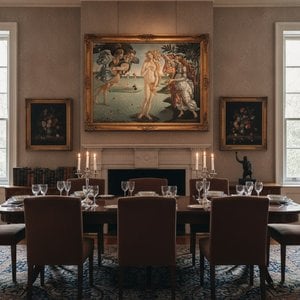
Elevate your dining room with museum-quality handmade oil reproductions. From Old Master grandeur to Impressionist serenity, discover bespoke art solutions for luxury interiors, custom portraits, and large-scale murals curated by WahooArt's master artists.

Elevate your interior design projects with our expert guide on matching masterpiece reproductions to luxury styles. Discover professional techniques for selecting hand-painted oils, multi-panel layouts, and custom commissions that transform spaces into curated galleries.

Elevate your home with museum-quality, hand-painted oil reproductions of iconic masterpieces. Discover bespoke art commissions, professional consultations, and timeless elegance designed to transform your living space into a curated gallery of history and luxury.


Stay updated with the latest art news, exclusive offers, and decoration ideas.
Tell us about your project and our art experts will provide you with 3 personalized art suggestions.
Let Us Curate 3 Options Just for You - Free!

 Preview
 Send
Send Share
Share
 Details

 Download
 Similars
 X-Ray
X-Ray Diaporama

 Read More







 Glass option is only available in size under 110 CM


