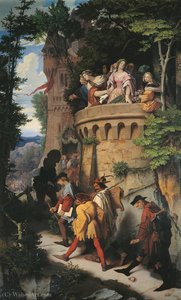
Moritz von Schwind: A Poet of the Romantic Imagination
Moritz von Schwind, born in Vienna’s vibrant artistic circles in 1804 and tragically passing away in Pöcking, Bavaria, in 1871, remains a captivating figure within German Romanticism. More than simply a painter, he was a poet rendered in oils, a weaver of dreams and folklore, and a master of evocative landscapes imbued with profound symbolism. His genius lay not just in technical skill but in his ability to translate the emotional currents of his time – chivalry’s lingering allure, the whispers of Germanic legends, and the burgeoning spirit of Romanticism – into visually arresting works that continue to resonate today. Schwind's life was a tapestry woven with friendships with musical giants like Schubert, commissions from royalty, and a relentless pursuit of capturing the essence of poetic fancy.
Early Life and Artistic Foundations
Schwind’s early years were marked by privilege and a fortunate exposure to artistic influences. Born into an aristocratic family, he received a rudimentary but solid education, fostering a love for literature and music alongside his burgeoning artistic talent. A key moment in his development occurred when he befriended Franz Schubert, whose songs provided a significant source of inspiration throughout Schwind’s career. He illustrated several of Schubert's compositions, capturing the composer’s melancholic beauty with remarkable sensitivity. Moving to Munich in 1828, following Schubert’s death, marked a pivotal shift. There, he found mentorship under Cornelius, then director of the Academy, and forged connections with fellow artists like Schnorr, creating a fertile environment for his artistic growth. This period laid the groundwork for his distinctive style – one characterized by lyrical grace, meticulous detail, and an almost dreamlike quality.
Royal Commissions and Artistic Flourishing
Schwind’s career truly ascended in the 1830s and 40s, fueled by a series of prestigious commissions. In 1834, he was entrusted with decorating King Ludwig's new palace in Munich, undertaking monumental wall paintings illustrating scenes from Tieck’s poetry – a project that showcased his burgeoning mastery of narrative composition and historical detail. Further cementing his reputation, he designed “Kinderfries” (children’s frieze) for the same palace, playful depictions of youthful merriment that demonstrated his ability to capture fleeting moments of joy. He also accepted commissions in Saxony and Baden, solidifying his position as a leading artist of the era. A particularly significant undertaking was his work at the Karlsruhe Academy in 1839, where he created a vast fresco embodying Goethe’s ideas – an ambitious project that reflected the intellectual fervor of the time.
The Height of Romantic Vision: Landscapes and Legends
Schwind's most celebrated works emerged during his residency in Frankfurt (1844-1847) and later in Munich. This period witnessed the creation of some of his finest easel paintings, including “Singers’ Contest in the Wartburg” (1846), a masterpiece that perfectly encapsulates Romantic ideals – a gathering of musicians lost in passionate song amidst a dramatic medieval setting. His designs for the Goethe celebration further showcased his ability to blend historical accuracy with poetic imagination. However, it was his interpretations of Germanic legends and folklore that truly defined his artistic legacy. The “Niebelungenlied” cycle, particularly his stunning frescoes for Hohenschwangau Castle depicting the epic tale of Siegfried and Brunhilde, stands as a testament to his skill in translating complex narratives into visually compelling scenes. His work on the story of Cupid and Psyche for Leipzig is equally remarkable, demonstrating his ability to evoke both beauty and melancholy.
Later Years and Legacy
Schwind’s later years were marked by declining health but continued artistic productivity. He returned to Vienna in 1847, where he created a cycle of paintings based on the legend of Melusine, showcasing his enduring talent. His final works, including designs for commemorative musicians at the Vienna State Opera, reflected a deep appreciation for music and its power to inspire. Moritz von Schwind died in Niederpöcking in 1871, leaving behind a rich artistic legacy that continues to captivate audiences today. His paintings are celebrated not only for their technical brilliance but also for their ability to transport viewers to worlds of myth, legend, and profound emotional resonance – solidifying his place as a key figure in the history of German Romantic art.
Notable Works
- Rübezahl (1834): A dramatic landscape featuring the mythical guardian of the Bavarian Alps, embodying themes of nature, power, and mystery.
- The Dream of Erwin von Steinbach (1822): An intricate drawing capturing a Gothic scene filled with symbolism and psychological depth.
- Landscape with Wanderer (1835): A haunting black-and-white drawing depicting a solitary figure contemplating a fantastical landscape, reflecting themes of isolation and introspection.
- Singers’ Contest in the Wartburg (1846): A vibrant and dynamic painting capturing a scene of musical passion amidst a medieval setting – Schwind's most famous work.
- Seven Ravens (1857): A series of illustrations based on Grimm’s fairy tales, showcasing his ability to blend fantasy with narrative storytelling.
Further Exploration



 Preview
 Buy Hand Made Painting
 Send
Send Share
Share
 Details
 Guide
Guide

 Download
 Similars
 X-Ray
X-Ray Diaporama
 Q&A
Q&A Stats
Stats


 Read More






































 Glass option is only available in size under 110 CM