


x

Hand-painted oil on canvas in your size and frame, made to order by our artists.





























Pick from our preset sizes that match the artwork's original proportions.

You may enter your own dimensions to fit a specific frame or space. If your selected size does not match the original image's proportions, we will either crop the artwork or extend the painting with additional hand-painted elements. A digital mockup will be sent for your approval before production begins.
Please note that the on-screen preview does not reflect the actual cropping or extension. Only the mockup will accurately show the final composition.
While custom sizes are available, we recommend selecting a dimension from the predefined list to preserve the original proportions.
Worldwide Delivery () in 3/4 weeks instead of standard 5 weeks. (1 July). No compromise on quality.


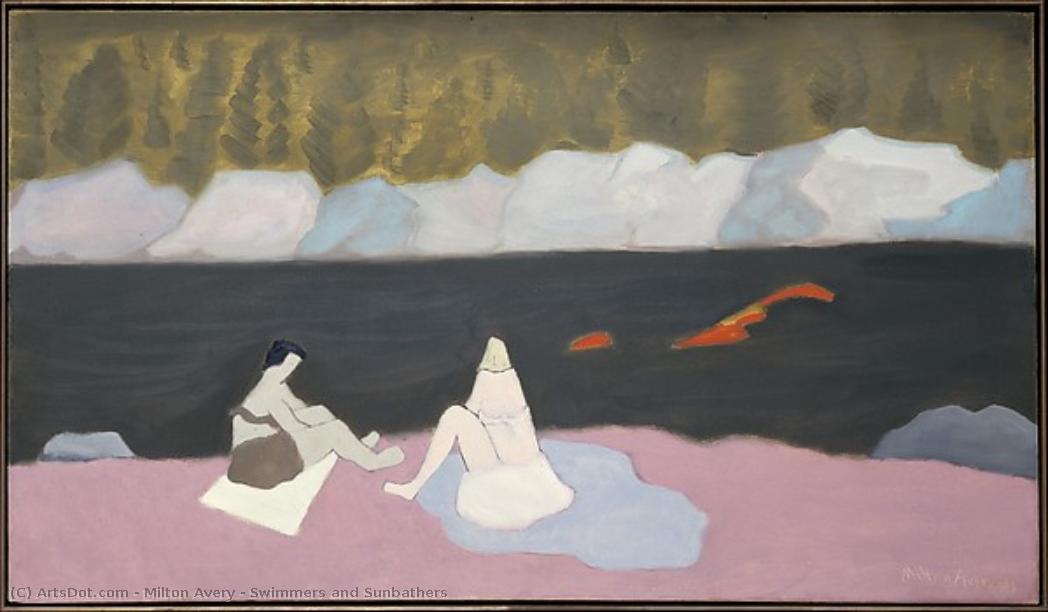
Swimmers and Sunbathers
Reproduction Size


Milton Clark Avery, born March 7, 1885, in the small hamlet of Altmar, New York, wasn’t a painter who stormed the art world with manifestos or radical pronouncements. Instead, his revolution unfolded quietly, through a subtle yet profound exploration of color and form that would deeply influence generations of American artists. His early life was steeped in practicality; as the son of a tanner, Avery began working at sixteen to support his family after his father’s untimely death, taking on various blue-collar jobs while nurturing a burgeoning passion for art. This period instilled in him a grounded sensibility, a connection to everyday life that would permeate his work. He pursued formal training at the Connecticut League of Art Students and later at the Art Students League of New York, but it was through self-directed study and an innate sensitivity to visual experience that Avery truly forged his artistic path. For years, he balanced painting with the demands of providing for a large family, working night jobs to allow daylight hours for creative exploration—a testament to his unwavering dedication.
Avery’s artistic journey wasn't one of immediate recognition. He worked in relative obscurity for decades, refining his vision through persistent experimentation. Early influences included the bold color palettes of French Fauvism—artists like Henri Matisse were pivotal—and the expressive distortions of German Expressionism, particularly the work of Ernst Ludwig Kirchner. However, Avery didn’t simply mimic these styles; he absorbed their lessons and synthesized them into something uniquely his own. He began to distill subjects – landscapes, figures, still lifes – to their essential forms, prioritizing color relationships and emotional resonance over meticulous detail. This simplification wasn't about a lack of skill but rather a deliberate choice to focus on the evocative power of pure color and flattened planes. His palette became increasingly luminous, his compositions more spacious and serene. A crucial turning point came with his marriage to Sally Michel in 1926; her support as an illustrator allowed him greater freedom to dedicate himself fully to painting, and their artistic dialogue proved invaluable. They developed a collaborative spirit, often referred to as “the Avery style,” characterized by its lyrical abstraction and harmonious color schemes.
For many years, Avery’s work remained largely unknown outside of a small circle of artists and collectors. This changed dramatically through the discerning eye of Roy Neuberger, a New York art dealer who recognized the exceptional quality and originality of Avery's paintings. Beginning in the late 1930s, Neuberger embarked on an ambitious campaign to promote Avery’s work, acquiring over one hundred paintings—including the iconic *Gaspé Landscape*—and strategically lending or donating them to museums around the world. This exposure was transformative, bringing Avery's art to a wider audience and establishing his reputation as a significant American modernist. During this period, Avery also forged friendships with prominent artists like Adolph Gottlieb and Mark Rothko, engaging in stimulating conversations about art and aesthetics that further shaped his artistic development. The Phillips Collection in Washington D.C., recognizing the importance of his work, became the first museum to purchase an Avery painting in 1929 and hosted his first solo exhibition in 1944—a landmark moment in his career.
Milton Avery's contribution to American art extends far beyond his own paintings. He served as a crucial bridge between representational painting and the burgeoning abstract expressionist movement of the 1940s and 50s. Artists like Rothko and Gottlieb, deeply influenced by Avery’s emphasis on color and simplified forms, acknowledged his pivotal role in paving the way for their own explorations of abstraction. Avery's work demonstrated that a painting didn't need to meticulously depict reality to convey profound emotional depth; it could achieve this through the expressive power of color, composition, and gesture. His paintings are not merely representations of landscapes or figures but rather evocations of mood, atmosphere, and personal experience. He died on January 3, 1965, at Montefiore Hospital in the Bronx, leaving behind a legacy that continues to inspire artists today. Sally Avery continued to champion his work after his death, donating his papers to the Archives of American Art, ensuring that future generations would have access to the rich intellectual and artistic heritage he created.
Milton Avery's art remains a testament to the power of quiet contemplation, the beauty of simplicity, and the enduring legacy of an artist who dared to forge his own path. His paintings invite us to slow down, to look closely, and to experience the world in a new light—a light infused with color, emotion, and a profound sense of harmony.

1885 - 1965 , United States of America

Explore the groundbreaking abstract expressionism of Morris Louis, a pioneer of Color Field painting. Discover his innovative techniques, influential series & lasting legacy in post-war American art. Learn more at WahooArt.

Explore the life & work of Jacob Kainen, a pivotal figure in American Abstract Expressionism and Color Field painting. Discover his journey from Social Realism to vibrant abstraction and lasting influence on 20th-century art.

Explore the captivating world of Beatrice Parsons, a pioneering British abstract expressionist. Discover her journey from garden watercolors to evocative color field paintings and learn about her place within art history.

Explore the profound world of Clyfford Still's Abstract Expressionism with WahooArt. Discover his unique style, existential themes & investment potential. Expert analysis for discerning collectors.

Explore the captivating world of Paul Jenkins, a pioneer of abstract expressionism & color field painting. Discover his unique ‘Phenomena’ series and investment potential for art collectors. Expert insights at WahooArt.


Stay updated with the latest art news, exclusive offers, and decoration ideas.
Tell us about your project and our art experts will provide you with 3 personalized art suggestions.
Let Us Curate 3 Options Just for You - Free!
 Buy print
 Send
Send Share
Share
 Details

 Download
 Similars
 X-Ray
X-Ray Diaporama









 Read more
 Glass option is only available in size under 110 CM


