A Vision of Medieval Valor: Mikhail Vrubel's "Thirty-three Knights"
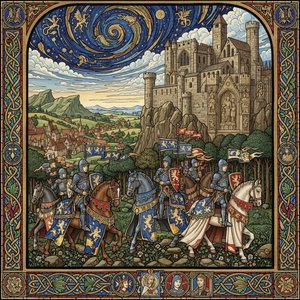
This striking oil on canvas, “Thirty-three Knights,” painted in 1901 by the renowned Russian artist Mikhail Vrubel, presents a dynamic and evocative scene steeped in medieval imagery. The painting depicts a procession of at least thirteen knights riding across a wide expanse of water – likely a river or lake – their figures rendered with a powerful sense of movement and determination. While the precise narrative source remains open to interpretation, the work clearly draws upon themes of chivalry, courage, and perhaps even pilgrimage, common motifs in medieval art and literature. The composition is dramatic; the knights are not presented as static portraits but as active participants in an unfolding event, their horses surging forward through the water.
Style and Technique: Symbolism Meets Art Nouveau
Vrubel’s artistic style is a fascinating blend of Russian Symbolism and Art Nouveau aesthetics. He was a pioneer in both movements, known for his ability to infuse traditional subjects with mystical and dreamlike qualities. In "Thirty-three Knights," this manifests through the somewhat ambiguous setting and the intense focus on conveying emotion rather than strict realism. Note the use of color – while the exact palette is not specified in available information, Vrubel was celebrated for his saturated tones reminiscent of precious stones, a technique he honed during his studies of medieval Venetian mosaics. The brushwork appears fluid and expressive, contributing to the overall sense of dynamism and energy within the scene. The composition itself suggests an almost theatrical presentation, with the knights arranged in a way that draws the viewer's eye across the canvas.
Historical Context and Inspiration
Vrubel’s work was deeply rooted in Russian history and folklore. His early career involved restoring lost murals and mosaics at St. Cyril's Church in Kiev, an experience which profoundly influenced his artistic development. This project exposed him to the rich traditions of medieval Christian art, particularly Byzantine iconography, which informed his use of color and symbolic imagery. While "Thirty-three Knights" doesn’t directly depict a specific historical event, it reflects a broader fascination with medieval themes prevalent in late 19th and early 20th century Russian art – a period marked by renewed interest in national identity and cultural heritage. The number thirty-three itself holds significance in Russian Orthodox tradition, often associated with the Ecumenical Councils of the Church, adding another layer of potential symbolic meaning to the work.
Emotional Impact and Interpretation
"Thirty-three Knights" evokes a powerful sense of adventure, determination, and perhaps even spiritual quest. The knights’ forward momentum across the water suggests overcoming obstacles and pursuing a noble goal. The painting's ambiguity allows for multiple interpretations; it could represent a military campaign, a religious pilgrimage, or simply a symbolic journey through life's challenges. Regardless of the specific narrative, the work resonates with a feeling of strength, resilience, and the enduring spirit of chivalry. The dramatic lighting and dynamic composition create an emotionally engaging experience for the viewer, inviting contemplation on themes of courage, faith, and the pursuit of ideals.
Why Acquire a Reproduction?
Owning a reproduction of "Thirty-three Knights" offers a unique opportunity to bring a piece of Russian Symbolist art into your home or office. Its striking imagery and powerful symbolism make it an excellent conversation starter and a captivating addition to any space. Whether you are an avid collector, an interior designer seeking a statement piece, or simply someone who appreciates beautiful art, this reproduction captures the essence of Vrubel’s masterpiece, allowing you to experience its beauty and emotional depth firsthand.
Questions & Answers
How saturated is the palette of "Thirty-three knights"?
The colors of "Thirty-three knights" by Mikhail Vrubel have a muted saturation. Saturation describes how vivid or muted the colors are.
Is a high-resolution download of "Thirty-three knights" available?
To get a digital file of "Thirty-three knights" by Mikhail Vrubel, order a high-resolution digital image download on its Digital Image page.
Where does "Thirty-three knights" fall in Mikhail Vrubel's career?
Within Mikhail Vrubel's career, "Thirty-three knights" falls in the Mature Period. The phase helps compare it with the artist's other works.


 Buy Hand Made Painting




 Preview
 Send
Send Share
Share
 Details
 Guide
Guide

 Download
 Similars
 X-Ray
X-Ray Diaporama
 Stats
Stats

 Read More






































 Glass option is only available in size under 110 CM


