

 Installation ArtInstallationMinimalist Architectural Forms
 2000Modern
 450.0 x 300.0 cm
 Guggenheim Museum Bilbao
Museum-quality giclée or canvas print with fast production and flexible finish options. ( Buy Hand Made Painting Switch to Digital Image)
Pick from our preset sizes that match the artwork's original proportions.

You may enter your own dimensions to fit a specific frame or space. If your selected size does not match the original image's proportions, we will either crop the artwork or extend the image with a mirrored or solid-fill edge. A digital mockup will be sent for your approval before production begins.
Please note that the on-screen preview does not reflect the actual cropping or extension. Only the mockup will accurately show the final composition.
While custom sizes are available, we recommend selecting a dimension from the predefined list to preserve the original proportions.
Worldwide Delivery () in 2 weeks instead of standard 4/5 weeks. (21 September)


Wall City
Reproduction Size
In the year 2000, Miguel Navarro presented "Wall City" (Ciudad muralla) at the Fondazione Giorgio Cini in Venice, a monumental installation that continues to resonate with its stark beauty and unsettling implications. This sprawling cityscape, initially conceived as a collection of approximately 1,000 zinc elements and subsequently expanded to over 4,000, stands as a powerful meditation on urban existence – a place where the individual dissolves into the vastness of the constructed environment. Measuring up to 500 square meters in scale, with towers reaching an imposing 4.5 meters, "Wall City" demands attention and invites contemplation about the nature of modern society.
"Wall City" is fundamentally defined by its geometric precision. Navarro meticulously assembled hundreds of rectangular and cylindrical elements from zinc (or a similar metallic material), creating a rigorously ordered cityscape. The sharp, angular lines and repetitive forms evoke the principles of minimalism while simultaneously generating a sense of controlled chaos – mirroring, perhaps, the complexities of urban life itself. The reflective surfaces of the metal contribute significantly to the artwork’s impact, capturing and distorting light in a way that adds depth and realism, almost as if the city were perpetually caught in a state of shimmering reflection.
Beyond its formal qualities, "Wall City" is laden with symbolic weight. The absence of human figures within the vast cityscape amplifies this effect, transforming it into an imagined metropolis – deserted, anonymous, and perhaps even oppressive. The repetitive nature of the elements suggests a uniformity or lack of individuality characteristic of modern urban environments. Navarro’s work can be interpreted as a critique of societal structures, prompting questions about identity, connection, and the potential for isolation within densely populated areas. It's a powerful visual statement on the relationship between individuals and their surroundings.
Created in 2000, "Wall City" reflects Miguel Navarro’s broader artistic trajectory – one deeply rooted in postmodernism, minimalism, and avant-garde principles. Influenced by artists like Donald Judd and Sol LeWitt, Navarro's work shares a commitment to geometric abstraction and the exploration of spatial relationships. His earlier sculpture “fraternitat,” a prominent piece located in Barcelona’s Parc del Fòrum, further demonstrates his mastery of these techniques and his ability to create impactful public artworks. Navarro’s versatility – encompassing sculpture, painting, and poetry – underscores his commitment to pushing the boundaries of contemporary artistic expression.

Born on September 29, 1945, in the Spanish town of Mislata, Miguel Navarro stands as a profound figure in the landscape of contemporary Spanish art. His creative journey is not merely a career but a multi-faceted exploration of form, space, and language. As an artist who refuses to be confined by a single medium, Navarro has masterfully navigated the realms of sculpture, painting, and contemporary poetry. This rare versatility allows him to weave a complex narrative across different disciplines, creating a cohesive artistic universe that resonates with both the tactile weight of bronze and the ethereal rhythm of verse. His education at the prestigious San Carlos School of Fine Arts in Valencia provided the foundational rigor that would later allow him to experiment with the boundaries of modern aesthetics.
The evolution of Navarro’s practice is marked by a significant transition in the early 1970s. While he began his professional path in the 1960s as a painter, capturing the nuances of color and light on canvas, it was in 1972 that he made the pivotal decision to dedicate himself exclusively to the art of sculpture. This shift allowed him to engage more intimately with volume, mass, and the physical presence of objects in space. His stylistic language emerged from a sophisticated blend of postmodernism, minimalism, and avant-garde influences. By stripping away unnecessary ornamentation and focusing on the essential geometry of form, Navarro created works that speak to the quiet strength of minimalism while maintaining the intellectual complexity characteristic of postmodern thought.
Navarro’s significance in the Spanish art scene is perhaps most poignantly felt through his ability to imbue physical structures with deep historical and social meaning. His work often serves as a bridge between the abstract and the commemorative. One of his most profound achievements is the sculpture Fraternitat, located in the Parc del Fòrum in Barcelona. This monumental piece acts as a solemn homage to the victims of the Camp de la Bota, those assassinated by nationalists during the Spanish Civil War. Through this work, Navarro transcends the purely aesthetic, using his sculptural mastery to ensure that collective memory is preserved within the public consciousness.
The prestige of his contributions is reflected in the esteemed institutions that house his creations. His art has been showcased in some of the world's most renowned galleries, including:
Beyond the physical permanence of his sculptures, Navarro’s identity as a poet adds a layer of lyrical depth to his entire body of work. This intersection of the visual and the literary creates a holistic experience for the viewer, where the silence of a minimalist sculpture is echoed by the rhythmic cadence of his poetry. As a primary reference point for contemporary Valencian and Spanish art, Miguel Navarro continues to inspire, reminding us that true artistry lies in the ability to find harmony between the tangible world and the boundless reaches of human emotion.

1945 - , Spain

Journey through art history with our Top 10 bronze sculptures! Explore masterpieces by Rodin, Michelangelo & more. Discover stories behind iconic statues and find museum-quality reproductions for your home decor at WahooArt.com.

Journey through art history with 10 legendary bronze sculptures – from Michelangelo's David to Rodin’s Thinker. Explore the stories, techniques & timeless beauty of these masterpieces. Find museum-quality reproductions & elevate your home decor on WahooArt.com.
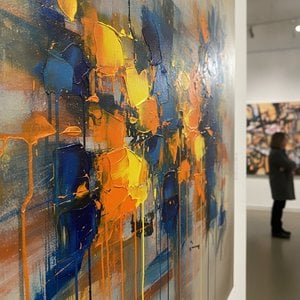
Master the high-impact world of contemporary abstraction. Discover how bold colors, textures, and modern movements like Abstract Expressionism can transform your space with premium, high-energy art curated for the design-conscious professional.

Explore the rich history of sculpture with WahooArt. Discover key techniques, influential artists & investment potential for discerning collectors. Expert insights into valuing and collecting timeless masterpieces.

Explore the rich history of sculpture from ancient masterpieces to contemporary innovations. Discover key techniques, influential artists & investment potential for discerning art collectors.

 Send
Send Share
Share
 Details
 Guide
Guide

 Download
 Similars
 Diaporama
 Stats
Stats Read More




































 Glass option is only available in size under 110 CM


