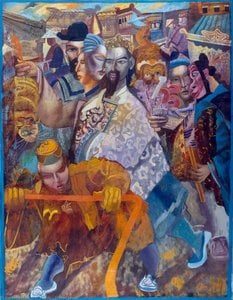
1992
1992 29.0 x 24.0 cm
 Bolton Museum And Art Gallery
Museum-quality giclée or canvas print with fast production and flexible finish options. ( Buy Hand Made Painting Switch to Digital Image)
Pick from our preset sizes that match the artwork's original proportions.

You may enter your own dimensions to fit a specific frame or space. If your selected size does not match the original image's proportions, we will either crop the artwork or extend the image with a mirrored or solid-fill edge. A digital mockup will be sent for your approval before production begins.
Please note that the on-screen preview does not reflect the actual cropping or extension. Only the mockup will accurately show the final composition.
While custom sizes are available, we recommend selecting a dimension from the predefined list to preserve the original proportions.
Worldwide Delivery () in 2 weeks instead of standard 4/5 weeks. (23 September)


Studio Interior
Reproduction Size

Mick Rooney, a name perhaps less familiar to the general public than some of his contemporaries, remains a quietly significant figure in mid-20th century British art. Born in Epsom, Surrey, in 1944, Rooney’s career unfolded with a distinctive blend of vibrant color, dynamic composition, and an underlying current of psychological depth. He wasn't merely depicting scenes; he was translating feeling onto canvas, creating works that resonate with the energy of everyday life and the complexities of human experience. His journey, marked by periods of intense activity followed by relative seclusion, offers a fascinating glimpse into the creative process of a truly original artist.
Rooney’s early influences were deeply rooted in his upbringing. Raised in a family connected to the performing arts – his father was a vaudevillian – he developed an instinctive understanding of visual storytelling and performance. This theatrical sensibility would later permeate his work, imbuing scenes with a sense of drama and immediacy. Crucially, Rooney’s artistic development coincided with a period of significant social and cultural change in Britain, including the rise of Pop Art and the burgeoning interest in abstract expressionism. While he never fully embraced either movement, these influences subtly shaped his approach to color, composition, and subject matter. His early work often featured scenes from London street life – bustling markets, crowded pubs, and impromptu gatherings – rendered with a bold, almost frenetic energy.
Rooney’s distinctive style is immediately recognizable through his masterful use of color. He eschewed muted tones in favor of vibrant, often clashing hues – reds, yellows, blues, and greens – applied with a loose, expressive brushstroke. This technique wasn't simply decorative; it served to heighten the emotional impact of his scenes, conveying a sense of energy, excitement, and sometimes even unease. His compositions are equally dynamic, frequently employing diagonal lines and overlapping forms to create a feeling of movement and instability. He avoided static arrangements, preferring to present scenes as they unfolded in real time – capturing fleeting moments of interaction and drama.
A particularly compelling example of this approach is “Windy Day in Brick Lane” (1991). The painting captures the chaotic energy of a London street scene, with figures jostling for space amidst a blur of color and movement. The use of bright, contrasting colors amplifies the sense of disorientation and excitement, while the dynamic composition draws the viewer into the heart of the action. Similarly, “The Truant Man” (2007), a diptych exploring themes of isolation and alienation, utilizes a surrealist style with symbolic imagery to evoke a powerful emotional response.
Rooney’s work is deeply rooted in the experience of urban life. He spent much of his career documenting the sights and sounds of London – its markets, pubs, street performers, and everyday encounters. However, he wasn't simply interested in portraying these scenes realistically; he sought to capture the underlying human drama that unfolded within them. His paintings often depict moments of connection and conflict, revealing the complexities of social interaction and the challenges of navigating a crowded urban landscape.
The recurring motif of “the outsider” – individuals marginalized or alienated from society – is also evident in his work. This theme reflects Rooney’s own experiences as an artist struggling to find recognition within the established art world, but it also speaks to broader concerns about social exclusion and isolation. His paintings invite viewers to contemplate the human condition and to consider the ways in which we connect with one another.
While Mick Rooney may not be a household name, his work continues to resonate with audiences today. His vibrant colors, dynamic compositions, and emotionally charged subject matter offer a compelling counterpoint to more conventional approaches to painting. He demonstrated an ability to translate the energy of everyday life onto canvas, creating works that are both visually striking and psychologically insightful.
His paintings serve as a reminder of the power of art to capture the complexities of human experience and to provoke reflection on our place in the world. The continued interest in his work through online galleries like Bridgeman Images demonstrates that Rooney’s artistic vision remains relevant and engaging for contemporary viewers, solidifying his position as a significant figure in British art history.

1944 -

 Preview
 Send
Send Share
Share
 Details
 Guide
Guide

 Download
 Similars
 X-Ray
X-Ray Diaporama
 Stats
Stats Read More




































 Glass option is only available in size under 110 CM