
Purchase a high-resolution, enhanced digital image, far superior to the online preview.
Each file is meticulously prepared by our in-house specialists using advanced tools and expert manual retouching. We ensure every image has exceptional clarity, precise color accuracy, and fine detail.
The final file is delivered via email within 72 hours, optimized for immediate use in professional, editorial, and print environments. This is the same quality trusted by top-tier design studios, publishers, and galleries.
Download a high-resolution file for personal display, printing, and creative projects. ( Switch to Print Buy Hand Made Painting)
When you choose WahooArt.com, you're not just getting an image - you're receiving a professionally enhanced digital artwork, crafted with precision and backed by a satisfaction guarantee. Here's everything that comes with your order, automatically:

Your high-resolution digital image file will be emailed to you within 72 hours of ordering - ready for immediate use.

Your artwork is professionally optimized using advanced AI tools and manual editing, ensuring maximum detail, clarity, and color accuracy.

Accidentally deleted or lost your file? No worries - we'll resend it to you anytime, free of charge.

Enjoy your artwork instantly with zero customs, duties, or delivery fees - digital downloads are always tax-free.

We ensure your digital image reflects the original colors as closely as possible using professional tools and color management.

If you're not satisfied with your digital image, we'll revise it or refund 100% within 100 days - no questions asked.

Not satisfied? Get a full refund within 100 days of receiving your digital file - no questions asked.

Buy 3 images, save 10% - Buy 5, save 15% - Buy 10+, save 20%. Great for creative projects, galleries, and agencies.
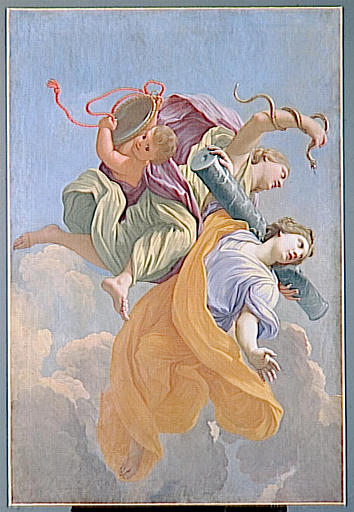
Michel Dorigny’s “La Force et la Prudence” (Strength and Prudence) is not merely a decorative ceiling painting; it's a carefully constructed allegory, a visual meditation on the virtues that underpinned Renaissance thought and continue to resonate today. Painted in 1659-1661 during his time at the Académie de peinture et de sculpture in Paris, this work embodies the spirit of the French Baroque while retaining a classical elegance—a testament to Dorigny’s rigorous training under masters like Vouet. The scene unfolds within a swirling cloudscape, reminiscent of both the heavens and the depths of human experience, suggesting that true strength and prudence are found not in earthly pursuits alone but also in understanding one's place within a larger order.
The painting’s composition is immediately striking – a deliberate pyramid structure anchored by the reclining figure of Prudence. This central female form, rendered with exquisite detail and draped in flowing robes of cream and pale blue, embodies wisdom, restraint, and foresight. Above her, bathed in a softer light, stands Strength, represented by an angel—a dynamic figure radiating power and determination. The careful arrangement creates a sense of upward movement, drawing the eye towards the celestial realm while simultaneously grounding it in the earthly concerns of virtue. Dorigny masterfully employs a muted color palette dominated by blues, yellows, pinks, and creams; these tones are not vibrant or dramatic but rather contribute to an atmosphere of serene contemplation. Subtle contrasts between the warm drapery and the cooler sky create depth and visual interest without disrupting the overall sense of harmony.
Dorigny’s technique is characterized by a remarkable attention to detail and a sophisticated understanding of oil painting. He utilizes thin, translucent glazes—a hallmark of the French Baroque style—to build up layers of color, creating a luminous effect that seems to emanate from within the canvas. The rendering of fabric is particularly noteworthy; each fold and drape appears incredibly tactile, conveying a sense of weight and movement. The cherubic figures are painted with delicate precision, their features subtly expressive yet retaining an air of innocence. Close examination reveals meticulous work in capturing the textures of skin, hair, and clothing—a testament to Dorigny’s skill as a painter and his dedication to realism within the context of allegorical representation. The use of lines is primarily curvilinear, mirroring the flowing drapery and cloud formations, contributing to the painting's overall sense of fluidity.
“La Force et la Prudence” is rich in symbolic meaning, drawing upon classical mythology and philosophical concepts. Prudence, often depicted as a goddess or wise woman, represents not just caution but also the ability to discern truth from falsehood, to make sound judgments, and to act with foresight. Strength, embodied by the angel, symbolizes courage, resilience, and the capacity to overcome obstacles. The interaction between these two figures suggests a harmonious balance—that true strength is not merely brute force but rather tempered by wisdom and prudence. The swirling clouds serve as a backdrop for this symbolic drama, representing the uncertainties of life and the need for guidance in navigating them.
More than three centuries after its creation, “La Force et la Prudence” continues to captivate viewers with its beauty, elegance, and profound symbolism. It stands as a powerful reminder of the enduring value of virtue—of strength tempered by wisdom, and of prudence guiding us towards a more fulfilling life. Reproductions of this exquisite painting offer a unique opportunity to bring this timeless masterpiece into your home or office, adding a touch of classical grace and intellectual depth to any space.

In the grand, often turbulent tapestry of the French Baroque era, where dramatic shadows and sweeping movements frequently commanded the viewer's attention, Michel Dorigny (1616–1665) carved out a unique and enduring niche. Born in Saint-Quentin, France, Dorigny emerged not as a painter of theatrical storms or violent mythologies, but as a master of tranquility. His life and work represent a profound devotion to the subtle rhythms of the natural world, capturing moments of stillness that invite the soul into deep contemplation. Through his meticulous eye, the fleeting nuances of light upon a leaf or the gentle ripple of water became subjects of eternal significance.
Dorigny’s artistic foundation was built within the prestigious halls of the Académie de peinture et de sculpture in Paris. Under the guidance of masters such as Georges Lallemand and the influential Simon Vouet, he absorbed the classical principles that would define his structural precision. His integration into the heart of the Parisian art scene was further solidified through his marriage to Vouet’s daughter, a union that placed him at the center of a vibrant intellectual and creative circle. This period of his life was marked by an immersion in humanist scholarship, which instilled in him a deep respect for the classical motifs and balanced compositions that would later grace his landscapes.
The true essence of Dorigny’s genius lies in his ability to marry technical rigor with emotional serenity. While his repertoire was diverse—spanning portraits, genre scenes of domestic life, and mythological narratives—it is his landscape painting that remains his most profound contribution to art history. Unlike many of his contemporaries who sought the sublime through scale and drama, Dorigny found it in the minute. He possessed an almost scientific devotion to the rendering of foliage, the delicate reflections in still waters, and the weathered textures of classical architecture.
His technique was a sophisticated dance of light and shadow, heavily influenced by the masterful color palettes of Vouet. By employing intricate glazing techniques, Dorigny achieved a luminous quality that seemed to breathe life into his canvases. Each layer of paint served to build depth and luminosity, allowing light to appear as if it were filtering through actual forest canopies or shimmering across a pastoral meadow. This painstaking approach resulted in works that felt less like mere depictions and more like windows into a peaceful, idealized reality.
Beyond his individual canvases, Dorigny’s impact extended to the very future of French painting. As a professor at the Academy, he played a vital role in nurturing the next generation of talent, passing down the meticulous traditions of the Baroque landscape. His influence was perhaps most intimately felt through his sons, Nicolas and Louis Dorigny, who carried his dedication to detail and classical harmony into their own celebrated careers. This lineage ensured that the quiet, observant spirit of his work would resonate well beyond his death in 1665.
Today, the works of Michel Dorigny serve as a testament to the power of restraint. In an age often defined by excess, his paintings offer a sanctuary of order and peace. He remains a pivotal figure in the development of the French landscape tradition, bridging the gap between the structured classical ideals of the early 17th century and the more naturalistic observations that would follow. To view a Dorigny landscape is to experience a moment of suspended time, where the beauty of the earth is captured in its most serene and perfected state.

1616 - 1665 , France

 Preview
 Send
Send Share
Share
 Details

 Download
 Similars
 X-Ray
X-Ray Diaporama
 Stats
Stats

 Read More


