
The artwork displayed on this page is protected by copyright law, which means we cannot legally create or sell an identical reproduction. This protection is enforced under international agreements such as the Berne Convention and by national laws, including those outlined by the U.S. Copyright Law - Title 17.
This method fully complies with copyright regulations because it does not involve copying or duplicating the protected artwork. Instead, it is a creative reinterpretation - a new painting that is influenced by the original but not identical to it.
Museum-quality giclée or canvas print with fast production and flexible finish options. ( Buy Hand Made Painting Switch to Digital Image)
Pick from our preset sizes that match the artwork's original proportions.

Type the width and the height you need, to fit your frame or your wall. A print can only be cut, never made bigger than the picture, so a size with a different shape loses a part of the image. We send you a digital mockup to approve before we print anything. The picture shown on this page does not show the real cut — only the mockup does.
Worldwide Delivery () in 2 weeks instead of standard 4/5 weeks. (18 November)
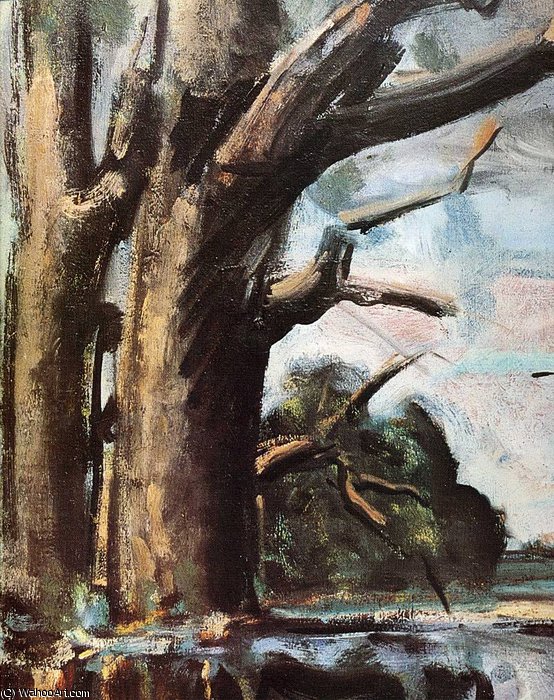
untitled (5066)
Reproduction Size

Max Weber, born in Białystok, Poland in 1881, embarked on a journey that would indelibly mark the landscape of American art. His early life was steeped in the traditions of Orthodox Judaism, a heritage that would later profoundly influence his artistic expression. The family’s emigration to Brooklyn, New York, when Weber was just ten years old, proved pivotal. This relocation thrust him into a vibrant, rapidly changing society—a crucible where Old World roots and New World aspirations collided. It was at the Pratt Institute in Brooklyn that Weber first formally engaged with art, studying under the influential Arthur Wesley Dow. Dow’s emphasis on innovative approaches to artistic creation, coupled with his exposure to Japanese aesthetics and connections to Paul Gauguin, ignited within Weber a nascent modernist sensibility.
In 1905, Weber ventured to Europe, specifically Paris, the epicenter of avant-garde thought. His time at the Académie Julian was merely a starting point; it was his immersion in the city’s artistic milieu that truly transformed him. He forged friendships with Henri Rousseau, whose naive yet profound style captivated him, and found himself drawn into the orbits of luminaries like Henri Matisse and Pablo Picasso—artists who were dismantling traditional notions of representation. Weber frequented Gertrude Stein's salon, a legendary gathering place for artists, writers, and intellectuals, and became acquainted with Guillaume Apollinaire, absorbing the latest currents in poetry and art theory. This exposure to the School of Paris fundamentally altered his artistic trajectory.
Upon returning to New York in 1909, Weber assumed the role of a cultural emissary, bravely introducing Cubism to an American audience largely unfamiliar with its radical principles. His early works during this period, such as Chinese Restaurant (1915), stand as compelling evidence of his embrace of Cubist fragmentation and geometric abstraction. However, this pioneering spirit was met not with acclaim but with fierce resistance.
The 1911 exhibition at the 291 Gallery, organized by Alfred Stieglitz, proved to be a watershed moment—and a deeply bruising one for Weber. His work was subjected to what many consider “one of the most merciless critical whippings” ever endured by an American artist. Critics dismissed his paintings as “brutal,” “vulgar,” and utterly devoid of artistic merit. The public struggled to comprehend the radical departure from representational norms, and Weber found himself ostracized by much of the art establishment.
Despite this discouraging reception, Weber’s talent did not go unnoticed by his peers. Artists like Alvin Langdon Coburn, Clarence White, and John Cotton Dana recognized the significance of his work and offered crucial support. Dana's decision to host a one-man exhibition at the Newark Museum in 1913 was particularly groundbreaking—it marked the first modernist exhibition ever held in an American museum, signaling a tentative shift in attitudes towards avant-garde art.
The sustained critical hostility eventually led Weber to reassess his artistic direction. Around 1920, he began to move away from the strictures of Cubism, turning instead toward more figurative themes. This shift was not a rejection of modernism but rather an exploration of new avenues for expression. His later work often depicted scenes from Jewish life—families gathered in intimate settings, rabbis engaged in Talmudic study, and evocative portraits that captured the spiritual depth of his heritage. These paintings were imbued with a profound sense of nostalgia and a renewed connection to his roots.
While initially overlooked, Weber’s contributions to American art gradually gained recognition in the decades following World War II. By the 1940s and 50s, his expressionist figurative paintings were attracting considerable attention. A major retrospective at the Jewish Museum in 1982 cemented his place in art history, solidifying his reputation as a pivotal figure in the development of American modernism.
Life magazine hailed him as a “pioneer of modern art in America” in 1945, and a Look magazine survey in 1948 ranked him second only to John Marin among the greatest living American artists. Today, Max Weber is celebrated not only for his early role in introducing European Modernism to the United States but also for his unique ability to synthesize diverse influences—Cubist experimentation, Jewish iconography, and a deeply personal vision—into a body of work that continues to resonate with audiences.

1881 - 1961 , Poland

Immerse yourself in the profound emotion of Abstract Expressionism. Explore our curated guide to the top 25 Mark Rothko masterpieces, from iconic color field paintings to museum-quality reproductions for your decor. Discover all masterpieces on WahooArt.com.

Journey through the dreamlike realms of Max Ernst. Explore 25 iconic Surrealist masterpieces, from pioneering collage to haunting landscapes. Find inspiration and museum-quality reproductions for your collection. Discover all masterpieces on WahooArt.com.

Discover the profound tranquility of Impressionist pond landscapes. From Monet's Giverny to masterfully hand-painted oil reproductions, explore how fine art captures light, reflection, and serenity for the discerning collector seeking timeless elegance.
 Preview
 Send
Send Share
Share
 Details
 Guide
Guide

 Download
 Similars
 X-Ray
X-Ray Diaporama
 Q&A
Q&A
 Stats
Stats
 Read More






































 Glass option is only available in size under 110 CM


