
Preview AR preview Switch to Print Switch to Digital Image Send
Details Guide Add to favorites Download Similars X-Ray Diaporama Stats

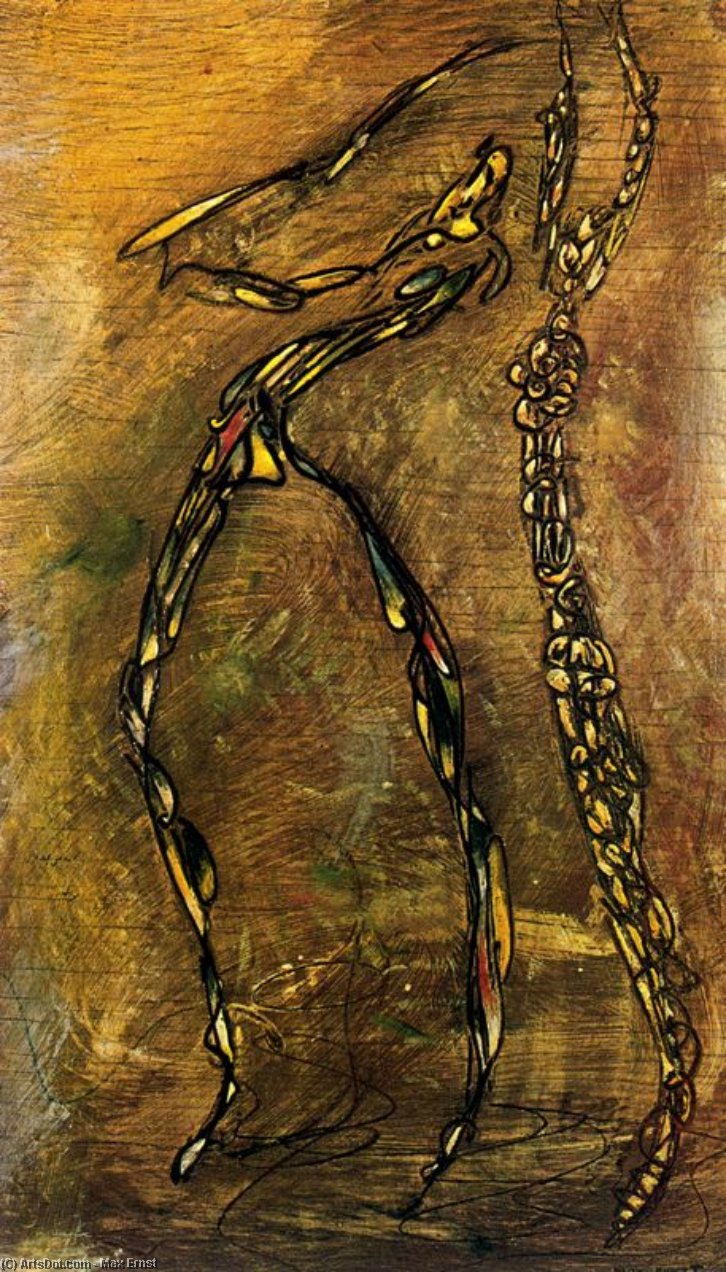
The dancers

Explore "The Dancers" by Max Ernst – an iconic expressionist masterpiece! Dynamic lines, textured gold background & elongated figures evoke movement & emotion. A unique piece for art collectors.

Explore the surreal world of Max Ernst (1891-1976), a Dada & Surrealism pioneer! Discover his innovative frottage, collages & dreamlike paintings featuring birds, landscapes & psychological themes. #MaxErnst #Surrealism #Dada

The artwork displayed on this page is protected by copyright law, which means we cannot legally create or sell an identical reproduction. This protection is enforced under international agreements such as the Berne Convention and by national laws, including those outlined by the U.S. Copyright Law - Title 17.

As a respectful and legal alternative, we offer custom, hand-painted artworks inspired by the original. Our skilled and professional artists carefully study the original's style, mood, and artistic essence to create a new, unique piece that evokes the same feeling - while remaining an original creation in its own right.

This method fully complies with copyright regulations because it does not involve copying or duplicating the protected artwork. Instead, it is a creative reinterpretation - a new painting that is influenced by the original but not identical to it.

Hand Made Oil Reproduction

Hand-painted oil on canvas in your size and frame, made to order by our artists. ( Switch to Print Switch to Digital Image)

Corner sample of the P118B picture frame: moulded polystyrene, 5 cm wide and 3 cm thick
P118B $10
Corner sample of the P118H picture frame: moulded polystyrene, 5 cm wide and 3 cm thick
P118H $10
Corner sample of the P118W picture frame: moulded polystyrene, 5 cm wide and 3 cm thick
P118W $10
Corner sample of the P438Z picture frame: moulded polystyrene, 5.5 cm wide and 3.5 cm thick
P438Z $10
Corner sample of the P508JH picture frame: moulded polystyrene, 7 cm wide and 3.5 cm thick
P508JH $12
Corner sample of the P508YH picture frame: moulded polystyrene, 7 cm wide and 3.5 cm thick
P508YH $12
Corner sample of the P805H picture frame: moulded polystyrene, 5 cm wide and 3.5 cm thick
P805H $10
Corner sample of the P805Z picture frame: moulded polystyrene, 5 cm wide and 3.5 cm thick
P805Z $10
Corner sample of the P919BZ picture frame: moulded polystyrene, 7 cm wide and 3.5 cm thick
P919BZ $10
Corner sample of the P919G picture frame: moulded polystyrene, 7 cm wide and 3.5 cm thick
P919G $10
Corner sample of the P919XJ picture frame: moulded polystyrene, 7 cm wide and 3.5 cm thick
P919XJ $10
Corner sample of the P959ZH picture frame: moulded polystyrene, 5 cm wide and 3 cm thick
P959ZH $10
Corner sample of the P968JZ picture frame: moulded polystyrene, 6 cm wide and 4 cm thick
P968JZ $12
Corner sample of the W106C picture frame: solid wood, 5 cm wide and 3 cm thick
W106C $8
Corner sample of the W218G picture frame: solid wood, 5 cm wide and 3 cm thick
W218G $10
Corner sample of the W218JH picture frame: solid wood, 5 cm wide and 3 cm thick
W218JH $8
Corner sample of the W218Y picture frame: solid wood, 5 cm wide and 3 cm thick
W218Y $10
Corner sample of the W307PJ picture frame: solid wood, 6 cm wide and 3 cm thick
W307PJ $10
Corner sample of the W316G picture frame: solid wood, 6 cm wide and 3 cm thick
W316G $10
Corner sample of the W316PJ picture frame: solid wood, 6 cm wide and 3 cm thick
W316PJ $8
Corner sample of the W316Y picture frame: solid wood, 6 cm wide and 3 cm thick
W316Y $10
Corner sample of the W398PJ picture frame: solid wood, 5 cm wide and 3 cm thick
W398PJ $8
Corner sample of the W4111J picture frame: solid wood, 6.5 cm wide and 3.5 cm thick
W4111J $10
Corner sample of the W500HY picture frame: solid wood, 7 cm wide and 5 cm thick
W500HY $15
Corner sample of the W500JH picture frame: solid wood, 7 cm wide and 5 cm thick
W500JH $15
Corner sample of the W692G picture frame: solid wood, 8 cm wide and 4 cm thick
W692G $12
Corner sample of the W849H picture frame: solid wood, 5 cm wide and 3 cm thick
W849H $8
Corner sample of the W940BG picture frame: solid wood, 7.5 cm wide and 4.5 cm thick
W940BG $15
Corner sample of the W953PJ picture frame: solid wood, 6 cm wide and 3.5 cm thick
W953PJ $8

Standard
custom
CM
INCH

Pick from our preset sizes that match the artwork's original proportions.

width
height

Type the width and the height you need, to fit your frame or your wall. This is hand-painted, so for a size with a different shape the artist can paint a bit more around the picture, or cut a bit — you choose. We send you a digital mockup to approve before the painting starts. The picture shown on this page does not show the real result — only the mockup does.

Examples of what can be changed: Replace face with customer photo; Add pet (e.g., replace cat with dog); Include hidden message in background; Change background landscape or elements.
After order, WahooArt.com team will email client for instructions and provide a mockup preview

Worldwide Delivery () in 3/4 weeks instead of standard 5 weeks. (26 October). No compromise on quality.

Free Worldwide Express Shipping
High-Quality Linen Canvas
Full Shipping Insurance
Customs Tax Refund Guarantee
True Color Matching Guarantee
100-Day Return Policy (Defects Only)
100% Money-Back Guarantee
Bulk Discount Offer

Total Price

$ 272

The dancers

Reproduction Medium

Reproduction Size

-

Total Price

$ 272

Quick Facts

  • style: Abstract, Dynamic lines, Simplified forms
  • title: The dancers
  • artist: Max Ernst
  • medium: Drawing and painting (likely)

Art Quiz

There is only one correct answer for each question.

Question 1:
Based on the description, which artistic movements is Max Ernst most closely associated with?
Question 2:
The artwork 'The dancers' is characterized by what dominant visual element?
Question 3:
What contributes to the sense of depth and texture in the background of 'The dancers'?
Question 4:
How would you best describe the figure(s) in 'The Dancers'?

An Ethereal Dance: Exploring Max Ernst’s Abstract Expression

This captivating work by Max Ernst presents a mesmerizing study in abstract form and dynamic movement. Rendered in striking contrast – dark, fluid lines against a richly textured golden-brown ground – the piece evokes a sense of both energy and introspection. While titled “The Dancers,” the artwork transcends literal representation, offering instead an evocative interpretation of human motion, perhaps even spiritual yearning.

Style & Technique: A Bridge Between Worlds

Ernst’s style here leans heavily into Expressionism, yet it also foreshadows elements that would become central to his later Surrealist explorations. The elongated figure is not defined by precise detail, but rather suggested through sweeping curves and bold outlines. This deliberate simplification focuses attention on the *essence* of movement – its rhythm, flow, and emotional weight. The technique appears to be a compelling blend of drawing and painting; visible brushstrokes contribute significantly to the textured surface, creating depth and visual interest reminiscent of aged wood grain or canvas. The flattened perspective further enhances the abstract quality, removing traditional spatial cues and inviting viewers into a more immediate, visceral experience.

Historical Context: Ernst’s Early Innovations

Born in 1891, Max Ernst was a pivotal figure in the development of both Dadaism and Surrealism. His early artistic journey was marked by experimentation and a rejection of conventional artistic norms. While the exact date of this piece is unknown, it likely originates from a period where Ernst was actively breaking away from traditional representation, influenced by encounters with artists like Pablo Picasso. This work demonstrates his growing interest in exploring the subconscious and expressing inner states through abstract forms – themes that would define much of his later career. His background studying philosophy, art history, literature, psychology, and psychiatry deeply informed his artistic approach, leading him to explore the complexities of the human psyche within his artwork.

Symbolism & Interpretation: Beyond the Literal

The symbolism within “The Dancers” is deliberately open-ended. The elongated figure could represent a striving for growth, an expression of inner turmoil, or even a connection to something beyond the physical realm. The warm color palette – dominated by golds and browns – evokes feelings of warmth, earthiness, and perhaps nostalgia. The darker lines, punctuated with hints of red-brown, introduce a sense of drama and intensity. The repetition of lines and curves creates a strong rhythmic quality, mirroring the cyclical nature of dance itself or the ebb and flow of emotions.

Emotional Impact & Aesthetic Appeal

This artwork possesses a powerful emotional resonance. Its abstract form allows for personal interpretation, inviting viewers to project their own feelings and experiences onto the image. The dynamic composition and expressive lines create a sense of energy and movement that is both captivating and thought-provoking. Its warm color palette and textured surface make it an ideal piece for adding depth and sophistication to any interior space. Whether appreciated by seasoned art collectors or those seeking inspiration, “The Dancers” offers a compelling glimpse into the innovative mind of Max Ernst.

Considerations for Reproduction & Display

  • Due to the textured background, high-quality reproductions should prioritize capturing the nuances of the surface.
  • The artwork’s verticality makes it well-suited for hallways or spaces with ample wall height.
  • Its warm color palette complements a variety of interior design styles, from modern to bohemian.

Questions & Answers

Where does "The dancers" stand among Max Ernst's recurring subjects?

"The dancers" depicts abstract figures, dynamic movement, golden texture”, “vertical composition”, “expressive lines”, “geometric forms”, emotional art”, while Max Ernst's recorded themes are key expressionist work, central to ernst's style, recurring motif, expressionist lines, geometric abstraction, dynamic composition, human movement, spiritual aspiration. Comparing the two shows how the work relates to the artist's usual subjects.

Where does "The dancers" sit within Max Ernst's body of work?

"The dancers" shares with Max Ernst's other works its Expressionism style and the recorded themes: key expressionist work, central to ernst's style, recurring motif, expressionist lines, geometric abstraction, dynamic composition, human movement, spiritual aspiration.

What is the recommended use of a print of "The dancers"?

The suggested use for "The dancers" by Max Ernst is accent. It can serve other purposes as well.


Artist Biography

A Life Immersed in the Surreal

Max Ernst, born Maximilian Maria Ernst on April 1st, 1891, in Brühl, Germany, was a restless spirit destined to become one of the most pivotal figures in 20th-century art. His journey wasn’t one of conventional artistic training; rather, it was a self-directed exploration fueled by philosophical inquiry, psychological fascination, and a profound disillusionment with societal norms. Ernst's father, a teacher of the deaf and an amateur painter, instilled in him both a sensitivity to the world and a rebellious streak against established authority. This early duality would become a defining characteristic of his artistic vision.

Ernst’s academic pursuits at the University of Bonn – encompassing philosophy, art history, literature, psychology, and psychiatry – were not merely diversions but foundational elements that deeply informed his later work. He wasn't simply interested in *how* to paint; he was grappling with *why*. This intellectual curiosity led him to encounter the groundbreaking works of Picasso, Van Gogh, and Gauguin at the Sonderbund exhibition in Cologne in 1912, a moment that irrevocably altered his artistic trajectory. The seeds of modernism had been sown.

Dada’s Disruption and the Birth of Surrealist Visions

The cataclysm of World War I proved to be a watershed moment for Ernst. His experiences as a soldier on both the Eastern and Western fronts left him profoundly shaken, fostering a deep skepticism towards established order and a yearning for new modes of expression. This disillusionment found fertile ground in the burgeoning Dada movement, which he embraced wholeheartedly after returning to Cologne in 1918. Alongside Hans Arp – a lifelong friend and collaborator – Ernst became a central figure in the Cologne Dada group, rejecting traditional artistic conventions and embracing absurdity, chance, and anti-rationality.

However, Dada was merely a stepping stone. In the early 1920s, Ernst migrated to Paris and joined the ranks of the Surrealists, led by André Breton. This marked a shift towards exploring the realm of dreams, the unconscious mind, and the irrational. Influenced by the psychoanalytic theories of Sigmund Freud, Ernst sought to unlock the hidden depths of human experience through his art. He wasn’t interested in depicting reality as it appeared but rather in revealing the underlying psychological forces that shaped it.

Pioneering Techniques: Frottage, Grattage, and Collage

Ernst's artistic innovation extended beyond subject matter; he was a relentless experimenter with technique. He didn’t simply adopt existing methods—he invented new ones. Perhaps his most famous contribution is frottage, a process of rubbing pencil or charcoal over textured surfaces to create unexpected and evocative images. This technique, born from a moment of boredom while observing wood grain, allowed Ernst to tap into the subconscious and generate forms that defied conscious control. Closely related was grattage, where paint is scraped across canvas revealing underlying layers.

He also masterfully employed collage, assembling disparate elements – images from magazines, scientific illustrations, photographs – into surreal compositions that challenged conventional notions of representation. These techniques weren’t merely stylistic choices; they were integral to his exploration of the unconscious and his desire to disrupt traditional artistic boundaries. His paintings often feature recurring symbolic imagery: birds (particularly his alter ego Loplop), desolate landscapes, unsettling juxtapositions, and a pervasive sense of mystery.

A Legacy of Innovation and Influence

The outbreak of World War II forced Ernst to flee Europe, finding refuge in the United States. He continued to paint and experiment with new techniques throughout his exile, eventually returning to France after the war where he remained active until his death on April 1st, 1976, in Paris. His influence on subsequent generations of artists is immeasurable.

Max Ernst’s contributions to Dada and Surrealism were nothing short of groundbreaking. He challenged artistic norms, delved into the depths of the subconscious mind, and invented innovative techniques that continue to inspire artists today. He wasn't merely a painter; he was an explorer, a provocateur, and a visionary who expanded the boundaries of art itself. His work remains a testament to the power of imagination, the allure of the irrational, and the enduring quest to understand the complexities of the human psyche.

  • Major Works: The Entire City, Euclides, Of This Men Shall Know Nothing, Forest and Dove
  • Influences: Pablo Picasso, Vincent van Gogh, Paul Gauguin, Sigmund Freud, Giorgio de Chirico
  • Movements: Dada, Surrealism
Max Ernst

Max Ernst

1891 - 1976 , Germany

Quick Facts

  • Artistic Movement Or Style:
    • Dada
    • Surrealism
  • Artists Or Movements Influenced By This Artist:
    • Karl Otto Gotz
    • Salvador Dali
    • Manuel Cargaleiro
  • Artists Who Influenced This Artist:
    • Pablo Picasso
    • Vincent van Gogh
    • Paul Gauguin
    • Sigmund Freud
    • Giorgio de Chirico
  • Full Name: Maximilian Maria Ernst
  • Nationality: German
  • Notable Artworks:
    • The Entire City
    • Euclides
    • Of This Men Shall Know Nothing
    • Forest and Dove
  • Place Of Birth: Brühl, Germany
  • Date Of Birth: 1891
  • Date Of Death: 1976
Explore artworks organized by themes, styles, and characteristics.



































