
 Acrylic On CanvasWallArtRenaissance
 1523
1523 434.0 x 320.0 cm
 Staatliche Museen
Museum-quality giclée or canvas print with fast production and flexible finish options. ( Buy Hand Made Painting Switch to Digital Image)





























Pick from our preset sizes that match the artwork's original proportions.

You may enter your own dimensions to fit a specific frame or space. If your selected size does not match the original image's proportions, we will either crop the artwork or extend the image with a mirrored or solid-fill edge. A digital mockup will be sent for your approval before production begins.
Please note that the on-screen preview does not reflect the actual cropping or extension. Only the mockup will accurately show the final composition.
While custom sizes are available, we recommend selecting a dimension from the predefined list to preserve the original proportions.
Worldwide Delivery () in 2 weeks instead of standard 4/5 weeks. (12 September)


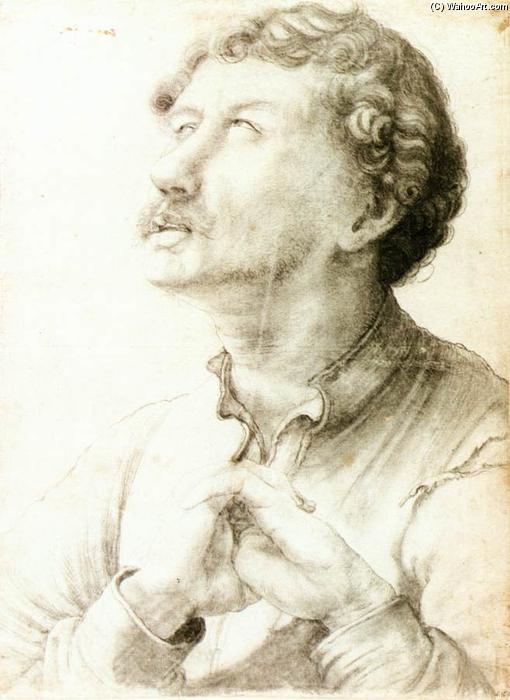
Man Looking Up
Reproduction Size
Matthias Grünewald’s “Man Looking Up,” completed in 1524, stands as a testament to the enduring power of observation and contemplation within the Northern Renaissance tradition. This remarkable pencil drawing captures a moment of profound introspection—a young man’s head and upper torso presented in a three-quarter view—executed with meticulous detail and imbued with an understated elegance that continues to resonate centuries later.
Historical Context & Artistic Influences
Painted during Grünewald's prolific period, “Man Looking Up” reflects the broader artistic landscape of its time. While Italy dominated the visual arts scene with burgeoning humanist ideals and stylistic innovations spearheaded by Leonardo da Vinci and Michelangelo, Grünewald remained firmly rooted in Germanic artistic sensibilities. He absorbed influences from artists like Albrecht Dürer and Martin Schongauer, whose mastery of realism and anatomical precision served as a guiding force for his own work. Importantly, Grünewald’s focus wasn't on philosophical discourse; rather, he channeled his talent into religious iconography—a tradition deeply ingrained in the cultural fabric of Central Europe.
Technique & Material Considerations
The artwork’s execution is entirely reliant on graphite pencil drawing. Grünewald skillfully employed varying pressures to achieve tonal gradations, creating a rich tapestry of light and shadow that breathes life into the figure. The dominant technique is hatching and cross-hatching—a painstaking process where intersecting lines build up texture and depth, particularly noticeable in the hair and drapery. These meticulous marks convey not only form but also an emotional resonance – conveying a sense of solemnity and quiet contemplation.
Composition & Visual Elements
The composition prioritizes verticality, emphasizing the man’s posture and hairstyle. The figure occupies most of the frame, creating a powerful visual impact. Careful attention to anatomical accuracy is evident in the rendering of facial features—the eyes gaze upwards with an expression of serene wonder. Shapes are predominantly organic, mirroring the contours of the face, hair, and clothing. Depth is achieved primarily through tonal variation and subtle linear recession – techniques borrowed from Renaissance masters.
Symbolism & Emotional Impact
"Man Looking Up" transcends mere portraiture; it embodies a deeper symbolic significance. The upward gaze represents aspiration—a yearning for something beyond the immediate earthly realm—and simultaneously conveys introspection, inviting viewers to contemplate their own inner thoughts and feelings. Grünewald’s masterful use of graphite captures not just likeness but also an emotional state – conveying dignity, serenity, and perhaps even a hint of spiritual reverence. It's a piece that speaks volumes without uttering a word, cementing its place as a cornerstone of Northern Renaissance art.

Matthias Grünewald, born Mathis Gothart Neithardt around 1470-1475 in Würzburg, Germany, was a pivotal figure of the German Renaissance. Despite living during a period increasingly influenced by Italian Renaissance ideals, Grünewald remained deeply rooted in the artistic traditions of late medieval Central Europe. Details about his early life are scarce, but it’s known he received training as an artist, likely within local workshops.
Grünewald's artistic development was shaped by the prevailing Northern European traditions of realism, emotional intensity, and detailed observation. His work shows influences from artists like Albrecht Dürer and Martin Schongauer, but he forged a unique path characterized by dramatic expression and vivid color. He wasn’t directly involved with the humanist circles prevalent in Italy; instead, his art served primarily religious purposes, reflecting the spiritual anxieties of his time.
Grünewald's style is distinguished by:
Grünewald's work stands as a testament to the enduring power of medieval artistic traditions in Germany during the Renaissance. He bridged the gap between the late Gothic style and the emerging Renaissance, creating a unique visual language that resonated with his contemporaries. His influence can be seen in later German artists who continued to explore themes of religious fervor and emotional intensity. While largely forgotten for centuries after his death in 1528, Grünewald experienced a revival in the 19th century, and today he is recognized as one of the most important painters of the German Renaissance. His art continues to captivate viewers with its raw emotion, technical brilliance, and profound spiritual depth.
Discover more about Matthias Grünewald’s life and works at: WahooArt

1480 - 1528 , Germany

Explore the profound artistry of graphite drawing. Discover professional techniques for mastering depth, texture, and detail through a lens of art history, from classical sketches to modern masterpieces. Elevate your understanding of the pencil medium with our expert guide.

Discover the sophisticated mastery of graphite drawing. Explore expert techniques for achieving profound depth, intricate texture, and hyper-realistic detail through the alchemy of carbon, curated for the discerning art enthusiast and professional collector.

Elevate your artistic practice with this expert guide to mastering the line. Discover advanced techniques in graphite, charcoal, and contour drawing designed for art students seeking technical precision and expressive depth in their fine art studies.
Explore the profound elegance of pencil and charcoal sketching. Discover how masters use line, shadow, and chiaroscuro to capture light and texture, bridging the gap between preparatory studies and timeless fine art masterpieces.

 Preview
 Send
Send Share
Share
 Details

 Download
 Similars
 X-Ray
X-Ray Diaporama
 Stats
Stats Read More







 Glass option is only available in size under 110 CM


