Museum-quality giclée or canvas print with fast production and flexible finish options. ( Buy Hand Made Painting Switch to Digital Image)
Pick from our preset sizes that match the artwork's original proportions.

Type the width and the height you need, to fit your frame or your wall. A print can only be cut, never made bigger than the picture, so a size with a different shape loses a part of the image. We send you a digital mockup to approve before we print anything. The picture shown on this page does not show the real cut — only the mockup does.
Worldwide Delivery () in 2 weeks instead of standard 4/5 weeks. (17 November)
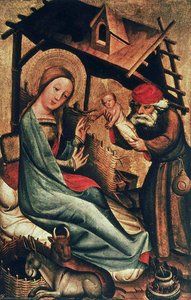
Passion, left wing
Reproduction Size

Born in Minden, Germany, around 1345 and passing away in Hamburg circa 1415, Master Bertram remains a captivating figure within the history of European art. Often referred to as Meister Bertram or Master of Minden, he stands as a pivotal artist bridging the International Gothic style with the nascent trends of the early Renaissance in Northern Europe. His legacy is primarily defined by his monumental altar panels and religious scenes, most notably the magnificent Grabow Altarpiece housed within the Kunsthalle Hamburg – a testament to his skill and ambition.
Bertram’s life unfolded largely within the bustling port city of Hamburg. Records indicate he first appeared in Hamburg's archives in 1367, quickly establishing himself as a respected citizen and achieving Master status by 1376. This period marked the peak of his professional activity; he amassed considerable wealth through commissions for religious art, reflecting the growing piety and prosperity within the region. Despite making a will anticipating a pilgrimage to Rome in 1390 – an undertaking that ultimately never materialized – Bertram’s artistic output remained remarkably consistent throughout his life. His marriage provided him with a daughter, but tragedy struck when his wife passed away in 1410, leaving him a widower and further solidifying his dedication to his craft.
The Grabow Altarpiece, completed around 1390, represents the pinnacle of Bertram’s artistic achievements. Measuring an impressive size – approximately 6.5 meters high and 8 meters wide – this monumental work is a complex triptych depicting scenes from the Apocalypse. The altarpiece showcases Bertram's mastery of color, detail, and spatial perspective, hallmarks of the International Gothic style. The figures are rendered with a delicate grace and expressive quality, imbued with a sense of solemnity and spiritual depth. Notably, the scene’s composition is remarkably detailed, featuring numerous figures and intricate architectural elements.
Alongside the Grabow Altarpiece, Bertram's workshop produced a significant altarpiece dedicated to Saint Christopher, now residing in Falsterbo Church, Sweden. This piece, along with other surviving fragments and depictions, offers valuable insights into Bertram’s artistic process and stylistic evolution. The Victoria and Albert Museum in London houses a 45-scene depiction of the Apocalypse, likely created by Bertram's workshop, further demonstrating his influence within the artistic community.
Bertram’s style is often characterized as a refined adaptation of International Gothic principles. While sharing similarities with other artists of the period, such as Master Francke (another prominent Hamburg painter), Bertram's work possesses a distinct character—a subtle restraint in emotional expression compared to Francke’s more overtly dramatic approach. However, this doesn’t diminish the beauty or power of his creations; rather, it lends them a quiet dignity and contemplative quality.
It is believed that Bertram was influenced by both French and Netherlandish artistic trends prevalent during his time. The influence of courtly art from France can be observed in the refined elegance of his figures and decorative elements, while the meticulous detail and realism characteristic of Early Netherlandish painting are evident in his depictions of architectural settings and objects. Despite these influences, Bertram maintained a uniquely Northern German sensibility, imbuing his work with a sense of regional identity.
Following the Renaissance, Master Bertram’s artistic legacy largely faded into obscurity. However, in the late 19th century, Alfred Lichtwark, the visionary director of the Hamburg Kunsthalle, spearheaded a renewed interest in his work. Lichtwark recognized the significance of Bertram's art and championed its rediscovery, bringing it to public attention once more.
Today, Master Bertram is rightfully regarded as one of the most important artists of the 14th century in Northern Europe. His monumental altar panels stand as enduring testaments to his skill, creativity, and profound understanding of religious art. Asteroid 85320 Bertram, named in his honor by German astronomer Freimut Börngen in 1995, serves as a lasting reminder of this remarkable artist’s contribution to the world of art.

1345 - 1415 , Germany

Journey through the divine elegance of Duccio di Buoninsegna. Explore 25 iconic Sienese masterpieces, from the Maestà to the Rucellai Madonna. Find inspiration for museum-quality art reproductions and timeless decor. Discover all masterpieces on WahooArt.com.

Immerse yourself in the profound emotion of Rogier van der Weyden. Explore 25 iconic Early Netherlandish masterpieces, from intricate textures to divine pathos. Find inspiration for museum-quality art reproductions and decor. Discover all masterpieces on WahooArt.com.
 Preview
 Send
Send Share
Share
 Details
 Guide
Guide

 Download
 Similars
 X-Ray
X-Ray Diaporama
 Q&A
Q&A
 Stats
Stats
 Read More






































 Glass option is only available in size under 110 CM