

The artwork displayed on this page is protected by copyright law, which means we cannot legally create or sell an identical reproduction. This protection is enforced under international agreements such as the Berne Convention and by national laws, including those outlined by the U.S. Copyright Law - Title 17.
This method fully complies with copyright regulations because it does not involve copying or duplicating the protected artwork. Instead, it is a creative reinterpretation - a new painting that is influenced by the original but not identical to it.
Museum-quality giclée or canvas print with fast production and flexible finish options. ( Buy Hand Made Painting Switch to Digital Image)
Pick from our preset sizes that match the artwork's original proportions.

Type the width and the height you need, to fit your frame or your wall. A print can only be cut, never made bigger than the picture, so a size with a different shape loses a part of the image. We send you a digital mockup to approve before we print anything. The picture shown on this page does not show the real cut — only the mockup does.
Worldwide Delivery () in 2 weeks instead of standard 4/5 weeks. (27 October)
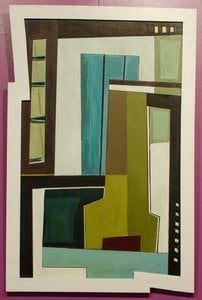
El Gran Ritmo
Reproduction Size

The life of Martin Blaszko was a profound odyssey of displacement, cultural immersion, and artistic evolution. Born in Berlin in 1920, his early years were marked by the shifting borders of a turbulent Europe. As his family moved from Germany to Poland in 1933, and subsequently to France in 19SB8, Blaszko was exposed to a tapestry of diverse environments that would later inform the rhythmic complexity of his work. This nomadic childhood instilled in him a unique perspective, one where identity was not tied to a single landscape but rather to the universal language of form and movement. The eventual migration to Argentina in 1939 provided a new horizon for his creative spirit, allowing him to settle into a period of intense artistic development that would eventually define his place in the annals of modern abstraction.
Blaszko’s artistic language is characterized by a masterful command of geometric abstraction and a deep preoccupation with the concept of order. His work often exists in a delicate balance between the monumental and the intimate. While his sculptures may possess a grandeur that commands the space around them, they are frequently built upon a foundation of precise, calculated movements that suggest a hidden, internal harmony. This duality is perhaps his greatest achievement; he managed to capture the kinetic energy of the modern world within the stillness of static objects. His paintings and sculptures serve as monuments to structural integrity, where every line and plane is a deliberate contribution to a larger, cohesive whole.
Throughout his prolific career, Blaszko remained deeply influenced by the prevailing abstract movements of the 20th century, yet he maintained a signature voice that was entirely his own. His ability to translate complex emotional states into structured, abstract compositions allowed him to transcend mere decoration, reaching instead for a deeper, more primal resonance. The significance of his work lies in this ability to find harmony within complexity—to take the fragmented experiences of a life lived across continents and synthesize them into works that feel both timeless and structurally rigorous.
The legacy of Martin Blaszko continues to resonate through the art world, serving as an inspiration for those who seek to explore the boundaries of shape and space. His contributions can be summarized through several key pillars of his artistic identity:
Though he passed away in Buenos Aires in 2011, Blaszko’s vision remains vibrant. His works stand as a testament to the power of perseverance and the capacity of the human spirit to find beauty and structure amidst the chaos of history.
1920 - 2011 , Germany

Explore the profound evolution of Neo-Abstract art. Discover how bold geometric forms, vibrant chromatic depth, and tactile textures redefine modern expression for the discerning collector seeking sophisticated, high-impact masterpieces for contemporary interiors.

Explore the profound spiritual depth of geometric abstraction. From Malevich's Suprematism to modern masters, our expert guide reveals how pure form and color command presence in fine art collections.

 Preview
 Send
Send Share
Share
 Details
 Guide
Guide

 Download
 Similars
 X-Ray
X-Ray Diaporama
 Stats
Stats


 Read More






































 Glass option is only available in size under 110 CM


