Purchase a high-resolution, enhanced digital image, far superior to the online preview.
Each file is meticulously prepared by our in-house specialists using advanced tools and expert manual retouching. We ensure every image has exceptional clarity, precise color accuracy, and fine detail.
The final file is delivered via email within 72 hours, optimized for immediate use in professional, editorial, and print environments. This is the same quality trusted by top-tier design studios, publishers, and galleries.
Download a high-resolution file for personal display, printing, and creative projects. ( Switch to Print Buy Hand Made Painting)
When you choose WahooArt.com, you're not just getting an image - you're receiving a professionally enhanced digital artwork, crafted with precision and backed by a satisfaction guarantee. Here's everything that comes with your order, automatically:

Your high-resolution digital image file will be emailed to you within 72 hours of ordering - ready for immediate use.

Your artwork is professionally optimized using advanced AI tools and manual editing, ensuring maximum detail, clarity, and color accuracy.

Accidentally deleted or lost your file? No worries - we'll resend it to you anytime, free of charge.

Enjoy your artwork instantly with zero customs, duties, or delivery fees - digital downloads are always tax-free.

We ensure your digital image reflects the original colors as closely as possible using professional tools and color management.

If you're not satisfied with your digital image, we'll revise it or refund 100% within 100 days - no questions asked.

Not satisfied? Get a full refund within 100 days of receiving your digital file - no questions asked.

Buy 3 images, save 10% - Buy 5, save 15% - Buy 10+, save 20%. Great for creative projects, galleries, and agencies.
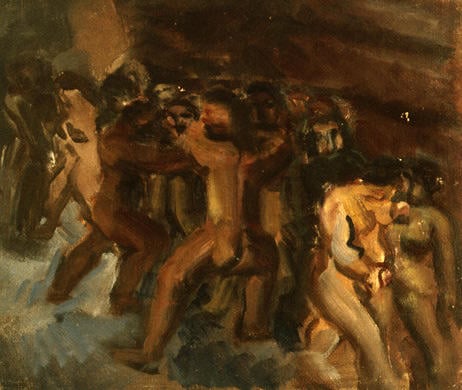
Mark Rothko’s “Untitled” (scene with nude figures), painted in 1964, stands as a cornerstone of Abstract Expressionism and arguably one of the most emotionally resonant artworks of the 20th century. More than just pigment on canvas; it's an invitation to confront profound questions about existence itself – questions Rothko wrestled with throughout his life’s turbulent journey.
Born in Dvinsk, Latvia, Markus Yakovlevich Rothkowitz experienced firsthand the anxieties of a Jewish family navigating antisemitism and political instability. This formative backdrop instilled within him an unwavering empathy for human suffering, a preoccupation that would permeate his artistic output. The subsequent relocation to Portland, Oregon, marked not merely a geographical change but a collision with new cultural currents – a move fraught with challenges of assimilation and shadowed by the premature death of his father.
Rothko’s distinctive style eschews representational imagery altogether. Instead, he employs large rectangular blocks of color—typically hues of crimson, orange, yellow, and blue—that bleed into one another, creating an ethereal haze. This technique, termed “color field painting,” prioritizes the emotional experience over visual perception. Rothko meticulously applied thin layers of oil paint to prepare the canvas, followed by multiple coats of pigment diluted with glazing mediums. The resulting surface is remarkably matte, absorbing light rather than reflecting it—a deliberate choice designed to foster contemplation and minimize distraction.
"Untitled" emerged during a period of intense artistic experimentation following World War II. Abstract Expressionists like Jackson Pollock and Willem de Kooning pushed the boundaries of painting, rejecting traditional conventions in favor of spontaneous gesture and unfiltered emotion. Rothko’s work aligns with this broader movement but distinguishes itself through its profound stillness and meditative quality. He sought to distill human experience into its purest form—color—believing that it could communicate feelings directly without relying on intellectual interpretation.
While Rothko vehemently denied any intention to imbue his paintings with symbolic meaning, scholars have identified recurring motifs suggestive of spiritual contemplation. The nude figures depicted within the composition are not anatomically precise but rather amorphous shapes that convey vulnerability and openness. Their positioning—often intertwined or overlapping—suggests a harmonious interconnectedness, mirroring Rothko’s belief in the universality of human emotion.
"Untitled" compels viewers to confront their own perceptions of beauty and sorrow. The sheer scale of the canvas overwhelms the senses, inviting immersion in a realm beyond rational thought. As Rothko himself famously stated, “I want people to come away from my paintings with a feeling that they have experienced something transcendent.” Indeed, gazing upon this masterpiece evokes a sense of awe—a recognition of the sublime—and prompts reflection on the fundamental mysteries of human existence.


1903 - 1970 , Latvia

 Preview
 Send
Send Share
Share
 Details
 Guide
Guide

 Download
 Similars
 X-Ray
X-Ray Diaporama
 Stats
Stats
 Read More