

The artwork displayed on this page is protected by copyright law, which means we cannot legally create or sell an identical reproduction. This protection is enforced under international agreements such as the Berne Convention and by national laws, including those outlined by the U.S. Copyright Law - Title 17.
As a respectful and legal alternative, we offer custom, hand-painted artworks inspired by the original. Our skilled and professional artists carefully study the original's style, mood, and artistic essence to create a new, unique piece that evokes the same feeling - while remaining an original creation in its own right.
This method fully complies with copyright regulations because it does not involve copying or duplicating the protected artwork. Instead, it is a creative reinterpretation - a new painting that is influenced by the original but not identical to it.
Hand-painted oil on canvas in your size and frame, made to order by our artists. ( Switch to Print Switch to Digital Image)





























Pick from our preset sizes that match the artwork's original proportions.

You may enter your own dimensions to fit a specific frame or space. If your selected size does not match the original image's proportions, we will either crop the artwork or extend the painting with additional hand-painted elements. A digital mockup will be sent for your approval before production begins.
Please note that the on-screen preview does not reflect the actual cropping or extension. Only the mockup will accurately show the final composition.
While custom sizes are available, we recommend selecting a dimension from the predefined list to preserve the original proportions.
Worldwide Delivery () in 3/4 weeks instead of standard 5 weeks. (8 October). No compromise on quality.
Untitled
Reproduction Size
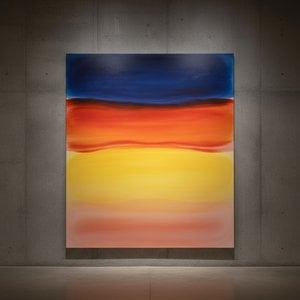
Mark Rothko's "Untitled," painted in 1970, is not merely a canvas filled with red; it’s an immersive experience designed to evoke profound contemplation. Born into a world marked by displacement and loss – his early life shaped by the anxieties of a Jewish family in Latvia and the subsequent upheaval of immigration to Portland – Rothko channeled these deeply felt emotions into his work. This particular painting, executed during a pivotal period of his career, exemplifies his signature Color Field technique: vast, luminous rectangles of color stacked upon one another, creating an atmosphere of quiet intensity. The dominant red hues aren’t uniform; they shift in saturation and tone, suggesting layers of feeling – from the fiery urgency of passion to the somber depths of grief and introspection. The subtle variations in paint application—almost imperceptible brushstrokes that add a tactile quality to the seemingly flat surfaces—invite close observation, revealing a deliberate control beneath the apparent simplicity.
Rothko's work is inextricably linked to the burgeoning Color Field movement of the 1960s. Rejecting traditional representational painting, artists like Rothko, Barnett Newman, and Clyfford Still sought to strip art down to its essential elements: color and form. They aimed to create paintings that would directly affect the viewer’s emotions, bypassing intellectual analysis. Rothko's approach was particularly focused on achieving a sense of transcendence through color. He believed that by reducing forms to their most basic components—large rectangles—he could tap into something primal within the human psyche. The Rothko Chapel in Houston, Texas, commissioned specifically for this purpose, became a crucial site for exploring these ideas, providing a contemplative space where viewers could immerse themselves in his monumental works.
While Rothko famously resisted definitive interpretations of his paintings, suggesting they were meant to be experienced rather than understood, certain symbolic readings have emerged. The deep reds often evoke associations with blood, sacrifice, and the intensity of human experience. The layering of colors can be interpreted as representing layers of memory, emotion, or spiritual yearning. The rectangular forms themselves—simple, geometric shapes—can symbolize stability, eternity, or even the void. It’s important to note that Rothko deliberately avoided providing a narrative framework for his paintings; he wanted them to speak directly to the viewer's own emotional landscape. The painting invites us to project our own feelings and experiences onto its surface, creating a deeply personal encounter.
Rothko’s mastery lay in his meticulous application of paint. He employed a technique known as “thin washing,” applying the pigment directly to the canvas with minimal preparation. This resulted in surfaces that appear almost translucent, allowing light to penetrate through the layers of color and create an ethereal glow. The use of industrial-grade oil paints contributed to the durability and luminosity of his works. He often applied multiple coats of paint, building up the colors gradually over time, creating a sense of depth and richness. This deliberate process—a combination of intuition and technical skill—is evident in the subtle variations within each rectangle, adding to the painting’s complex visual texture. The scale of the work – though unknown precisely – contributes significantly to its immersive quality, enveloping the viewer in a sea of red.
A hand-painted reproduction from WahooArt captures the essence of "Untitled" with remarkable fidelity. Each brushstroke is meticulously recreated, preserving the subtle nuances and luminous quality of the original painting. The vibrant reds are reproduced with stunning accuracy, while the delicate layering of colors evokes the same sense of depth and atmosphere. Whether adorning a grand living room or a serene bedroom, this reproduction offers a powerful connection to Rothko’s profound exploration of color and emotion – a timeless testament to the enduring power of abstract expressionism.
"Untitled" was created in 1970 using the acrylic on canvas technique. Material and date describe how and when the original was made.
"Untitled" is defined by a dark palette led by red (#dc1a21).
The palette of "Untitled" by Mark Rothko is described as dark. It is a compact description of the work's colors.
A Stats page exists for "Untitled". It charts the monthly visits of the artwork and of the artist's other works, with country and language breakdowns.
Mark Rothko was 67 years old when creating "Untitled" in 1970. The age is computed from the artist's birth year, 1903.
The creation of "Untitled" by Mark Rothko is dated 1970.
"Untitled" is attributed to Mark Rothko.

1903 - 1970 , Latvia

Explore the profound emotional world of Abstract Expressionism with WahooArt. Discover key artists like Pollock & Rothko, learn about collecting, and find museum-quality reproductions to inspire your space.

Explore the philosophical and aesthetic foundations of Color Field painting with WahooArt. Discover key artists like Rothko & Newman, its spiritual influences, and lasting impact on modern art. Expert insights for collectors.
Explore the profound emotional depth of Mark Rothko's abstract expressionism. Discover the history, techniques & lasting impact of this pivotal Color Field painter. Expert insights for collectors and art enthusiasts.

Explore 10 defining Abstract Expressionism masterpieces by Pollock, Rothko & de Kooning. Discover the stories behind these iconic paintings and find museum-quality art reproductions to elevate your home decor on .
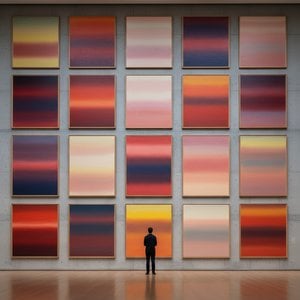
Explore 25 iconic Mark Rothko paintings that define Abstract Expressionism. Discover the stories, colors & emotions behind these masterpieces. Find museum-quality art reproductions and curated decor ideas at WahooArt.com.

 Preview
 Send
Send Share
Share
 Details
 Guide
Guide

 Download
 Similars
 X-Ray
X-Ray Diaporama
 Stats
Stats


 Read More









 Glass option is only available in size under 110 CM


