


The artwork displayed on this page is protected by copyright law, which means we cannot legally create or sell an identical reproduction. This protection is enforced under international agreements such as the Berne Convention and by national laws, including those outlined by the U.S. Copyright Law - Title 17.
This method fully complies with copyright regulations because it does not involve copying or duplicating the protected artwork. Instead, it is a creative reinterpretation - a new painting that is influenced by the original but not identical to it.
Museum-quality giclée or canvas print with fast production and flexible finish options. ( Buy Hand Made Painting Switch to Digital Image)





























Pick from our preset sizes that match the artwork's original proportions.

Type the width and the height you need, to fit your frame or your wall. A print can only be cut, never made bigger than the picture, so a size with a different shape loses a part of the image. We send you a digital mockup to approve before we print anything. The picture shown on this page does not show the real cut — only the mockup does.
Worldwide Delivery () in 2 weeks instead of standard 4/5 weeks. (21 November)
No. 4
Reproduction Size
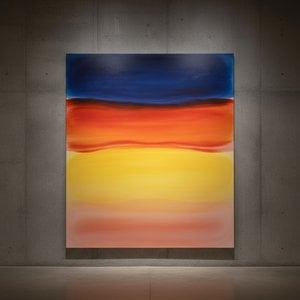
Created in 1964, this powerful work by Mark Rothko exemplifies the pinnacle of Color Field painting and stands as a testament to his lifelong exploration of human emotion through abstract form. Measuring an impressive 264 x 227 cm, the artwork commands attention not through representational imagery, but through its sheer presence and contemplative atmosphere.
Rothko was a central figure in the Abstract Expressionist movement, yet he diverged from the gestural energy of artists like Jackson Pollock. Instead, he focused on reducing painting to its most essential elements: color and form. This piece embodies that philosophy, featuring softly blurred rectangular shapes layered within one another. The technique—thin washes of oil paint meticulously applied to build luminous depth—creates a surface that seems to breathe with subtle variations in tone.
The composition is strikingly simple: a darker, almost blackish-brown rectangle nested within a surrounding field of maroon and burgundy. This central form isn’t sharply defined; its edges dissolve into the background, fostering a sense of ambiguity and inviting prolonged contemplation. The absence of lines or discernible brushstrokes emphasizes the pure experience of color itself. Rothko deliberately avoided representational imagery, believing that abstract forms could more directly access universal human emotions.
Emerging in the post-World War II era, Rothko’s work often grappled with themes of tragedy, existentialism, and spirituality. While he resisted definitive interpretations, his paintings are frequently seen as explorations of profound emotional states – grief, loss, and transcendence. He famously rejected commissions that would place his art within commercial spaces, believing they diminished the intended immersive experience. His Seagram Murals, ultimately donated to the Tate Gallery, exemplify this commitment to preserving the integrity of the artwork’s emotional impact.
The somber palette and minimalist composition evoke a sense of quietude and introspection. The dark central rectangle can be interpreted as a void, a window into another realm, or simply a space for personal reflection. Rothko aimed to create paintings that were not *about* anything specific, but rather *were* emotional experiences in themselves. This artwork’s power lies in its ability to bypass intellectual analysis and connect directly with the viewer's subconscious.
This reproduction captures the nuanced color variations and subtle textures of the original, making it a compelling addition to any modern or contemporary space. Its large scale creates a focal point that invites contemplation, while its subdued palette complements a variety of interior design schemes. Whether displayed in a living room, study, or gallery-style setting, this artwork promises to inspire conversation and evoke a lasting emotional response.
"No. 4" by Mark Rothko is a portrait composition. The proportions are worth checking before choosing a print size.
"No. 4" by Mark Rothko combines a monochrome palette with a melancholic tone.
The monochrome colors of "No. 4" by Mark Rothko match its recommended space: a living room.

Mark Rothko was born Markus Yakovlevich Rothkowitz in 1903. He was born in Dvinsk, Russia, in a place now known as Daugavpils, Latvia. His family lived within the Pale of Settlement, a region marked by political unrest and the constant shadow of pogroms. This atmosphere of instability followed the family when they emigrated to the United States in 1913. After passing through Ellis Island, they settled in Portland, Oregon.
His father, Jacob, worked as a pharmacist. He was an intellectual man with socialist leanings who fostered a home centered on learning and debate. This environment of deep thought was interrupted by a sudden loss. Shortly after the family arrived in America, Jacob died from colon cancer. This early experience of grief and the struggle of the immigrant experience became a quiet foundation for the man he would become.
The move to New York City in 1923 brought a shift in focus. After time spent at Yale University, the pull of the city led him away from formal academics. He sought out the Art Students League to refine his practice. During these early years, his brush was occupied with the tangible. He painted portraits and urban scenes, applying a careful attention to detail to the faces of people and the grit of city streets. The work was grounded in realism, capturing the physical world before the shift toward abstraction took hold.
By 1940, he made the decision to change his name to Mark Rothko. This was a period of transition, moving away from the structured representation of his youth. The focus began to drift from the recognizable objects of the city toward something less defined. He was searching for a way to express the weight of human experience without relying on the literal shapes of the world around him.
As the 1940s progressed, the careful realism of his earlier years began to recede. The focus shifted away from the recognizable details of urban scenes and portraits. Instead, he turned toward the language of Surrealism and mythology. He used these themes to find a way to express the weight of human emotion. The paintings from this period often featured biomorphic shapes. These forms seemed to float, caught in a state of being neither fully figures nor entirely abstract.
This period marked his association with the American abstract expressionism movement. He moved away from the structured world of objects to explore something more internal. The canvases became less about what a thing looked like and more about the feeling it carried. He was searching for a way to communicate the complexities of the human condition through shape and myth.
By the late 1940s, the work began to change. He moved away from the shapes of figures and the stories of mythology, stripping away recognizable imagery to find something more direct. The canvases grew in scale, occupied by large, rectangular blocks of color that seemed to hover. These forms did not sit on the surface but appeared to exist within a shallow, breathing space. This shift marked the beginning of his mature period, a time closely linked to the emergence of Color Field painting.
The application of paint was a slow, layered process. He used thin washes of pigment to build up the surface, creating subtle shifts in tone and texture. These layers allowed light to appear as if it were coming from within the canvas itself. The edges of the colored shapes were never sharp; instead, they were blurred and soft, making the boundaries between different hues feel permeable. This method turned the canvas into a place of quiet, heavy presence.
The work relies on a specific, quiet method of layering. He applied thin washes of oil paint, building up the surface through meticulous, translucent layers. This process creates a velvety texture that seems to hold light within the pigment rather than just reflecting it from the surface. Instead of sharp lines, the edges of his rectangular forms are blurred, allowing colors to bleed and hover against one another. These large blocks of color are meant to create a sense of depth, making the canvas appear to breathe.
He stripped away titles that might suggest a specific subject or narrative. Many canvases carry only simple numbers, such as No. 1 or No. 6, leaving the viewer to face the color without any preconceived ideas. This choice forces a direct encounter with the paint. He used these luminous fields to reach for specific, heavy human emotions: tragedy, ecstasy, and despair. The scale of the works is intended to envelop the person standing before them, turning the act of looking into a silent, immersive experience.
Rothko’s work often moved beyond the individual canvas to occupy entire rooms. He spent significant time on the Seagram murals, a series of paintings intended for a New York restaurant. He eventually decided the setting was not right for the work and donated them to the Tate Gallery in London. His interest in how color occupies a space also led to the Harvard Mural series, which was created for a dining room at the Holyoke Center.
In Houston, Texas, he left behind fourteen paintings for the Rothko Chapel. This non-denominational space contains works in varying shades of black. The paintings are arranged to sit within the architecture of the chapel, creating a specific environment for quiet reflection. The scale of these works is meant to meet the viewer where they stand, filling the peripheral vision with color.
The weight of his own work often seemed to press heavily upon him. Throughout his life, Rothko struggled with depression, a persistent shadow that accompanied his search for emotional truth. He lived a modest existence, often retreating into the quiet spaces required for his large-scale canvases. The intensity of his focus on the human condition—tragedy, ecstasy, and despair—was not merely a subject for the brush, but a reality he carried within himself.
By the end of his life, the struggle became too much to bear. On February 25, 1970, Rothko died by suicide in his studio. He was 66 years old. His death left behind a vast collection of works, including many that remained unfinished or were part of the large estate of paintings that his family and executors would later navigate through complex legal disputes.
The weight of his presence remains in the way his canvases occupy a room. He left behind an estate containing 798 paintings, a vast collection that continues to anchor modern art history. His shift toward large, luminous rectangles of color helped define the Abstract Expressionism movement and later influenced the Minimalist movement. These works do not rely on recognizable shapes to hold a viewer's attention; instead, they rely on the slow, rhythmic breathing of color to create a sense of depth.
His influence is felt in the way subsequent generations approached the canvas as a space for psychological and spiritual exploration. By stripping away narrative clutter, he changed how people interact with the physical reality of paint. His paintings are recognized as some of the most significant works of 20th-century art, often found in the permanent collections of major institutions like the Museum of Modern Art in New York and the Tate Modern in London. The scale of his work often swallows the peripheral vision, forcing a quiet, meditative stillness.
To stand before his canvases is to experience the weight of color in a quiet room. In New York, the Museum of Modern Art holds several of his works. Across the Atlantic, the Tate Modern in London offers a similar space to sit with his large-scale forms. In Washington, D.C., the National Gallery of Art keeps a collection of his paintings, where the light hits the layered pigments in a way that reveals the depth he sought through thin washes of oil.
There is a specific stillness found in the Rothko Chapel in Houston, Texas. It is a non-denominational space containing fourteen of his paintings in varying shades of black. The architecture of the building, an octagon inscribed in a Greek cross, was influenced by the artist himself. It remains a place for quiet reflection, where the scale of the works is meant to envelop the person standing before them.
In Daugavpils, Latvia, the Rothko Museum is housed within the historic artillery arsenal building of the Daugavpils fortress. This institution is the only place in Europe that permanently displays original paintings on loan from his estate. Visitors can find his work in the Rothko Room, a space designed to hold these specific canvases in a setting that honors his origins.

1903 - 1970 , Latvia

Immerse yourself in the profound emotion of Abstract Expressionism. Explore our curated guide to the top 25 Mark Rothko masterpieces, from iconic color field paintings to museum-quality reproductions for your decor. Discover all masterpieces on WahooArt.com.
Explore the profound emotional depth of Rothko and Color Field painting through expert analysis. Discover the power of pure abstraction now.
Explore the profound emotional depth of Mark Rothko's abstract expressionism. Discover the history, techniques & lasting impact of this pivotal Color Field painter. Expert insights for collectors and art enthusiasts.

Unveil the visceral power of Abstract Expressionism. Our expert exploration delves into the transformative legacies of Pollock, Rothko, and De Kooning, offering discerning collectors a profound understanding of the New York School’s enduring mastery and historical impact.

Explore the profound emotional landscapes of Mark Rothko. An expert editorial on Color Field painting, decoding the spiritual depth, technique, and enduring legacy of these abstract masterpieces for the discerning global collector.
 Preview
 Send
Send Share
Share
 Details
 Guide
Guide

 Download
 Similars
 X-Ray
X-Ray Diaporama
 Q&A
Q&A
 Stats
Stats

 Read More









 Glass option is only available in size under 110 CM


