

 Oil On CanvasWallArtColor Field Painting
 1961Modern
 259.0 x 228.0 cm
The artwork displayed on this page is protected by copyright law, which means we cannot legally create or sell an identical reproduction. This protection is enforced under international agreements such as the Berne Convention and by national laws, including those outlined by the U.S. Copyright Law - Title 17.
This method fully complies with copyright regulations because it does not involve copying or duplicating the protected artwork. Instead, it is a creative reinterpretation - a new painting that is influenced by the original but not identical to it.
Museum-quality giclée or canvas print with fast production and flexible finish options. ( Buy Hand Made Painting Switch to Digital Image)





























Pick from our preset sizes that match the artwork's original proportions.

You may enter your own dimensions to fit a specific frame or space. If your selected size does not match the original image's proportions, we will either crop the artwork or extend the image with a mirrored or solid-fill edge. A digital mockup will be sent for your approval before production begins.
Please note that the on-screen preview does not reflect the actual cropping or extension. Only the mockup will accurately show the final composition.
While custom sizes are available, we recommend selecting a dimension from the predefined list to preserve the original proportions.
Worldwide Delivery () in 2 weeks instead of standard 4/5 weeks. (10 October)
No. 1
Reproduction Size
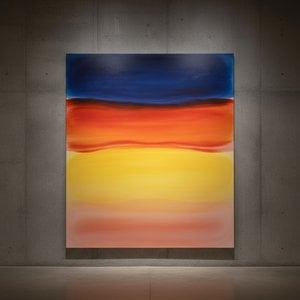
“No. 1” exemplifies Mark Rothko’s signature style within the Color Field painting movement, a pivotal development in abstract expressionism. This vertical composition presents a layered arrangement of rectangular blocks—ash brown, ruby red, and deep eggplant purple—suspended against one another. The deliberate simplicity of form belies a profound exploration of color's emotional power. Rothko sought to move beyond representational art, aiming instead to evoke primal emotions and spiritual experiences through the direct interaction of color fields. Unlike action painting, which emphasized the artist’s gesture, Color Field painting prioritizes large areas of flat color, inviting contemplation and introspection.
Created in 1961, “No. 1” reflects a period of significant artistic experimentation following World War II. The anxieties and uncertainties of the era fueled a desire among artists to move beyond traditional forms of representation. Rothko’s work emerged as a response to this climate, offering viewers an immersive experience that transcended narrative or symbolic meaning. His intention was not to depict anything specific but rather to create an environment—a space for contemplation and emotional resonance. The Seagram Murals commission (later declined), intended for a high-end restaurant, highlights Rothko’s desire to remove his art from the realm of mere decoration and place it in a context that fostered genuine engagement.
The artist behind "No. 1" is Mark Rothko. The work is catalogued under Mark Rothko's name.
The creation of "No. 1" by Mark Rothko is dated 1961.
A Stats page exists for "No. 1". It charts the monthly visits of the artwork and of the artist's other works, with country and language breakdowns.
"No. 1" by Mark Rothko can be downloaded from the artwork's Download page, as a high-resolution digital image download.
"No. 1" is suggested for anniversary as a present, with mood in mind.
When "No. 1" was created in 1961, Mark Rothko - born in 1903 - was 58 years old.
Mark Rothko's recurring themes include surrealism & mythology, european modernism, abstract expressionism, representative of mature style, key example of color field work, exploration of pure color forms, emotional depth, contemplation; "No. 1" focuses on abstract, rectangles, color fields, red, brown, purple, geometric, vertical.

1903 - 1970 , Latvia

Explore the profound history and emotional depth of Color Field painting. From Mark Rothko to Barnett Newman, discover how pure color redefined modern art through our expert-led guide for students and collectors alike.
Explore the profound emotional depth of Mark Rothko's abstract expressionism. Discover the history, techniques & lasting impact of this pivotal Color Field painter. Expert insights for collectors and art enthusiasts.

Explore 25 iconic Mark Rothko paintings that define Abstract Expressionism. Discover the stories, colors & emotions behind these masterpieces. Find museum-quality art reproductions and curated decor ideas at WahooArt.com.

Explore the profound emotional depth of Color Field painting. Discover the history of mid-century abstraction, from Rothko to Newman, and learn how pure color transforms the viewer's experience through our expert art history guide.

Explore 10 defining Abstract Expressionism masterpieces by Pollock, Rothko & de Kooning. Discover the stories behind these iconic paintings and find museum-quality art reproductions to elevate your home decor on .

 Preview
 Send
Send Share
Share
 Details
 Guide
Guide

 Download
 Similars
 X-Ray
X-Ray Diaporama
 Stats
Stats Read More









 Glass option is only available in size under 110 CM


