Preview AR preview Buy Hand Made Painting Switch to Digital Image Send
Details Guide Add to favorites Download Similars X-Ray Diaporama Stats

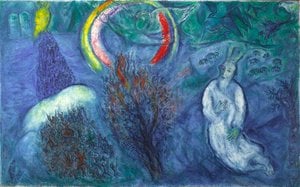
The Concert

Marc Chagall’s mesmerizing ‘The Concert,’ painted in 1957, embodies Naive Art's dreamlike beauty with vibrant blues and reds depicting a fantastical gathering beneath an ethereal sky—a timeless masterpiece to explore and cherish.

Explore the vibrant world of Marc Chagall (1887-1985), a Russian-French master known for his dreamlike paintings, Jewish folklore themes, and stunning stained glass art. Discover his legacy!

The artwork displayed on this page is protected by copyright law, which means we cannot legally create or sell an identical reproduction. This protection is enforced under international agreements such as the Berne Convention and by national laws, including those outlined by the U.S. Copyright Law - Title 17.

This method fully complies with copyright regulations because it does not involve copying or duplicating the protected artwork. Instead, it is a creative reinterpretation - a new painting that is influenced by the original but not identical to it.

Giclée / Art Print

Museum-quality giclée or canvas print with fast production and flexible finish options. ( Buy Hand Made Painting Switch to Digital Image)

Corner sample of the P118B picture frame: moulded polystyrene, 5 cm wide and 3 cm thick
P118B $10
Corner sample of the P118H picture frame: moulded polystyrene, 5 cm wide and 3 cm thick
P118H $10
Corner sample of the P118W picture frame: moulded polystyrene, 5 cm wide and 3 cm thick
P118W $10
Corner sample of the P438Z picture frame: moulded polystyrene, 5.5 cm wide and 3.5 cm thick
P438Z $10
Corner sample of the P508JH picture frame: moulded polystyrene, 7 cm wide and 3.5 cm thick
P508JH $12
Corner sample of the P508YH picture frame: moulded polystyrene, 7 cm wide and 3.5 cm thick
P508YH $12
Corner sample of the P805H picture frame: moulded polystyrene, 5 cm wide and 3.5 cm thick
P805H $10
Corner sample of the P805Z picture frame: moulded polystyrene, 5 cm wide and 3.5 cm thick
P805Z $10
Corner sample of the P919BZ picture frame: moulded polystyrene, 7 cm wide and 3.5 cm thick
P919BZ $10
Corner sample of the P919G picture frame: moulded polystyrene, 7 cm wide and 3.5 cm thick
P919G $10
Corner sample of the P919XJ picture frame: moulded polystyrene, 7 cm wide and 3.5 cm thick
P919XJ $10
Corner sample of the P959ZH picture frame: moulded polystyrene, 5 cm wide and 3 cm thick
P959ZH $10
Corner sample of the P968JZ picture frame: moulded polystyrene, 6 cm wide and 4 cm thick
P968JZ $12
Corner sample of the W106C picture frame: solid wood, 5 cm wide and 3 cm thick
W106C $8
Corner sample of the W218G picture frame: solid wood, 5 cm wide and 3 cm thick
W218G $10
Corner sample of the W218JH picture frame: solid wood, 5 cm wide and 3 cm thick
W218JH $8
Corner sample of the W218Y picture frame: solid wood, 5 cm wide and 3 cm thick
W218Y $10
Corner sample of the W307PJ picture frame: solid wood, 6 cm wide and 3 cm thick
W307PJ $10
Corner sample of the W316G picture frame: solid wood, 6 cm wide and 3 cm thick
W316G $10
Corner sample of the W316PJ picture frame: solid wood, 6 cm wide and 3 cm thick
W316PJ $8
Corner sample of the W316Y picture frame: solid wood, 6 cm wide and 3 cm thick
W316Y $10
Corner sample of the W398PJ picture frame: solid wood, 5 cm wide and 3 cm thick
W398PJ $8
Corner sample of the W4111J picture frame: solid wood, 6.5 cm wide and 3.5 cm thick
W4111J $10
Corner sample of the W500HY picture frame: solid wood, 7 cm wide and 5 cm thick
W500HY $15
Corner sample of the W500JH picture frame: solid wood, 7 cm wide and 5 cm thick
W500JH $15
Corner sample of the W692G picture frame: solid wood, 8 cm wide and 4 cm thick
W692G $12
Corner sample of the W849H picture frame: solid wood, 5 cm wide and 3 cm thick
W849H $8
Corner sample of the W940BG picture frame: solid wood, 7.5 cm wide and 4.5 cm thick
W940BG $15
Corner sample of the W953PJ picture frame: solid wood, 6 cm wide and 3.5 cm thick
W953PJ $8

Standard
custom
CM
INCH

Pick from our preset sizes that match the artwork's original proportions.

width
height

Type the width and the height you need, to fit your frame or your wall. A print can only be cut, never made bigger than the picture, so a size with a different shape loses a part of the image. We send you a digital mockup to approve before we print anything. The picture shown on this page does not show the real cut — only the mockup does.

Worldwide Delivery () in 2 weeks instead of standard 4/5 weeks. (22 October)

Free Worldwide Express Shipping
High-Quality Linen Canvas
Full Shipping Insurance
Customs Tax Refund Guarantee
True Color Matching Guarantee
100-Day Return Policy (Defects Only)
100% Money-Back Guarantee
Bulk Discount Offer

Total Price

$ 69

The Concert

Giclée / Art Print

Reproduction Size

-

Total Price

$ 69

Quick Facts

  • Year: 1957
  • Notable elements or techniques: Dreamlike atmosphere; Floating figures
  • Influences: Fauvism
  • Title: The Concert
  • Dimensions: 140 x 239 cm
  • Subject or theme: Musical performance; Jewish heritage

A Dreamscape of Color and Melody

In the vast, evocative landscape of twentieth-century modernism, few works capture the ethereal boundary between reality and reverie as profoundly as Marc Chagall’s 1957 masterpiece, "The Concert." This oil on canvas is not merely a painting; it is a visual symphony that invites the viewer to step into a world where gravity is optional and memory is painted in vibrant, liquid hues. Measuring an impressive 140 x 239 cm, the work commands attention through its sheer scale and its ability to transport the observer into a dreamlike realm. Chagall, a poet of the brush, utilizes the principles of Naive Art to bypass academic rigidity, opting instead for a raw, unfiltered emotionality that resonates deeply with the soul. The scene unfolds with a sense of cosmic movement, where figures dance and musicians play amidst a sea of azure and a sky ablaze with celestial fire.

The technical execution of "The Concert" is a testament to Chagall’s mastery of color and texture. The artist employs a predominantly blue and white palette, a choice that evokes both the tranquil depths of the ocean and the spiritual weight of Jewish liturgical traditions. Yet, this serenity is punctuated by sudden, joyous bursts of crimson, saffron, and tangerine that streak across the heavens like musical notes caught in flight. Through a meticulous layering process, Chagall builds a surface that possesses an inner luminosity, as if the canvas itself were glowing from within. His brushstrokes are loose and expressive, favoring flattened planes of color that recall the ancient beauty of Byzantine icons while maintaining a distinctly modern, rhythmic energy. This technique allows the composition to breathe, creating a sense of fluidity where the boundaries between the figures, the colossal blue boat, and the swirling sky become beautifully blurred.

Symbolism and the Echoes of Memory

Beyond its visual splendor, "The Concert" is a deeply layered narrative rich with personal and cultural symbolism. At the heart of the composition lies a massive blue boat, a vessel that serves as a poignant metaphor for the human condition. For Chagall, the boat often represented displacement and the wandering spirit—a reflection of the Jewish experience of migration and the search for a permanent home. However, within this specific work, the boat also acts as a stage for hope, carrying the weight of artistic expression and communal joy. The musicians scattered throughout the scene are not merely performers; they are the architects of spiritual communion, their melodies weaving the disparate elements of the painting into a cohesive emotional whole.

For collectors and interior designers alike, this piece offers an unparalleled opportunity to introduce a sense of narrative depth and whimsical elegance into a space. The way the vibrant green of a central figure’s dress contrasts against the deep blues creates a focal point that is both grounding and stimulating. Whether placed in a grand gallery or as a centerpiece in a sophisticated living environment, "The Concert" acts as a window into a more imaginative existence. It is a work that does not just decorate a wall; it animates a room, offering a continuous dialogue between the viewer’s reality and the boundless possibilities of the artist's dream.

Questions & Answers

What palette and what feeling does "The Concert" combine?

In "The Concert", dark colors accompany an ethereal feeling.

What color saturation does "The Concert" by Marc Chagall have?

The colors of "The Concert" by Marc Chagall have a vivid color saturation. Saturation describes how vivid or muted the colors are.

What colors dominate "The Concert" by Marc Chagall?

"The Concert" is defined by a dark palette led by plum (#b9c1de).


Artist Biography

A Life Painted in Dreams: The World of Marc Chagall

Marc Chagall, born Moishe Shagal in 1887 in the small Belarussian town of Liozna near Vitebsk, wasn’t merely a painter; he was a poet of color, a weaver of dreams, and a chronicler of memory. His life, spanning nearly a century, mirrored the tumultuous currents of the 20th century, yet his art remained steadfastly rooted in a deeply personal vision—one infused with the folklore of his Hasidic Jewish upbringing and an unwavering belief in the power of imagination. Vitebsk itself was more than just a birthplace; it became the emotional core of his artistic universe, a recurring motif populated by flying figures, whimsical animals, and the vibrant hues of remembered landscapes. The town’s unique blend of cultures—Russian Orthodox churches alongside bustling Jewish marketplaces—forged an aesthetic sensibility that would defy easy categorization throughout his long career. Though he sought formal training first with a local sign painter and later in St. Petersburg under Léon Bakst, and then in Paris at the Académie de la Grande Chaumière, Chagall never fully embraced any single artistic movement. He absorbed elements of Cubism, Symbolism, and Fauvism, but always filtered them through his own intensely personal lens, creating a style that was uniquely, unmistakably Chagall.

Forging a Unique Visual Language

Chagall’s early works already hinted at the distinctive language he would develop. Paintings like I and the Village (1911) are not simply depictions of place; they are explorations of identity, memory, and the relationship between the individual and community. The village isn't rendered realistically but as a fragmented collection of recollections, imbued with symbolic meaning. This ability to transmute personal experience into universal themes became a hallmark of his art. His palette was bold and expressive, often employing vibrant, non-naturalistic colors to convey emotion rather than literal representation. Figures float and dance across the canvas, defying gravity and logic, creating a dreamlike atmosphere that invites viewers into his inner world. This stylistic approach wasn’t accidental; it stemmed from a desire to move beyond mere imitation of reality and capture the essence of feeling, the weight of memory, and the power of folklore. The Russian Revolution brought Chagall back to Vitebsk, where he became involved in cultural initiatives, establishing an art school that briefly flourished before succumbing to the restrictions imposed by the new regime. This period was marked by both creative energy and political disillusionment, a tension that would continue to shape his artistic trajectory.

A Life Between Worlds: Paris, New York, and Beyond

Eventually, Chagall left Russia for good, settling in France in 1923. This marked the beginning of a period of international recognition and prolific creativity. Works like Over Vitebsk (1920-1922) demonstrate his continued engagement with his childhood memories, while paintings inspired by biblical stories—such as Jacob’s Dream—reveal a growing interest in religious themes. The outbreak of World War II forced him to flee occupied France for the United States, where he spent seven years in New York City. This period was marked by profound emotional upheaval and artistic experimentation. He found solace in his art, creating powerful works that reflected the anxieties and uncertainties of the time. White Crucifixion (1938), a haunting depiction of suffering and persecution, stands as a testament to this era. After the war, Chagall returned to France, where he continued to paint and create until his death in 1985 at the age of 97.

Legacy and Enduring Influence

In his later years, Marc Chagall received numerous prestigious commissions, including the ceiling of the Paris Opera (1964), a breathtaking explosion of color and form that celebrated musical masterpieces, and stunning stained glass windows for the Hadassah Hebrew University Medical Center synagogue in Jerusalem. These large-scale projects allowed him to translate his artistic vision into architectural spaces, creating immersive environments that continue to inspire awe and wonder. Chagall’s influence on subsequent generations of artists is undeniable. His lyrical quality, emotional depth, and imaginative power resonated with Surrealists and other movements that embraced fantasy and symbolism. He bridged the gap between European modernism and Jewish cultural identity, becoming known as “the quintessential Jewish artist of the twentieth century.” His ability to synthesize personal experience, folklore, and universal themes continues to resonate with audiences worldwide. His work reminds us of the power of art to transcend boundaries, to connect us to our shared humanity, and to illuminate the beauty and mystery of life.

A Lasting Impression

Marc Chagall’s legacy extends beyond his paintings and stained glass; it resides in the enduring power of his vision—a vision that celebrates love, memory, and the boundless possibilities of the human imagination. He left behind a body of work that is both deeply personal and universally accessible, inviting viewers to lose themselves in a world painted with dreams and illuminated by hope. The Musée Marc Chagall in Nice stands as a testament to his enduring influence, housing an extensive collection of his works and offering visitors a glimpse into the heart and soul of this extraordinary artist. His art continues to inspire, challenge, and move us, ensuring that his vibrant and imaginative spirit will live on for generations to come.
Marc Chagall

Marc Chagall

1887 - 1985 , Belarus

Quick Facts

  • Artistic Movement Or Style:
    • Cubism
    • Symbolism
    • Fauvism
  • Artists Or Movements Influenced By This Artist: ['Surrealists']
  • Artists Who Influenced This Artist: ['Léon Bakst']
  • Full Name: Marc Chagall
  • Nationality: Russian-French
  • Notable Artworks:
    • I and the Village
    • Over Vitebsk
    • White Crucifixion
    • Jacob's Dream
  • Place Of Birth: Liovana, Belarus
  • Date Of Birth: 1887
  • Date Of Death: 1985
Explore artworks organized by themes, styles, and characteristics.