

 Acrylic On CanvasWallArtSurrealist Expressionism
 1952
1952 168.0 x 103.0 cm
The artwork displayed on this page is protected by copyright law, which means we cannot legally create or sell an identical reproduction. This protection is enforced under international agreements such as the Berne Convention and by national laws, including those outlined by the U.S. Copyright Law - Title 17.
This method fully complies with copyright regulations because it does not involve copying or duplicating the protected artwork. Instead, it is a creative reinterpretation - a new painting that is influenced by the original but not identical to it.
Museum-quality giclée or canvas print with fast production and flexible finish options. ( Buy Hand Made Painting Switch to Digital Image)





























Pick from our preset sizes that match the artwork's original proportions.

Type the width and the height you need, to fit your frame or your wall. A print can only be cut, never made bigger than the picture, so a size with a different shape loses a part of the image. We send you a digital mockup to approve before we print anything. The picture shown on this page does not show the real cut — only the mockup does.
Worldwide Delivery () in 2 weeks instead of standard 4/5 weeks. (22 October)
Resistance
Reproduction Size
Marc Chagall's "Resistance," painted in 1952, isn’t merely a depiction of a biblical scene; it’s a visceral embodiment of the anxieties and fervent hopes swirling within Europe at the dawn of the Cold War. This monumental canvas, measuring 168 x 103 cm, immediately commands attention with its dramatic red background – a color historically associated with both sacrifice and revolutionary fervor. Chagall, deeply rooted in his Belarusian Jewish heritage, masterfully blends elements of religious iconography with personal memory and surrealist expression to create an image that resonates far beyond the confines of traditional representation.
The heart of the painting is undeniably the central figure: a towering depiction of Jesus Christ on the cross. However, Chagall doesn’t offer a serene or contemplative portrayal. Instead, he presents a Christ undergoing immense suffering, surrounded not by angels or mourners, but by a chaotic and intensely engaged crowd. This isn't a passive witness to sacrifice; it’s an active participation in a moment of profound significance. The sheer number of individuals – at least fourteen – underscores the scale of this event, suggesting a collective experience, a shared burden of faith and perhaps, a burgeoning resistance against oppression.
Chagall’s genius lies in his ability to imbue seemingly simple elements with layers of meaning. The figures surrounding the cross are not simply spectators; they are actively involved, some brandishing swords – a potent symbol of defense and defiance against perceived enemies. The presence of two horses is particularly striking. One positioned near the top left corner, almost hovering above the scene, evokes a sense of divine intervention or perhaps the relentless passage of time. The second horse, located towards the center-right, could represent the forces of chaos and conflict that threaten to overwhelm the figure on the cross. Furthermore, scattered objects – fragments of everyday life – are held by various individuals: a book, a musical instrument, a piece of cloth—each hinting at the diverse facets of human experience converging in this pivotal moment.
The artist’s distinctive technique is immediately apparent. Chagall's signature loose brushstrokes and vibrant color palette contribute to the painting’s dynamic energy. He employs a flattened perspective, characteristic of his style, which emphasizes emotional impact over realistic representation. The figures are often depicted with elongated limbs and simplified features, lending them an almost dreamlike quality. This deliberate distortion further amplifies the painting's surrealist undertones, suggesting that this is not simply a historical event but a symbolic representation of universal struggles.
Painted in 1952, “Resistance” reflects the post-war anxieties and ideological tensions gripping Europe. The shadow of World War II still loomed large, and the burgeoning Cold War between East and West fueled a climate of fear and uncertainty. Chagall himself had experienced firsthand the horrors of war and persecution, having been briefly imprisoned during the Nazi occupation of Vitebsk. This personal history undoubtedly informed his artistic response to the era’s challenges. The painting can be interpreted as an allegory for the ongoing struggle between good and evil, faith and doubt, freedom and oppression – themes that resonated deeply with audiences at the time.
Beyond its immediate historical context, “Resistance” speaks to a timeless human experience: the confrontation with suffering and the assertion of one’s beliefs in the face of adversity. Chagall's ability to capture this complex interplay of emotions through his distinctive visual language makes "Resistance" not just a painting but a powerful testament to the enduring spirit of humanity. A reproduction of this artwork offers a captivating glimpse into the mind of a visionary artist and a poignant reflection on the challenges of our time.
"Resistance" measures 168 x 103 cm in its original form. Original dimensions are a useful reference when choosing a reproduction size.
The emotional tone recorded for "Resistance" by Marc Chagall is mysterious. It summarizes the feeling the work expresses.
The 1952 date places "Resistance" in the Mature Period of Marc Chagall's development.


1887 - 1985 , Belarus

Embark on a sophisticated journey through the surrealist movement. Discover how masters like Dalí and Ernst blurred the lines between dreams and reality through innovative techniques, exploring the profound impact of the subconscious on fine art history with expert authority.

Embark on a journey through the subconscious with our expert guide to Surrealism. Discover the profound symbolism of masters like Dalí and Ernst, exploring how dreamlike imagery reshaped art history and continues to inspire collectors and enthusiasts worldwide.
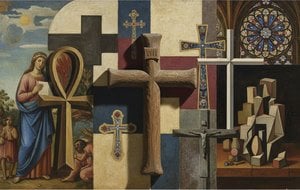
Delve into the profound symbolism of cross imagery in fine art history. From Renaissance masterpieces to sacred iconography, explore how religious motifs shape Western art through our expert cultural analysis and curated collection of museum-quality reproductions.

 Preview
 Send
Send Share
Share
 Details
 Guide
Guide

 Download
 Similars
 X-Ray
X-Ray Diaporama
 Stats
Stats Read More









 Glass option is only available in size under 110 CM


