A Dreamscape in Black and White: Unveiling Marc Chagall’s ‘Proshka’
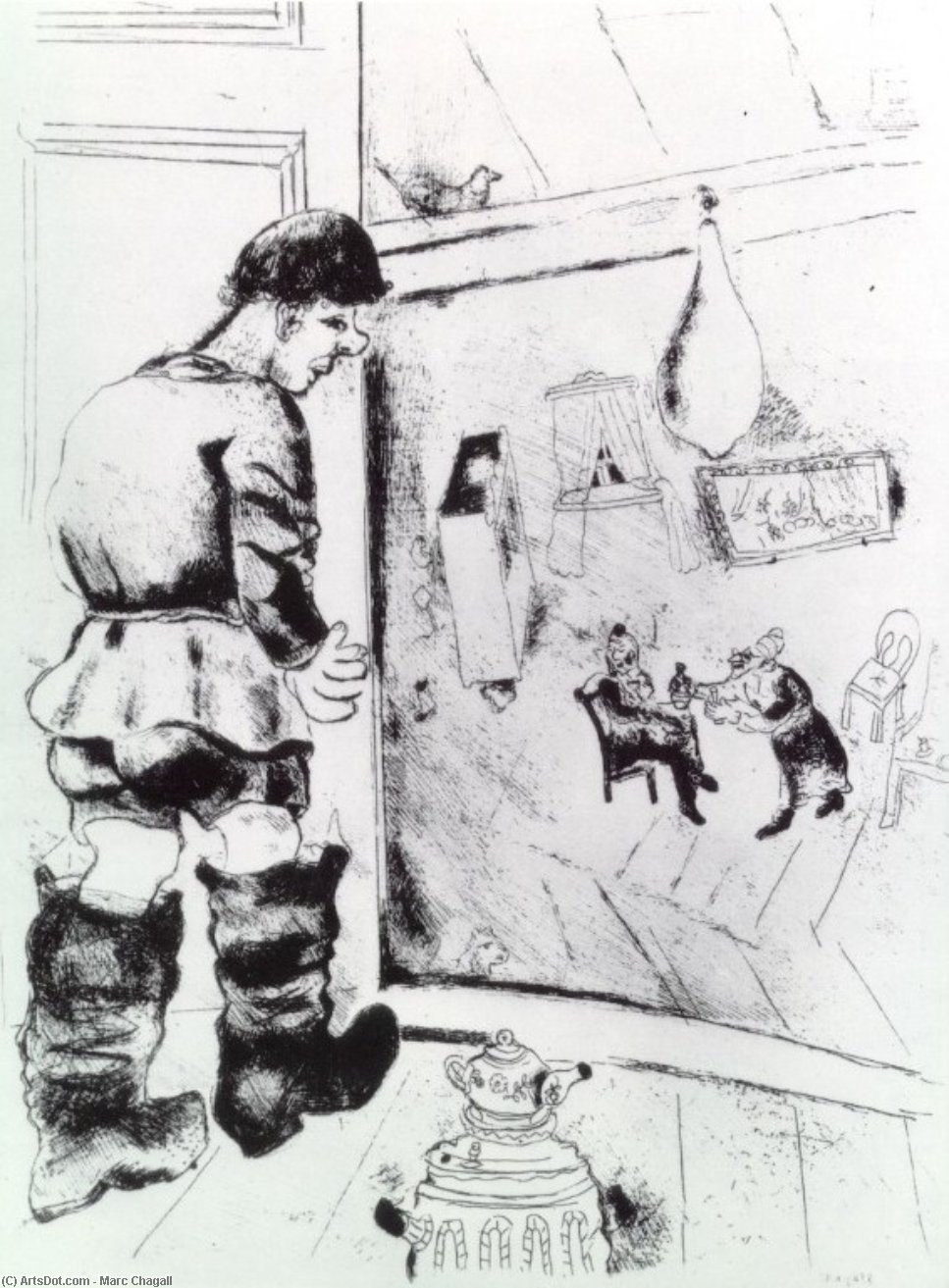
Marc Chagall's “Proshka,” painted around 1923, isn’t merely a depiction of a scene; it’s an immersion into a world where reality subtly bends to the whims of memory and imagination. This captivating work, rendered in the stark elegance of black and white, immediately draws the viewer into a domestic interior brimming with quiet mystery. The painting pulsates with a dreamlike quality, characteristic of Chagall's signature style – a potent blend of Cubism’s fragmented forms, Expressionism’s emotional intensity, and Symbolism’s layered meanings. At its heart lies Proshka himself, a figure both imposing and vulnerable, standing within an entryway that feels simultaneously familiar and utterly surreal.
Chagall masterfully employs line as the primary language of his composition. Thick, assertive lines delineate Proshka's form – his oversized boots, his head, even the folds of his clothing – creating a sense of monumental presence. These bold strokes contrast with the finer, more delicate lines used to capture the texture of the walls, the patterns on furniture, and the subtle details of domestic objects. The interplay between these line weights generates depth and dynamism, guiding the eye through the scene while simultaneously hinting at an underlying emotional current. The technique appears to be drawing or etching, utilizing pen and ink on paper, lending a tactile quality to what could easily feel like a purely abstract image.
Decoding Symbolism: Proshka and His World
Proshka’s identity remains deliberately ambiguous, adding to the painting's enigmatic allure. While often interpreted as a reference to the Hasidic figure of Proshka, a beloved storyteller within Jewish communities, his posture – gazing intently into the room – suggests an anticipation or perhaps even a longing. The exaggerated proportions—the large boots and head—are not accidental; they amplify Proshka’s presence, imbuing him with a sense of importance and strength. The surrounding interior, filled with objects like a samovar (a traditional Russian tea urn) and various furniture pieces, evokes a feeling of warmth and familiarity, anchoring the fantastical elements within a recognizable domestic space. These everyday items are imbued with symbolic weight, hinting at memories, traditions, and perhaps even the artist’s own personal history.
The composition itself is deliberately flattened and distorted, contributing to the painting's dreamlike atmosphere. Depth isn’t achieved through traditional perspective but rather through overlapping elements and variations in line density – a technique that further emphasizes the subjective nature of Chagall’s vision. The lighting, seemingly originating from an unseen source, casts subtle shadows, highlighting key areas and adding to the overall sense of mystery. The painting feels less like a representation of reality and more like a carefully constructed memory, filtered through the artist's unique perspective.
A Legacy of Innovation: Chagall’s Artistic Roots
“Proshka” exemplifies Chagall’s distinctive artistic lineage, drawing upon influences from various movements while forging his own singular style. Elements reminiscent of Cubism—the fragmented forms and multiple viewpoints—are interwoven with the emotional intensity of Expressionism and the symbolic richness of Symbolism. Furthermore, there's a clear connection to folk art traditions, particularly those rooted in Eastern European culture, evident in the simplified forms and vibrant use of line. This fusion of influences creates an aesthetic that is both modern and deeply personal, reflecting Chagall’s own experiences and memories.
Created around 1923, during a period of significant artistic experimentation in Paris, “Proshka” stands as a testament to Chagall's ability to transform the ordinary into the extraordinary. It’s a painting that invites contemplation, prompting viewers to consider the nature of memory, identity, and the power of imagination. Reproductions of this captivating artwork offer a remarkable opportunity to bring this dreamlike vision into your home, capturing not only its visual beauty but also the profound emotional resonance of Chagall's genius.



 Preview
 Buy Hand Made Painting
 Send
Send Share
Share
 Details

 Download
 Similars
 X-Ray
X-Ray Diaporama

 Read More






































 Glass option is only available in size under 110 CM