x


 PastelWallArtSurrealist Expressionism
 1963Modern
 28.0 x 42.0 cm
Museum-quality giclée or canvas print with fast production and flexible finish options. ( Buy Hand Made Painting Buy Image)





























Pick from our preset sizes that match the artwork's original proportions.

You may enter your own dimensions to fit a specific frame or space. If your selected size does not match the original image's proportions, we will either crop the artwork or extend the image with a mirrored or solid-fill edge. A digital mockup will be sent for your approval before production begins.
Please note that the on-screen preview does not reflect the actual cropping or extension. Only the mockup will accurately show the final composition.
While custom sizes are available, we recommend selecting a dimension from the predefined list to preserve the original proportions.
Worldwide Delivery () in 2 weeks instead of standard 4/5 weeks. (4 September)


Noah and the Rainbow (9)
Reproduction Size
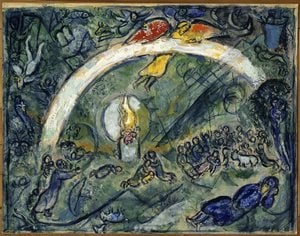
In the vast, kaleidoscopic universe of Marc Chagall, certain moments transcend the boundaries of mere biblical retelling to become profound meditations on the human spirit. His 1963 masterpiece, Noah and the Rainbow, is one such portal. This work does not simply depict a post-diluvian promise; it invites the viewer into a surrealist dreamscape where the weight of history meets the lightness of divine hope. As one gazes upon the composition, the boundaries between reality and imagination dissolve, replaced by a luminous atmosphere that feels as much like a cherished memory as it does a sacred vision. The painting captures a fantastical moment following the Great Flood, rendered with an unmistakable Expressionist flair that speaks to Chagall’s lifelong fascination with the interplay of myth and personal identity.
The heart of the piece is anchored by a striking, dreamlike central figure: a man perched atop a horse, his gaze directed upward toward the heavens. This upward movement serves as a spiritual conduit, drawing the eye from the terrestrial struggle toward the celestial promise. Scattered throughout this busy, enchanting landscape are other figures and elements—a boat drifting on the periphery and people moving through a dense, mystical forest—all interacting in a way that defies traditional physics but adheres perfectly to the logic of a dream. For the collector or interior designer, this piece offers more than just visual interest; it provides a focal point of profound narrative depth, making it an ideal centerpiece for spaces designed to inspire contemplation and wonder.
Chagall’s mastery lies in his ability to manipulate medium and color to evoke visceral emotional responses. In Noah and the Rainbow, he employs a sophisticated layering of Indian ink, oil, and pastel on paper to achieve a remarkable textural depth. The meticulous application of ink provides a foundational structure, grounding the more whimsical elements with fine detail and sharp definition. Over this, the fluid application of oil paints infuses the canvas with a radiant, inner light, particularly evident in the lush blues and greens that dominate the landscape. These colors are not merely decorative; they are echoes of Chagall’s formative years in Vitebsk, Belarus, reflecting the verdant, mystical landscapes of his childhood.
The true triumph of the technique, however, is found in the depiction of the rainbow itself. A radiant band of color that dominates the upper portion of the composition, it acts as a bridge between the earthly and the divine. The way the light seems to bleed through the pigments creates a sense of translucency, as if the rainbow were composed of pure emotion rather than mere light. This luminous quality makes a high-quality reproduction of this work particularly captivating, as the interplay of light and shadow can be captured to bring that same sense of spiritual transcendence into a modern home or gallery setting.
To understand this artwork is to understand the cultural tapestry of Chagall’s soul. His work is deeply rooted in the duality of his upbringing—the juxtaposition of Orthodox churches and Jewish marketplaces in Eastern Europe. In Noah and the Rainbow, this duality manifests as a tension between the heavy, grounded reality of the flood's aftermath and the weightless, soaring hope of the rainbow. The rainbow serves as the ultimate symbol of God’s covenant, a promise of peace and renewal that resonates universally, transcending its specific biblical origins to represent the resilience of life itself.
For those seeking to curate an environment of sophistication and emotional resonance, this piece offers an unparalleled opportunity. It is a work that demands attention through its complexity yet rewards the viewer with a sense of peace. Whether placed in a quiet study, a grand living area, or a curated art collection, Noah and the Rainbow brings with it the legacy of a master who could paint the very essence of a dream. Owning a reproduction of such a significant work allows one to inhabit a space where memory, faith, and the infinite beauty of the imagination are always present.


1887 - 1985 , Belarus

Master the nuances of Giclée printing with our expert guide. Discover how pigment-based inks and museum-grade substrates create fade-resistant, high-fidelity art reproductions designed for discerning collectors seeking unparalleled quality and longevity.

Explore the ethereal beauty of pastel art. Discover how Impressionist masters used soft hues and velvety textures to capture light. A professional guide for art enthusiasts seeking to understand, collect, and appreciate the delicate magic of this timeless medium.

Embark on a visual journey through the ethereal beauty of rainbows in fine art. Explore how masters captured light, color, and atmosphere through Impressionism and beyond. Discover timeless masterpieces for your collection with expert insights into the spectrum of splendor.

Transform your digital artistry into a prestigious global brand with WahooArt’s premium Giclée prints. Experience museum-quality archival excellence and seamless on-demand fulfillment designed for the modern creative entrepreneur seeking to build a lasting artistic legacy.


Stay updated with the latest art news, exclusive offers, and decoration ideas.
Tell us about your project and our art experts will provide you with 3 personalized art suggestions.
Let Us Curate 3 Options Just for You - Free!

 Preview
 Send
Send Share
Share
 Details

 Download
 Similars
 X-Ray
X-Ray Diaporama
 Read More







 Glass option is only available in size under 110 CM