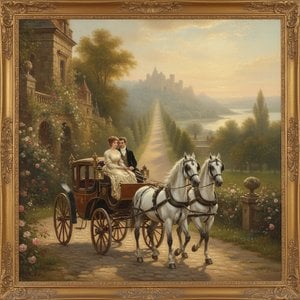
Marc Chagall's *Equestrienne*: A Dreamscape of Memory
Marc Chagall’s Equestrienne, painted in 1927, is more than just a depiction of a woman and a horse; it’s an immersive journey into the artist’s deeply personal world. Born Moishe Shagal in 1887 in Liozna, Belarus – a town that would forever haunt his imagination – Chagall developed a unique artistic language rooted in folklore, memory, and a profound sense of longing. This painting, rendered in vibrant hues characteristic of his mature style, exemplifies this approach perfectly. The scene unfolds with an almost surreal quality, inviting the viewer to step into a dreamscape where earthly concerns dissolve and symbolic narratives take center stage.
- Subject Matter: The central focus is a nude woman reclining on the back of a horse, a motif that recurs frequently in Chagall’s work. This isn't a realistic portrayal but rather an idealized vision, imbued with romanticism and a sense of timelessness.
- Technique: Chagall employed his signature technique – bold, expressive brushstrokes applied with a seemingly effortless fluidity. The colors are rich and saturated, creating a luminous effect that dominates the canvas. He utilized layering and glazing to build up depth and create an almost palpable texture.
Symbolism and Narrative
The symbolism within *Equestrienne* is layered and open to interpretation, reflecting Chagall’s own complex emotional landscape. The horse itself represents strength, nobility, and perhaps even a connection to the earth – themes central to his Jewish heritage. The woman, often interpreted as a self-portrait or a representation of his beloved wife, Bryna, embodies grace, vulnerability, and an almost ethereal beauty. Her crown suggests royalty or spiritual significance, while her relaxed posture evokes a sense of peace and surrender. The inclusion of the moon above adds to the dreamlike atmosphere, symbolizing intuition, mystery, and the cyclical nature of time. The birds, subtly placed in the composition, could represent freedom, hope, or messengers from another realm – elements frequently found within Chagall’s fantastical visions.
Historical Context and Artistic Influences
Painted in 1927, *Equestrienne* emerged during a period of significant artistic experimentation. Following the devastation of World War I and the rise of new ideologies, artists sought to express profound emotions and explore alternative modes of representation. Chagall’s work, deeply influenced by Russian folklore, Jewish mysticism (Kabbalah), and his own personal memories, offered a powerful counterpoint to prevailing modernist trends. His early training as a sign painter undoubtedly shaped his bold use of color and decorative elements, which he later masterfully integrated into his larger compositions. The painting reflects the artist’s evolving relationship with Vitebsk – a place that simultaneously represented both his roots and the source of profound emotional turmoil.
Emotional Impact and Artistic Value
*Equestrienne* possesses a captivating emotional resonance, drawing viewers into its dreamlike world. Its vibrant colors, expressive brushwork, and evocative symbolism create a powerful visual experience. This hand-painted reproduction captures not only the aesthetic beauty of Chagall’s original but also the depth of his artistic vision. A piece like this is more than just decoration; it's an investment in art history, a connection to a master artist’s soul, and a source of enduring inspiration. Its size (51 x 99 cm) makes it suitable for a variety of interior spaces, from a gallery wall to a statement piece within a living room or bedroom.
Questions & Answers
Where can I find a guide to "Equestrienne"?
The guide to "Equestrienne" is the artwork's Guide page - a printable factsheet showing the artwork with its caption, credit line and identity table (artist, dates, medium, original size, collection).
Is "Equestrienne" typical of what Marc Chagall usually created?
Among Marc Chagall's recorded themes - jewish folklore, dreams, symbolism, biblical narratives, spirituality, russian identity, vitebsk memories, surrealism - "Equestrienne" brings its own focus on chagall, horse, woman, moon, crown, birds, dreamlike, folklore.
What technique and size is the original "Equestrienne" by Marc Chagall?
The original "Equestrienne" by Marc Chagall is an acrylic on canvas work measuring 51 x 99 cm. Technique and size describe the original object.



 Preview
 Buy Hand Made Painting
 Send
Send Share
Share
 Details
 Guide
Guide

 Download
 Similars
 X-Ray
X-Ray Diaporama
 Q&A
Q&A Stats
Stats


 Read More






































 Glass option is only available in size under 110 CM