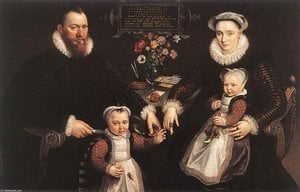
OilWallArtFlemish Mannerism
 1577Early Modern
 106.0 x 75.0 cm
 Onze-Lieve Vrouwekathedraal
Hand-painted oil on canvas in your size and frame, made to order by our artists. ( Switch to Print Switch to Digital Image)





























Pick from our preset sizes that match the artwork's original proportions.

Type the width and the height you need, to fit your frame or your wall. This is hand-painted, so for a size with a different shape the artist can paint a bit more around the picture, or cut a bit — you choose. We send you a digital mockup to approve before the painting starts. The picture shown on this page does not show the real result — only the mockup does.
Worldwide Delivery () in 3/4 weeks instead of standard 5 weeks. (24 October). No compromise on quality.
Nativity
Reproduction Size

Maerten de Vos, born in the bustling artistic hub of Antwerp in 1532, emerged from a family deeply rooted in the city’s painting tradition. His father, Pieter de Vos, originally hailing from Leiden, had established himself as a respected painter after an apprenticeship with Jeroom Scuelens. Young Maerten, alongside his brother Pieter, initially received his foundational training within their father's workshop, absorbing the techniques and sensibilities of the mid-16th century Flemish school. While speculation suggests a possible tutelage under the prominent Frans Floris—the leading history painter of the time—documentary evidence remains elusive. This early period undoubtedly instilled in him a solid understanding of composition, draftsmanship, and the prevailing artistic currents of Antwerp.
As was common for ambitious Flemish artists seeking to broaden their horizons, Maerten de Vos embarked on an extended journey to Italy between 1550 and 1558. This transformative experience proved pivotal in shaping his artistic style. He likely sojourned in major centers like Rome, Florence, and Venice, immersing himself in the masterpieces of the Italian Renaissance and Mannerism. The vibrant colors and dynamic compositions of Venetian painters—particularly Paolo Veronese and Jacopo Tintoretto—left an indelible mark on his work. Carlo Ridolfi, a 17th-century art biographer, even claimed that de Vos studied directly under Tintoretto in Venice, though this assertion requires careful consideration. Regardless, the influence is palpable: a newfound richness of hue, a heightened sense of drama, and a more fluid approach to form characterize his paintings following his return to Antwerp.
Upon his return to Antwerp in 1558, de Vos quickly integrated into the city’s artistic community, joining the Guild of Saint Luke. He married Joanna le Boucq, a woman from Valenciennes, and together they raised a large family. The art world of Antwerp was competitive; Frans Floris dominated the scene with his expansive workshop. De Vos initially faced challenges securing commissions but proved fortunate in 1564 when he received patronage from Gillis Hooftman, a wealthy merchant who commissioned several significant works. However, it was the tumultuous period following the Beeldenstorm of the 1560s—the wave of iconoclasm that swept through the Netherlands—that truly propelled de Vos to prominence. Floris, deeply shaken by the destruction of his art, retreated from active painting, creating a void in the market for history paintings. De Vos skillfully stepped into this breach, becoming one of the leading figures in the Spanish Netherlands.
De Vos distinguished himself as a prolific painter of history and allegorical scenes, often imbued with moral or religious themes. His work reflects both his earlier Flemish training and the Italian influences he absorbed during his travels. He was particularly adept at depicting complex narratives filled with numerous figures, showcasing his mastery of composition and anatomical detail. In 1570, he received a prestigious commission to decorate the palatine chapel of William, Duke of Brunswick-Lüneburg in Celle, Germany—a project that involved creating a Lutheran scheme of decoration. This demonstrates his adaptability and willingness to cater to diverse religious patrons. Later in his career, as Antwerp experienced a resurgence of Catholic fervor, de Vos became a leading producer of altarpieces, effectively paving the way for the rise of Peter Paul Rubens.
Maerten de Vos’s impact extended beyond his own paintings. He was an exceptionally prolific draftsman, creating hundreds of designs that were widely circulated through Antwerp printing workshops. These prints served as models for tapestries, stained glass windows, and other decorative arts, disseminating his style throughout Europe and the Spanish colonies. His influence can be seen in the works of numerous artists who followed him. He left a lasting legacy not only as a skilled painter but also as an important innovator in printmaking and a key figure in the transition from Mannerism to Baroque art in the Netherlands. He died in Antwerp on December 4, 1603, leaving behind a rich artistic heritage that continues to captivate and inspire.

1532 - 1603

Explore the dramatic brilliance of the Flemish Baroque movement. Discover how masters like Peter Paul Rubens utilized chiaroscuro and dynamic composition to redefine art history through light, shadow, and unparalleled emotion.

 Preview
 Send
Send Share
Share
 Details
 Guide
Guide

 Download
 Similars
 X-Ray
X-Ray Diaporama
 Stats
Stats Read More









 Glass option is only available in size under 110 CM