Hand-painted oil on canvas in your size and frame, made to order by our artists. ( Switch to Print Switch to Digital Image)





























Pick from our preset sizes that match the artwork's original proportions.

You may enter your own dimensions to fit a specific frame or space. If your selected size does not match the original image's proportions, we will either crop the artwork or extend the painting with additional hand-painted elements. A digital mockup will be sent for your approval before production begins.
Please note that the on-screen preview does not reflect the actual cropping or extension. Only the mockup will accurately show the final composition.
While custom sizes are available, we recommend selecting a dimension from the predefined list to preserve the original proportions.
Worldwide Delivery () in 3/4 weeks instead of standard 5 weeks. (11 October). No compromise on quality.
Boats
Reproduction Size
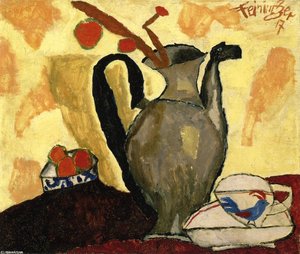
In the vast landscape of early twentieth-century modernism, few works capture the rhythmic pulse of movement and light as elegantly as Lyonel Feininger’s Boats. Painted in 1917, this masterpiece serves as a breathtaking bridge between the whimsical precision of graphic illustration and the profound structural depth of Cubism. At first glance, the viewer is greeted by a serene maritime scene, yet upon closer inspection, the water and vessels dissolve into a mesmerizing dance of geometric planes. Feininger, a master who could just as easily navigate the sharp lines of a comic strip as the ethereal complexities of Expressionism, uses this piece to invite us into a world where reality is fragmented, yet harmoniously reconstructed through the lens of color and form.
The composition is a masterful study in perspective and spatial layering. Several sailboats, varying in scale, drift across a canvas dominated by deep, evocative blues. Some vessels appear anchored in the foreground, their sails catching the light with sharp, angular clarity, while others recede into a misty background, creating an illusion of infinite depth. This technique of multiple viewpoints—a hallmark of the Cubist movement—allows the eye to wander through the scene, experiencing the boats from several angles simultaneously. The presence of two subtle human figures, positioned near the edges of the frame, provides a sense of scale and a quiet, contemplative narrative, grounding the abstract geometry in a moment of lived experience.
Technically, Boats is an extraordinary testament to Feininger’s ability to manipulate light as if it were a physical substance. The artist employs a palette that balances cool, aquatic tones with sudden, brilliant highlights that suggest the sun reflecting off a moving tide. His use of line is particularly noteworthy; there is a stained-glass quality to the way the shapes intersect, a precursor to his later, even more architectural works. Each stroke of oil on canvas contributes to a sense of dynamism, where the stillness of the water is constantly challenged by the sharp, energetic edges of the sails.
For the discerning collector or interior designer, this artwork offers much more than mere decoration. It provides a sophisticated focal point that embodies the intellectual rigor of the Cubist era while maintaining an emotional warmth. The painting’s ability to evoke both tranquility and motion makes it a versatile choice for modern spaces, particularly those seeking to introduce a sense of historical depth and avant-garde elegance. To possess a reproduction of Boats is to bring a piece of the Musée National d'Art Moderne into one's own sanctuary, offering a daily encounter with the transformative power of light, color, and geometric grace.
The color composition of "Boats" by Lyonel Feininger combines a serene contrast with a strong color unity harmony.
"Boats" was created by Lyonel Feininger. The information on this page describes Lyonel Feininger's original work.
Historically, "Boats" is a Cubism work of the broader Modern era.
"Boats" by Lyonel Feininger uses a neutrals color palette. The palette summarizes the work's overall color character.
"Boats" by Lyonel Feininger was created in 1917.
Lyonel Feininger made "Boats" at the age of 46. The artist was born in 1871 and the work is dated 1917.
The color identity of "Boats" by Lyonel Feininger: a neutrals palette, dominated by rosy brown (#b3b490).


1871 - 1956 , United States of America

Master the complexities of Cubist composition with our expert guide. Explore analytical techniques, geometric deconstruction, and the art of simultaneous perspective to deepen your appreciation for this avant-garde movement.

Explore the profound evolution of Cubist still life, from Cézanne's structural foundations to the fragmented brilliance of Braque and Léger. Discover how geometric abstraction redefined reality through a sophisticated lens of form, color, and modern artistic mastery.

Explore the profound depth of Cubist Expression. From the deconstructed forms of Picasso to Braque’s geometric mastery, discover how shattering reality through abstraction redefined modern art and continues to inspire sophisticated collectors worldwide.

 Preview
 Send
Send Share
Share
 Details
 Guide
Guide

 Download
 Similars
 X-Ray
X-Ray Diaporama
 Stats
Stats

 Read More









 Glass option is only available in size under 110 CM