

 OilWallArtBaroque Revival
 1580Renaissance
 95.0 x 73.0 cm
 Hermitage Museum
Museum-quality giclée or canvas print with fast production and flexible finish options. ( Buy Hand Made Painting Switch to Digital Image)





























Pick from our preset sizes that match the artwork's original proportions.

Type the width and the height you need, to fit your frame or your wall. A print can only be cut, never made bigger than the picture, so a size with a different shape loses a part of the image. We send you a digital mockup to approve before we print anything. The picture shown on this page does not show the real cut — only the mockup does.
Worldwide Delivery () in 2 weeks instead of standard 4/5 weeks. (28 October)
Circumcision
Reproduction Size
In the heart of the Spanish Renaissance, where the spiritual fervor of Toledo met the burgeoning humanism of Europe, Luis de Carbajal captured a moment of profound theological significance. His masterpiece, Circumcision, is not merely a depiction of a ritual, but a window into the soul of sixteenth-century Spain. The scene unfolds within an intimate, solemn interior, drawing the viewer into a tight-knit circle of witnesses. As we gaze upon the gathering, we see a diverse assembly of men and women, their faces etched with a mixture of reverence and quiet intensity. At the center of this sacred choreography lies the infant, the focal point around which the entire composition breathes. The presence of a sword and the formal arrangement of figures suggest a ceremony that is as much about communal identity and covenant as it is about the physical act itself.
Carbajal, a contemporary and stylistic peer to the legendary El Greco, brings a unique tension to this work—a bridge between the structural grandeur of the Gothic tradition and the dramatic, emotive lighting of the Mannerist movement. The painting utilizes a sophisticated interplay of light and shadow to guide the eye through the crowded scene. Light falls upon the central figures with a purposeful clarity, highlighting the textures of heavy robes and the delicate skin of the child, while the background recedes into a soft, atmospheric depth. This technique does more than create three-dimensional form; it imbues the room with a sense of divine presence, as if the very air is thick with the weight of the holy event.
For the discerning collector or interior designer, this work offers an unparalleled opportunity to introduce a piece of profound historical gravity into a curated space. Carbajal’s technical prowess is evident in his meticulous attention to the material world—the heavy folds of liturgical garments, the sturdy presence of the wooden furniture, and the subtle architectural elements that ground the scene in a recognizable reality. Yet, beneath this surface-level realism lies a deep symbolic language. The gathering of twelve figures evokes the apostolic tradition, suggesting that the covenant made with this child is one that encompasses the entirety of the faithful. Every element, from the placement of the chair to the glint of steel, serves to reinforce the narrative of continuity and sacred law.
To possess a reproduction of Circumcision is to invite a conversation about heritage, faith, and the enduring power of the Spanish Renaissance into one's home. It is a piece that demands contemplation, offering a rich tapestry of textures and tones that complement both classical and contemporary settings. Whether placed in a grand library or a quiet study, the painting acts as an anchor of sophistication, providing a sense of timelessness and intellectual depth. It remains a testament to Carbajal’s ability to transform a specific religious rite into a universal expression of human connection and spiritual devotion.
The color of "Circumcision" is subtle color in saturation and monochromatic in intensity.
The colors of "Circumcision" form an earthy palette. This classification describes the dominant color families.
In the catalog, "Circumcision" by Luis De Carbajal is filed as wall art. The category helps find similar works.

In the heart of Toledo, a city where the echoes of medieval devotion meet the burgeoning light of the Renaissance, the life of Luis de Carbajal unfolded as a profound testament to spiritual and artistic endurance. Born around 1531, Carbajal emerged from the vibrant, intellectually charged atmosphere of Spain’s most storied religious center. While history often casts a long shadow through the ethereal mysticism of El Greco, Carbajal stands as a monumental figure in his own right—a master who bridged the gap between the soaring, structural grandeur of the Gothic tradition and the nuanced, humanistic spirit of the Spanish Renaissance. His journey was one of deep connection to the sacred, moving through the halls of cathedrals and royal monasteries, leaving behind a visual legacy that captured the very soul of an era defined by faith.
The foundations of Carbajal’s artistry were laid within the prestigious workshops of Toledo, under the guidance of masters like Juan de Villoldo. This early training provided him with a rigorous understanding of classical proportions and compositional balance, yet it was his encounter with the transformative energy of El Greco that truly ignited his creative vision. From this connection, Carbajal embraced the dramatic power of chiaroscuro, learning to manipulate light and shadow to evoke deep emotional resonance. Unlike the more otherworldly, elongated figures of his contemporary, Carbajal’s work maintained a grounded, architectural dignity. He drew inspiration from the very bones of Toledo—its ribbed arches, vaulted ceilings, and stained glass—incorporating these Gothic elements into his canvases to create spaces that felt both physically immense and spiritually intimate.
Carbajal’s career was marked by an extraordinary level of productivity, with estimates suggesting he produced over 300 works during his long life. His talent earned him the prestigious distinction of being named a painter for King Philip II of Spain, a role that placed him at the epicenter of the Spanish Golden Age. His brush traveled through the most sacred corridors of the empire, from the intimate oratories of the Pardo Palace to the imposing halls of the monastery in El Escorial. One of his most significant achievements was the creation of seven large-scale canvases for the church of the Escorial in 1570, where he masterfully paired saints such as Cosme and Damián, and Cecilia and Barbara, weaving complex theological narratives into single, cohesive compositions.
His ability to command large-scale religious subjects allowed him to become a primary architect of visual devotion. His works were not merely decorations but were essential tools for the dissemination of Catholic doctrine during a period of intense religious fervor. Through his meticulous attention to detail and his ability to render the divine within a tangible, earthly framework, he achieved several notable milestones:
The historical importance of Luis de Carbajal lies in his role as a stabilizer of tradition during a time of radical artistic change. While the art world moved toward the more distorted and emotive Mannerism, Carbajal provided a sense of continuity, anchoring the new humanist ideas within the familiar, comforting language of Gothic architecture and classical balance. He was a painter who understood that to move the heart, one must first respect the structure of the faith. His work remains a vital link in the evolution of Spanish art, representing a moment when the medieval past and the Renaissance future existed in perfect, painted harmony.
Today, the traces of his genius can still be found in the great repositories of Spanish heritage, including the Museo del Prado in Madrid. To study Carbajal is to witness the pulse of Toledo itself—a master who took the stone and light of his homeland and transformed them into an eternal dialogue between the human and the divine. His life, stretching well into the 17th century, serves as a bridge across eras, ensuring that the spiritual gravity of the Spanish Renaissance would never be forgotten.

1531 - 1618 , Spain
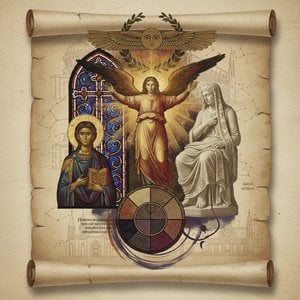
Explore the profound impact of spiritual themes in fine art. From Renaissance iconography to Baroque drama, discover how sacred symbolism and divine visions have shaped art history through a scholarly and reflective lens.

Journey through history with 10 breathtaking masterpieces of saints. From Renaissance grace to Baroque drama, explore the stories behind these iconic works. Find museum-quality art reproductions and curated decor inspiration at WahooArt.com. Discover all masterpieces online.

Immerse yourself in the sacred grandeur of Baroque church interiors. Explore museum-quality, hand-painted oil reproductions and bespoke religious art commissions. From breathtaking frescoes to dramatic altarpieces, we bring historical majesty to your luxury space with unmatched expertise.

Explore the profound power of religious symbolism in art history. From Renaissance masterpieces to sacred iconography, uncover the hidden meanings behind divine details in a deep dive into classical art excellence.

 Preview
 Send
Send Share
Share
 Details
 Guide
Guide

 Download
 Similars
 X-Ray
X-Ray Diaporama
 Stats
Stats Read More









 Glass option is only available in size under 110 CM


