Preview AR preview Buy Hand Made Painting Switch to Digital Image Send
Details Guide Add to favorites Download Similars X-Ray Diaporama Stats

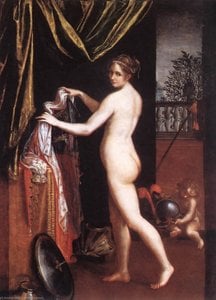
Lucretia

Lucas Cranach's "Lucretia" portrays Lucretia’s courageous act of suicide to protect her honor after Tarquin’s attempted rape, embodying Renaissance ideals of virtue and masterful chiaroscuro technique.

Explore the captivating world of Lucas Cranach the Elder, a pivotal German Renaissance master known for his portraits, Reformation art, and mythological scenes. Discover his legacy!

Giclée / Art Print

Museum-quality giclée or canvas print with fast production and flexible finish options. ( Buy Hand Made Painting Switch to Digital Image)

Corner sample of the P118B picture frame: moulded polystyrene, 5 cm wide and 3 cm thick
P118B $10
Corner sample of the P118H picture frame: moulded polystyrene, 5 cm wide and 3 cm thick
P118H $10
Corner sample of the P118W picture frame: moulded polystyrene, 5 cm wide and 3 cm thick
P118W $10
Corner sample of the P438Z picture frame: moulded polystyrene, 5.5 cm wide and 3.5 cm thick
P438Z $10
Corner sample of the P508JH picture frame: moulded polystyrene, 7 cm wide and 3.5 cm thick
P508JH $12
Corner sample of the P508YH picture frame: moulded polystyrene, 7 cm wide and 3.5 cm thick
P508YH $12
Corner sample of the P805H picture frame: moulded polystyrene, 5 cm wide and 3.5 cm thick
P805H $10
Corner sample of the P805Z picture frame: moulded polystyrene, 5 cm wide and 3.5 cm thick
P805Z $10
Corner sample of the P919BZ picture frame: moulded polystyrene, 7 cm wide and 3.5 cm thick
P919BZ $10
Corner sample of the P919G picture frame: moulded polystyrene, 7 cm wide and 3.5 cm thick
P919G $10
Corner sample of the P919XJ picture frame: moulded polystyrene, 7 cm wide and 3.5 cm thick
P919XJ $10
Corner sample of the P959ZH picture frame: moulded polystyrene, 5 cm wide and 3 cm thick
P959ZH $10
Corner sample of the P968JZ picture frame: moulded polystyrene, 6 cm wide and 4 cm thick
P968JZ $12
Corner sample of the W106C picture frame: solid wood, 5 cm wide and 3 cm thick
W106C $8
Corner sample of the W218G picture frame: solid wood, 5 cm wide and 3 cm thick
W218G $10
Corner sample of the W218JH picture frame: solid wood, 5 cm wide and 3 cm thick
W218JH $8
Corner sample of the W218Y picture frame: solid wood, 5 cm wide and 3 cm thick
W218Y $10
Corner sample of the W307PJ picture frame: solid wood, 6 cm wide and 3 cm thick
W307PJ $10
Corner sample of the W316G picture frame: solid wood, 6 cm wide and 3 cm thick
W316G $10
Corner sample of the W316PJ picture frame: solid wood, 6 cm wide and 3 cm thick
W316PJ $8
Corner sample of the W316Y picture frame: solid wood, 6 cm wide and 3 cm thick
W316Y $10
Corner sample of the W398PJ picture frame: solid wood, 5 cm wide and 3 cm thick
W398PJ $8
Corner sample of the W4111J picture frame: solid wood, 6.5 cm wide and 3.5 cm thick
W4111J $10
Corner sample of the W500HY picture frame: solid wood, 7 cm wide and 5 cm thick
W500HY $15
Corner sample of the W500JH picture frame: solid wood, 7 cm wide and 5 cm thick
W500JH $15
Corner sample of the W692G picture frame: solid wood, 8 cm wide and 4 cm thick
W692G $12
Corner sample of the W849H picture frame: solid wood, 5 cm wide and 3 cm thick
W849H $8
Corner sample of the W940BG picture frame: solid wood, 7.5 cm wide and 4.5 cm thick
W940BG $15
Corner sample of the W953PJ picture frame: solid wood, 6 cm wide and 3.5 cm thick
W953PJ $8

Standard
custom
CM
INCH

Pick from our preset sizes that match the artwork's original proportions.

width
height

Type the width and the height you need, to fit your frame or your wall. A print can only be cut, never made bigger than the picture, so a size with a different shape loses a part of the image. We send you a digital mockup to approve before we print anything. The picture shown on this page does not show the real cut — only the mockup does.

Worldwide Delivery () in 2 weeks instead of standard 4/5 weeks. (27 October)

Free Worldwide Express Shipping
High-Quality Linen Canvas
Full Shipping Insurance
Customs Tax Refund Guarantee
True Color Matching Guarantee
100-Day Return Policy (Defects Only)
100% Money-Back Guarantee
Bulk Discount Offer

Total Price

$ 69

Lucretia

Giclée / Art Print

Reproduction Size

-

Total Price

$ 69

Quick Facts

  • Influences: South German Masters
  • Notable elements or techniques: Psychological depth, Technical precision
  • Artist: Lucas Cranach the Elder
  • Artistic style: Elegant
  • Movement: German Renaissance

Art Quiz

There is only one correct answer for each question.

Question 1:
What is the title of this painting?
Question 2:
Who painted Lucretia?
Question 3:
Where can you find this painting?
Question 4:
What medium was used to create Lucretia?
Question 5:
Lucretia is a significant figure in Roman mythology and history. What event is depicted?

A Renaissance Portrait of Virtue and Tragedy

Lucas Cranach the Elder’s “Lucretia” stands as a cornerstone of German Renaissance art, embodying both exquisite craftsmanship and profound psychological insight. Painted around 1504 for Frederick III, Elector of Saxony—a patron deeply invested in humanist ideals—the artwork transcends mere visual representation to delve into themes of virtue, honor, and the devastating consequences of betrayal. The painting depicts Lucretia, wife of Sextus Tarquinius Superbus, Rome’s tyrannical king. Following a scandalous affair between Sextus and Lucretia's younger sister, Julia, Lucretia bravely took her own life to protect her honor after Sextus attempted to rape Julia.

Cranach meticulously captures the moment of Lucretia’s suicide—a woman draped in white linen, clutching a dagger—creating an image that is simultaneously serene and fraught with sorrow. The artist's masterful technique exemplifies the prevailing artistic sensibilities of his time. Executed on oak panel using oil paint, he employs chiaroscuro – dramatic contrasts between light and dark – to sculpt Lucretia’s form and imbue the scene with palpable emotion. The subtle shading highlights the delicate musculature of her torso and emphasizes the vulnerability conveyed by her gaze. Cranach's meticulous attention to detail extends beyond anatomy; he renders the drapery with remarkable realism, capturing folds and textures that contribute significantly to the painting’s overall atmosphere.

Beyond its technical brilliance, “Lucretia” resonates deeply with mythological symbolism rooted in Roman legend. Lucretia herself is a figure from Virgil's Aeneid, representing chastity and virtue—qualities deemed paramount by Renaissance humanists. The dagger symbolizes sacrifice and defiance against oppression, reflecting the moral dilemma faced by Lucretia as she chose honor over survival. The painting’s emotional impact remains powerfully felt centuries later. Cranach's portrayal of grief is understated yet profound, conveying a sense of tragic beauty that speaks to universal human experiences. “Lucretia” serves not merely as a depiction of an historical event but as a meditation on the enduring importance of moral integrity and the devastating repercussions of injustice.

Artwork Description

Visual Details

The painting depicts a woman holding a sword in her hand. She appears to be wearing a necklace around her neck and is draped in white linen. The artwork is an oil on panel painting.

Provenance and Location

  • Artist: Lucas Cranach the Elder
  • Year Painted: 1504
  • Location: Museo de Bellas Artes de Bilbao (Bilbao, Spain)

Questions & Answers

Why is the copyright status of "Lucretia" what it is?

"Lucretia" by Lucas Cranach the Elder is in the public domain - its copyright has expired. Copyright duration runs from the artist's death, which occurred in 1553.

What mood and emotion does "Lucretia" by Lucas Cranach the Elder express?

"Lucretia" by Lucas Cranach the Elder conveys a calm feeling within an overall elegant mood.

What is the emotional tone of "Lucretia" by Lucas Cranach the Elder?

The emotional tone recorded for "Lucretia" by Lucas Cranach the Elder is calm. It summarizes the feeling the work expresses.


Artist Biography

A Renaissance Master of Saxony: The Life and Art of Lucas Cranach the Elder

Lucas Cranach the Elder, born in Kronach, Germany around 1472, stands as a pivotal figure of the German Renaissance. His life unfolded during a period of immense religious and political upheaval, and his art became inextricably linked to both the burgeoning Protestant Reformation and the opulent courts he served. Initially trained by his father, Hans Maler, Cranach’s early artistic development remains somewhat shrouded in mystery, though influences from South German masters are evident in his evolving style. He quickly distinguished himself not merely as a skilled craftsman but as an artist capable of capturing psychological depth alongside technical precision – qualities that would soon draw the attention of powerful patrons. In 1504, he entered the service of Frederick III, Elector of Saxony, a relationship that would define much of his career and provide him with both stability and access to influential circles. This appointment as court painter in Wittenberg wasn’t simply about producing decorative works; it placed Cranach at the very heart of one of the most transformative movements in European history.

Patronage, Reformation, and Artistic Innovation

Cranach's position within the Saxon court proved crucial not only for his livelihood but also for his artistic development. He wasn’t merely documenting events; he was actively shaping visual narratives during a time of profound change. His most enduring legacy is arguably his close association with Martin Luther, the central figure of the Protestant Reformation. Cranach created no fewer than eleven portraits of Luther, each offering a unique glimpse into the reformer's personality and evolving role. These weren’t simply likenesses; they were carefully constructed images designed to project authority, piety, and intellectual strength – essential qualities for a leader challenging the established religious order. Beyond portraiture, Cranach translated Reformation theology into visual form, producing woodcuts and paintings that disseminated Protestant ideas widely. His depictions of biblical scenes moved away from traditional Catholic iconography, emphasizing direct engagement with scripture and fostering a more personal relationship between the viewer and faith. The Annunciation to Joachim, for example, radiates a joyful spirit, reflecting the new emphasis on individual piety within the reformed church. This innovative approach extended beyond religious subjects; Cranach’s mythological paintings, such as depictions of Venus and other classical figures, often carried allegorical meanings relevant to contemporary political and social issues.

A Workshop Dynasty: Style and Technique

Lucas Cranach the Elder was not a solitary artist working in isolation. He ran a remarkably productive workshop, employing numerous assistants and apprentices who contributed significantly to his output. This collaborative approach meant that many works attributed to Cranach were actually produced under his direction or by members of his circle – including his son, Lucas Cranach the Younger. The Cranach workshop became known for its distinctive style: elegant figures with elongated proportions, vibrant colors, and meticulous attention to detail. His technique involved a combination of oil painting, woodcut, and engraving, allowing him to reach a broad audience through both original artworks and affordable prints. Stag Hunt of Elector Friedrich III the Wise, exemplifies his mastery of Northern Renaissance style, showcasing detailed realism alongside noble symbolism. The composition is dynamic, capturing the energy of the hunt while simultaneously conveying the power and status of the elector. Cranach’s use of light and shadow creates a sense of depth and atmosphere, drawing the viewer into the scene. His portraits are equally compelling, characterized by their psychological insight and refined execution.

Legacy and Enduring Influence

Lucas Cranach the Elder died in 1553, leaving behind an extraordinary artistic legacy that continues to resonate today. He was a master of portraiture, a skilled interpreter of religious themes, and a shrewd businessman who understood the power of visual communication. His work not only reflects the cultural and intellectual currents of his time but also helped shape them. The Cranach workshop continued to flourish after his death, ensuring that his style and techniques were perpetuated for generations. His influence can be seen in the works of numerous subsequent artists, and his paintings remain highly sought-after by collectors and museums worldwide. From the iconic portraits of Martin Luther to the captivating mythological scenes, Cranach’s art offers a fascinating window into the world of the German Renaissance – a world marked by both profound spiritual questioning and artistic innovation. His ability to blend religious fervor, political savvy, and artistic talent cemented his place as one of the most important artists of his era, and his contributions continue to inspire and captivate audiences centuries later.
Lucas Cranach the Elder

Lucas Cranach the Elder

1472 - 1553 , Germany

Quick Facts

  • Artistic Movement Or Style: German Renaissance
  • Date Of Birth: 1472
  • Date Of Death: 1553
  • Full Name: Lucas Cranach the Elder
  • Nationality: German
  • Notable Artworks:
    • Stag Hunt
    • Self-Portrait
    • Annunciation to Joachim
    • Adam and Eve
    • Judith with Holofernes
  • Place Of Birth: Kronach, Germany
Explore artworks organized by themes, styles, and characteristics.