

 Traditional Chinese Art
 126.0 x 24.0 cm
The artwork displayed on this page is protected by copyright law, which means we cannot legally create or sell an identical reproduction. This protection is enforced under international agreements such as the Berne Convention and by national laws, including those outlined by the U.S. Copyright Law - Title 17.
As a respectful and legal alternative, we offer custom, hand-painted artworks inspired by the original. Our skilled and professional artists carefully study the original's style, mood, and artistic essence to create a new, unique piece that evokes the same feeling - while remaining an original creation in its own right.
This method fully complies with copyright regulations because it does not involve copying or duplicating the protected artwork. Instead, it is a creative reinterpretation - a new painting that is influenced by the original but not identical to it.
Hand-painted oil on canvas in your size and frame, made to order by our artists. ( Switch to Print Switch to Digital Image)





























Pick from our preset sizes that match the artwork's original proportions.

Type the width and the height you need, to fit your frame or your wall. This is hand-painted, so for a size with a different shape the artist can paint a bit more around the picture, or cut a bit — you choose. We send you a digital mockup to approve before the painting starts. The picture shown on this page does not show the real result — only the mockup does.
Worldwide Delivery () in 3/4 weeks instead of standard 5 weeks. (26 October). No compromise on quality.
CALLIGRAPHY COUPLET IN REGULAR SCRIPT
Reproduction Size

Lu Runxiang (陸潤庠), born in Suzhou, Jiangsu province, during the late Qing Dynasty (1841-1915), stands as a significant figure in Chinese calligraphy, particularly renowned for his masterful execution of running script (行書) and kaishu script (楷書). While often operating under the pseudonym Feng Shi (楓石), he was a man of considerable scholarly achievement, holding prestigious positions within the imperial court – including serving as tutor to Puyi, the last emperor of China. His work transcends mere aesthetic beauty; it’s imbued with the spirit of his era and reflects a deep understanding of traditional Chinese philosophy and artistic principles.
Lu's early life was marked by academic excellence. He excelled in the imperial examinations, achieving the highest rank – ‘zhuangyuan’ – in 1874. This remarkable accomplishment opened doors to a distinguished career within the Qing bureaucracy. His administrative roles, including positions as libationer of the Imperial Academy and president of the Censorate, provided him with valuable insights into the workings of government and society, experiences that subtly informed his artistic perspective. However, it was his dedication to calligraphy that truly defined his legacy. He embraced the ‘tiexue’ (帖學) tradition – a rigorous study of classical calligraphic models established by Wang Xizhi – as the foundation for his own style.
Lu Runxiang's calligraphy is characterized by a remarkable balance between technical precision and expressive fluidity. His kaishu script, in particular, demonstrates an exceptional command of form – the precise strokes, balanced proportions, and unwavering verticality are hallmarks of this traditional style. Yet, it’s within his running script that he truly shines. Running script, with its dynamic brushwork and relaxed execution, allows for a greater degree of personal expression. Lu masterfully harnessed this freedom, imbuing each character with a sense of movement and vitality.
His works frequently incorporate couplets – paired verses designed to evoke specific emotions or philosophical ideas. These couplets, often inscribed on hanging scrolls, are not merely decorative; they represent a sophisticated form of communication, blending poetry, calligraphy, and visual aesthetics. The choice of script, the arrangement of characters, and the overall composition all contribute to the intended meaning and impact. A key element in Lu’s style is his deliberate use of aged paper, often simulating the appearance of antique scrolls – a technique that adds layers of historical resonance and enhances the sense of timelessness.
Lu Runxiang's artistic development was shaped by several influential factors. The late Qing Dynasty witnessed a revival of interest in classical Chinese art and philosophy, fueled by a desire to reconnect with traditional values amidst rapid social and political change. The concept of ‘fengxue’ (風學), or “wind learning,” emerged as a counterpoint to the rigid formalism of earlier artistic movements, emphasizing spontaneity, naturalness, and individual expression. Lu's calligraphy reflects this shift towards greater freedom and personal interpretation.
Furthermore, his exposure to Confucian scholarship – particularly the teachings of Wang Xizhi and other classical masters – provided him with a deep understanding of aesthetic principles and compositional techniques. His work is often seen as a synthesis of these influences, blending technical mastery with a profound appreciation for the philosophical underpinnings of Chinese art.
Several of Lu Runxiang’s works have achieved significant recognition within the art world. The ‘Calligraphy Couplet in Regular Script,’ currently held by WahooArt.com, exemplifies his skill and artistic vision. The aged paper and intricate script details evoke a sense of timeless beauty and historical depth. His auction records demonstrate consistent demand for his pieces, reflecting their enduring appeal to collectors and connoisseurs alike.
Lu Runxiang’s legacy extends beyond the individual works he created. He represents a pivotal figure in the development of Chinese calligraphy during a period of profound transformation. His dedication to ‘tiexue,’ combined with his embrace of running script, established him as a master of both tradition and innovation – an artist whose work continues to inspire and captivate audiences today. His influence can be seen in subsequent generations of calligraphers who sought to emulate his technical skill and expressive power.
To delve deeper into the world of Lu Runxiang’s calligraphy, we encourage you to explore the resources available on WahooArt.com, particularly the ‘Calligraphy Couplet in Regular Script’ artwork page (https://www.wahooeart.com/en/art/lu-runxiang-calligraphy-couplet-in-regular-script-AQZEX6-en/) and the artist’s profile page (https://www.wahooeart.com/en/artists/lu-runxiang-en/). Additionally, resources such as the SoWAs auction house website (https://en.sowas-group.com/auctions/artist/36) and Wikidata (https://www.wikidata.org/wiki/Q15945757) offer valuable insights into his life, career, and artistic output.
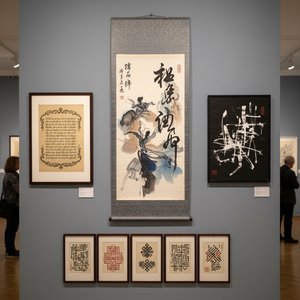
Explore the profound beauty of calligraphy art. From the fluid running script of Chinese masters to historical ink masterpieces, discover how the elegance of line transforms spaces with timeless grace and scholarly sophistication.
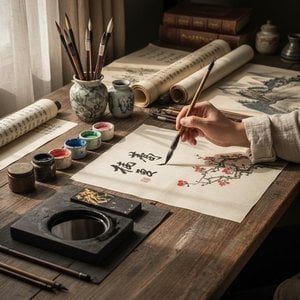
Embark on a sophisticated exploration of ink wash painting and Sumi-e. Uncover the profound historical lineages, Zen philosophies, and technical mastery behind this timeless medium in our authoritative guide for fine art enthusiasts.

Embark on a profound journey through the soul of Chinese calligraphy. Explore the historical mastery of ink, brush, and script, from ancient Zhuanshu to elegant running script, and discover how this timeless art form reflects the enduring spirit of classical East Asian aesthetics.

 Preview
 Send
Send Share
Share
 Details
 Guide
Guide

 Download
 Similars
 X-Ray
X-Ray Diaporama
 Stats
Stats Read More









 Glass option is only available in size under 110 CM


