

 Acrylic On CanvasWallArtExpressionism
 1915
1915 95.0 x 72.0 cm
 Niedersächsisches Landesmuseum Für Kunst Und Kulturgeschichte Oldenburg
Hand-painted oil on canvas in your size and frame, made to order by our artists. ( Switch to Print Switch to Digital Image)





























Pick from our preset sizes that match the artwork's original proportions.

You may enter your own dimensions to fit a specific frame or space. If your selected size does not match the original image's proportions, we will either crop the artwork or extend the painting with additional hand-painted elements. A digital mockup will be sent for your approval before production begins.
Please note that the on-screen preview does not reflect the actual cropping or extension. Only the mockup will accurately show the final composition.
While custom sizes are available, we recommend selecting a dimension from the predefined list to preserve the original proportions.
Worldwide Delivery () in 3/4 weeks instead of standard 5 weeks. (16 September). No compromise on quality.


Wilhelmine with a Ball
Reproduction Size
Lovis Corinth’s “Wilhelmine with a Ball,” painted in 1915, stands as a poignant emblem of early 20th-century expressionism – an artistic movement driven by a fervent desire to convey inner psychological states rather than merely mirroring external reality. More than just a depiction of a young girl seated elegantly in a chair, the painting delves into themes of vulnerability and introspection, capturing a moment suspended between youthful innocence and the subtle anxieties inherent in navigating social conventions.
The painting’s composition is meticulously crafted to draw attention to Wilhelmine—the central figure—who occupies a slightly off-center position within the frame. A large window dominates the background, rendered in shades of gray and indistinctness; this deliberate blurring serves not only as visual texture but also symbolically represents the limitations of perception and the elusive nature of truth. Corinth skillfully utilizes lines – primarily gestural marks – to guide the viewer’s eye across the canvas, creating a dynamic interplay between form and space.
Corinth imbues “Wilhelmine” with layers of symbolic meaning. The girl's hat—a prominent feature of the portrait—functions as a visual shorthand for vulnerability and innocence, reflecting Corinth’s fascination with portraying psychological states through carefully chosen objects. Similarly, the subdued color palette contributes to the painting’s emotional impact, conveying a sense of quiet sadness and contemplative reflection. Corinth’s masterful use of light – diffused and natural – casts soft shadows that illuminate Wilhelmine's face and form, enhancing her expressive gaze.
Ultimately, “Wilhelmine with a Ball” transcends mere visual representation; it aspires to evoke an emotional response in the viewer. Corinth’s artistic intention was not to depict Wilhelmine as she appeared but rather to convey her inner world—her anxieties, her dreams, and her unspoken emotions. The painting's enduring power lies in its ability to resonate with audiences across generations, reminding us that art can serve as a conduit for profound psychological insight.


1858 - 1925 , Netherlands

Delve into the visceral world of German Expressionism. Explore the history, key artists like Kirchner and Kandinsky, and the movement's profound emotional impact through an expert art-history lens. Discover how bold colors and distortion redefined modern aesthetics.

Explore the profound emotional depth of Expressionist painting. From the bold colors of Emil Nolde to the distorted forms of Kirchner, discover how this movement redefined art through raw feeling and visceral texture in our expert guide to art history.
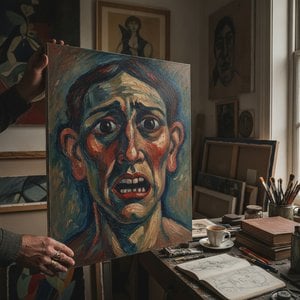
Discover the profound power of Expressionist art. From the raw intensity of Edvard Munch to the visceral textures of Neo-Expressionism, explore how subjective emotion and distorted reality define this movement. An expert guide for discerning collectors seeking depth and soul in fine art.

Explore the profound psychological depth of Expressionist portraiture. From Munch to Schiele, discover how distorted forms and visceral brushstrokes unmask raw human emotion in this definitive guide for art enthusiasts and collectors.

Explore the raw emotion of German Expressionism through a definitive guide to Ernst Ludwig Kirchner. Discover how his bold colors and distorted forms redefined modern art history, from Berlin street scenes to iconic masterpieces.

 Preview
 Send
Send Share
Share
 Details

 Download
 Similars
 X-Ray
X-Ray Diaporama
 Stats
Stats Read More







 Glass option is only available in size under 110 CM


