

Museum-quality giclée or canvas print with fast production and flexible finish options. ( Buy Hand Made Painting Switch to Digital Image)





























Pick from our preset sizes that match the artwork's original proportions.

You may enter your own dimensions to fit a specific frame or space. If your selected size does not match the original image's proportions, we will either crop the artwork or extend the image with a mirrored or solid-fill edge. A digital mockup will be sent for your approval before production begins.
Please note that the on-screen preview does not reflect the actual cropping or extension. Only the mockup will accurately show the final composition.
While custom sizes are available, we recommend selecting a dimension from the predefined list to preserve the original proportions.
Worldwide Delivery () in 2 weeks instead of standard 4/5 weeks. (22 September)


Scène de cabaret
Reproduction Size
In the heart of early 19th-century Paris, amidst the shifting political tides between the reign of Louis XVI and the rise of Napoleon Bonaparte, there existed a world of shared laughter, whispered secrets, and communal revelry. Louis Léopold Boilly’s “Scène de cabaret” serves as a masterful time capsule, capturing this ephemeral energy with the precision of a photographer and the soul of a poet. The painting invites us into a bustling tavern, where the boundaries between social classes seem to blur under the warmth of shared companionship. As we gaze upon the crowded composition, we are not merely observers of a distant historical moment; we are participants in a lively gathering, drawn into the rhythmic pulse of a society finding joy in the simple act of togetherness.
The subject matter is a quintessential example of genre painting, focusing on the unvarnished beauty of everyday life. Boilly meticulously populates the cabaret with figures engaged in the timeless rituals of socialization—sipping wine, leaning into intimate conversations, and navigating the lively movement of a public space. This microcosm of bourgeois society offers a profound sense of intimacy, making it an ideal centerpiece for those looking to bring a sense of lived-in history and warmth to a sophisticated interior.
Technically, “Scène de cabaret” is a triumph of the École de peinture française Realism. Boilly’s approach eschews the idealized grandeur of Romanticism in favor of an unflinching, tactile accuracy. Through the careful layering of oil paints on canvas, he achieves a remarkable textural depth that rewards close inspection. One can almost feel the rough weave of a woolen waistcoat, the cool smoothness of a polished wooden table, and the delicate crispness of white linen collars. This commitment to detail is supported by a sophisticated use of linear perspective, which guides the viewer’s eye through the dense crowd, creating an immersive sense of three-dimensional space.
The color palette is intentionally restrained, relying on a harmonious arrangement of muted earth tones—rich browns, soft beiges, creamy whites, and subtle grays. This sophisticated, neutral scheme allows the nuances of light and shadow to take center stage. The lighting within the scene feels natural and diffused, as if filtered through a high tavern window, casting a gentle glow that avoids harsh shadows and instead bathes the subjects in an even, inviting light. For the discerning collector or interior designer, this balanced palette offers incredible versatility, complementing both classical and contemporary decor with its understated elegance.
Beyond its technical brilliance, the painting resonates with a deep emotional intelligence. There is a palpable sense of conviviality—a celebration of the human spirit that remains universally relatable across centuries. The composition, while crowded, maintains a sense of stability through its horizontal format, yet it vibrates with an underlying dynamism. Every figure contributes to a larger narrative of connection and shared experience, making the artwork feel less like a static image and more like a captured breath of life.
To possess a reproduction of this work is to bring more than just paint and canvas into a home; it is to invite an atmosphere of cultured nostalgia and spirited warmth. Whether placed in a grand library or a cozy dining nook, “Scène de cabaret” acts as a conversation starter, evoking the charm of old Paris and the enduring beauty of the human connection. It remains a timeless tribute to the art of living well.


1761 - 1845 , France

Journey through the soul of Contemporary Realism. Explore 10 iconic masterpieces, uncovering the stories and techniques behind these lifelike triumphs. Find inspiration for your decor with museum-quality art reproductions. Discover all masterpieces on WahooArt.com.
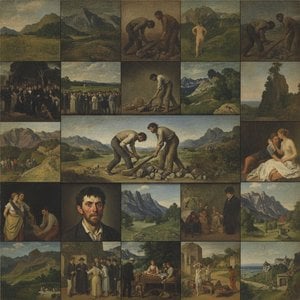
Immerse yourself in the raw power of Realism with our curated guide to the top 25 Gustave Courbet masterpieces. From iconic landscapes to profound social portraits, explore the stories behind these timeless works and find museum-quality reproductions. Discover all masterpieces on WahooArt.com

 Preview
 Send
Send Share
Share
 Details
 Guide
Guide

 Download
 Similars
 X-Ray
X-Ray Diaporama
 Stats
Stats


 Read More







 Glass option is only available in size under 110 CM


