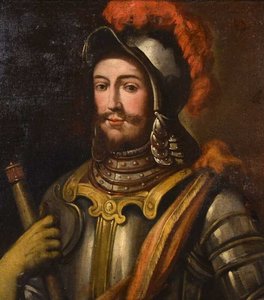
The Divine Brush of the Lombard Master
In the twilight of the twelfth century, a period defined by the profound intersection of theological inquiry and burgeoning artistic expression, there emerged a figure whose work would bridge the gap between the rigid structures of the late Gothic era and the soft elegance of the early Renaissance. Known to history as the Lombard Master, or Peter Lombard, this Italian painter and theologian possessed a rare duality of spirit. Born in Novara, Italy, around 1096, his life was a tapestry woven from the intellectual rigor of the cathedral schools and the luminous devotion of sacred iconography. His journey took him from the humble beginnings of a poor family to the prestigious halls of Paris, where he studied under the legendary shadows of Peter Abelard and Hugh of St. Victor, absorbing a level of scholastic depth that would forever inform the spiritual weight of his brushstrokes.
The artistry of the Lombard Master is characterized by an ethereal grace that seems to transcend the physical limitations of medieval medium. His technique is most celebrated for its use of uniform gold grounds, a technique that creates a sense of timeless, divine space, stripping away the distractions of the earthly realm to focus the viewer's soul on the sacred. Within these shimmering golden voids, he placed figures of remarkable elegance—slender, elongated forms that possess a rhythmic fluidity. This stylistic choice reflects a pivotal moment in art history, where the stiff, symbolic representations of the early Middle Ages began to yield to a more humanized, graceful aesthetic that would eventually blossom into the Renaissance.
Sacred Iconography and Lasting Legacy
The works surviving from the Lombard Master’s hand serve as windows into a world where theology and visual beauty were inseparable. His ability to imbue even the smallest panel with profound narrative power is evident in his most cherished pieces. One might contemplate the delicate tension found in Cleopatra / Eurydice, where a slender, near-naked female figure stands before a parapet, a composition that showcases his mastery of form and the subtle interplay between light and shadow. His devotion to the saints is equally palpable in works such as Saint Anthony Abbot and the Saint Martyr Deacon Panel. These smaller, intimate pieces, often measuring approximately 17 x 52 cm, demonstrate how he could command a limited space to evoke an immense sense of piety and presence.
Beyond his individual paintings, the historical significance of the Lombard Master lies in his role as a bridge between eras and disciplines. As a subdeacon and later a priest, his theological authority allowed him to infuse his art with a deep, doctrinal meaning that resonated throughout the medieval art world. He was not merely a creator of images but an influential teacher whose pedagogical reach extended to both artists and theologians, shaping the intellectual landscape of his time. Today, his legacy is preserved in prestigious institutions such as the Museo Poldi Pezzoli in Milan, where his golden compositions continue to inspire awe, reminding us of a period when the pursuit of divine truth was expressed through the most exquisite mastery of paint and gold.



 Preview
 Buy print
 Send
Send Share
Share
 Details

 Download
 Similars
 X-Ray
X-Ray Diaporama

 Read More






































 Glass option is only available in size under 110 CM