


Get a print-ready file that goes far beyond the web preview. Every digital image we sell comes from a high-resolution master in our stock database — usually 5,000 to 15,000 pixels wide — so you can print large, crop tightly, or reproduce fine detail with confidence.
No file leaves our studio untouched. A digital expert checks the colors against the original painting and corrects them if needed, then improves clarity and detail with professional retouching tools — always staying faithful to the artist's brushwork and style. The result is an image that looks like the painting, not like a filtered scan.
You approve before you're done: our expert sends the image by e-mail within 72 hours for your review. Not satisfied? Ask for improvements or corrections, or request a refund if the quality falls short.
This is the quality relied on by publishers, design studios, galleries and print shops.
Download a high-resolution file for personal display, printing, and creative projects. ( Switch to Print Buy Hand Made Painting)
When you choose WahooArt.com, you're not just getting an image - you're receiving a professionally enhanced digital artwork, crafted with precision and backed by a satisfaction guarantee. Here's everything that comes with your order, automatically:
Your high-resolution digital image file will be emailed to you within 72 hours of ordering - ready for immediate use.
Your artwork is professionally optimized using advanced AI tools and manual editing, ensuring maximum detail, clarity, and color accuracy.
Accidentally deleted or lost your file? No worries - we'll resend it to you anytime, free of charge.
Enjoy your artwork instantly with zero customs, duties, or delivery fees - digital downloads are always tax-free.
We ensure your digital image reflects the original colors as closely as possible using professional tools and color management.
If you're not satisfied with your digital image, we'll revise it or refund 100% within 100 days - no questions asked.
Not satisfied? Get a full refund within 100 days of receiving your digital file - no questions asked.
Buy 3 images, save 10% - Buy 5, save 15% - Buy 10+, save 20%. Great for creative projects, galleries, and agencies.
To encounter Leonardo da Vinci's Study for the Last Supper is to step directly into the workshop of a genius, witnessing the raw, electric moment before a masterpiece was solidified. Created around 1494, this profound preparatory work serves as much more than a mere sketch; it is a window into the psychological architecture of the High Renaissance. While the final mural in Milan captures the monumental scale of the event, this study offers an intimate, almost whispered meditation on faith and human frailty. It captures the precise instant where the divine intersects with the mortal, as Leonardo meticulously maps out the complex web of emotions that would soon define one of history's most iconic compositions.
The subject matter is deeply rooted in the Christian tradition, depicting the pivotal moment of the Passover meal where Jesus Christ reveals his impending betrayal. However, through Leonardo’s eyes, the scene transcends simple religious iconography. He focuses intensely on the humanity of the apostles—their startled gestures, their furrowed brows, and the palpable tension that ripples through the group. It is a study of motion and reaction, an attempt to freeze the very essence of shock and devotion within a single, unified frame.
Technically, this work showcases Leonardo’s unparalleled command over sfumato, his signature technique of soft, smoky transitions. Rather than relying on harsh, definitive outlines, the artist employs subtle gradations of tone to blur the boundaries between figures and their environment. This creates an ethereal, dreamlike atmosphere where light seems to emerge from within the subjects themselves. The delicate application of medium—often involving pen, ink, and subtle washes—allows for a depth of shadow that gives the composition a sculptural, three-dimensional quality.
For the discerning collector or interior designer, the aesthetic value of this study lies in its sophisticated use of chiaroscuro. The interplay between light and dark does not merely provide structure; it directs the viewer's eye through the narrative, pulling attention to the central figure of Christ while allowing the peripheral apostles to recede into a mysterious, atmospheric gloom. This technique lends the piece an enduring elegance that complements both classical and contemporary spaces, offering a sense of profound intellectual depth.
The historical context of this study is inseparable from the spirit of the uomo universale—the universal man. Working under the patronage of Ludovico Sforza in Milan, Leonardo was simultaneously a scientist, an engineer, and an artist. This duality is evident in the meticulous attention to anatomical accuracy and spatial perspective found within the sketch. Every hand gesture and facial expression is calculated with scientific precision to evoke a specific emotional response, making the work a triumph of both observation and imagination.
Owning a high-quality reproduction of this study allows one to bring a piece of the Renaissance soul into a modern setting. It is an invitation to contemplate the complexities of human interaction and the eternal search for meaning. Whether placed in a quiet study, a grand gallery, or a curated living space, this artwork serves as a powerful focal point, inspiring awe through its historical weight and captivating all who linger before its enigmatic, shadowed beauty.
The dominant color of "Study for the Last Supper" by Leonardo da Vinci is white (#eee5e1).
A preview of "Study for the Last Supper" by Leonardo da Vinci is available on the artwork's Preview page.
Leonardo da Vinci used the oil technique for "Study for the Last Supper". The technique defines the material nature of the original work.
Leonardo da Vinci was born on 15 April 1452 near the small Tuscan village of Anchiano. He was the illegitimate son of Piero da Vinci and Caterina di Meo Lippi. His early years were spent in this rural setting, far from the busy streets of the larger cities. This beginning shaped the way he would later observe the natural world.
At fourteen, he entered the workshop of Andrea del Verrocchio in Florence. This apprenticeship provided the foundation for his ability to capture the human form. In the studio, he learned the discipline of drawing and the mechanics of sculpture. He absorbed the methods of his teacher, working alongside others who sought to master the physical reality of the world. These formative years in Florence established the technical grounding he would carry into his later life.
Leonardo spent much of his time in Milan, working in the service of Ludovico Sforza. His presence in the city was part of a career that saw him moving between Milan, Florence, and a brief period in Rome. In the Sforza court, his work took on a different weight, moving between the demands of a patron and his own restless investigations. He did not stay in one place, shifting his focus as the needs of his patrons and his own interests changed.
Between 1495 and 1498, he painted The Last Supper. This work is located in the refectory of the Convent of Santa Maria delle Grazie in Milan, Italy. He chose to use an oil-based paint mixed with mastic, a resin intended to allow for slow, layered adjustments. This choice was an experiment in how color and light might be handled differently than with traditional fresco, though the technique proved difficult to maintain over time.
His early work shows a developing hand, such as the Portrait of Ginevra de' Benci from 1474. By 1478, the Annunciation was finished, showing a careful eye for the Tuscan landscape. He moved toward more complex compositions with the Adoration of the Magi in about 1481. Later, the Virgin of the Rocks was worked on between about 1483 and 1486, a piece that highlights his interest in how light and shadow interact with stone and skin.
The 1490s brought the Lady with an Ermine, where he captured a specific, quiet moment. His work in Milan led to the creation of The Last Supper, a large mural in the refectory of the Convent of Santa Maria delle Grazie. In 1503, he began the Mona Lisa, a portrait that has become one of his most recognized subjects. His output also included the Salvator Mundi, though the question of whether he painted it remains a subject of debate among scholars.
Leonardo’s hand moved with a specific intent, seeking to dissolve the hard edges of the world. He pioneered sfumato, a method of applying thin, translucent glazes to create smoky, seamless transitions between light and shadow. This technique allowed him to move away from harsh outlines, favoring subtle gradations of tone that mimic how the eye actually perceives form. He was a master of chiaroscuro, using the interplay of light and dark to sculpt figures and give them a sense of weight and presence. In his work, the boundary between a subject and the air surrounding it becomes blurred, creating an atmosphere that feels lived-in and soft.
His approach to depth relied heavily on atmospheric perspective. By observing how light scatters through the air, he could render distant landscapes with a pale, hazy quality that pulled the viewer's eye toward the horizon. This was not merely a visual trick but a result of his scientific inquiry into optics. He sought to marry aesthetic brilliance with a precise understanding of how light and shadow function in nature. This marriage of observation and application is visible in his handling of complex scenes, where every gesture is shaped by a deep knowledge of human anatomy and the way light falls upon a surface.
The way he applied his materials was often experimental. For The Last Supper, he chose to work with an oil-based paint mixed with mastic, a resin intended to allow for slow, careful layering. While this choice was meant to provide greater control over the drying process, it changed the way the paint interacted with the wall. His technical choices were often driven by a desire to capture the precise psychological tension of a moment, using the softness of his brushwork to mirror the complexity of human emotion.
Leonardo’s mind moved between the studio and the laboratory, rarely settling on a single discipline. He was a polymath of the High Renaissance, working as a painter, draughtsman, engineer, scientist, theorist, sculptor, and architect. His curiosity was not a series of separate interests but a single, continuous effort to understand how things function. This drive is most visible in his eleven surviving manuscripts of notes and drawings. These pages contain a vast range of observations, from the mechanics of flight to the way light hits a surface. He spent much of his time dissecting the world to see its hidden parts.
His notebooks reveal a man obsessed with the details of the natural world. He filled them with sketches and notes on anatomy, astronomy, botany, cartography, and palaeontology. He did not merely look at a leaf or a bone; he sought to map the logic behind its shape and growth. This habit of recording everything—from the flow of water to the structure of a muscle—shows a mind that treated every observation as a way to decode the universe. His drawings were often as much about scientific accuracy as they were about art.
Leonardo da Vinci helped shape the High Renaissance, leaving a mark on the way artists approached the canvas. His influence reached through the generations, affecting how painters understood the human form and the space it occupies. In many ways, the scale of his contribution to European art is matched only by the work of Michelangelo. He did not simply paint figures; he used religious iconography to weave complex narratives, changing how much emotion could be felt within a sacred scene. This shift allowed for a deeper psychological presence in art, where a gesture or a look could carry the weight of a story.
His approach to light and shadow, specifically the way colors blend without harsh borders, changed the visual language of his time. By observing how light moves across a surface, he moved away from the rigid lines of his predecessors. This method allowed for a sense of atmosphere that made his subjects feel as though they were breathing within a real, tangible environment. The way he handled the transition between light and dark helped define a new standard for realism in Western painting.
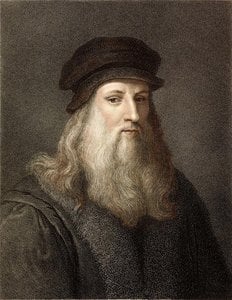
1452 - 1519 , Italy
 Preview
 Send
Send Share
Share
 Details
 Guide
Guide

 Download
 Similars
 X-Ray
X-Ray Diaporama
 Q&A
Q&A
 Stats
Stats


 Read More


