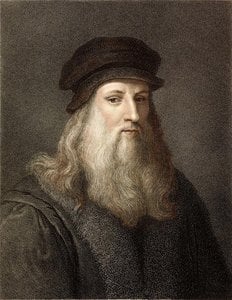
The Life and Early Training of Leonardo da Vinci
Leonardo da Vinci was born on 15 April 1452 near the small Tuscan village of Anchiano. He was the illegitimate son of Piero da Vinci and Caterina di Meo Lippi. His early years were spent in this rural setting, far from the busy streets of the larger cities. This beginning shaped the way he would later observe the natural world.
At fourteen, he entered the workshop of Andrea del Verrocchio in Florence. This apprenticeship provided the foundation for his ability to capture the human form. In the studio, he learned the discipline of drawing and the mechanics of sculpture. He absorbed the methods of his teacher, working alongside others who sought to master the physical reality of the world. These formative years in Florence established the technical grounding he would carry into his later life.
Activity in Milan and the Sforza Court
Leonardo spent much of his time in Milan, working in the service of Ludovico Sforza. His presence in the city was part of a career that saw him moving between Milan, Florence, and a brief period in Rome. In the Sforza court, his work took on a different weight, moving between the demands of a patron and his own restless investigations. He did not stay in one place, shifting his focus as the needs of his patrons and his own interests changed.
Between 1495 and 1498, he painted The Last Supper. This work is located in the refectory of the Convent of Santa Maria delle Grazie in Milan, Italy. He chose to use an oil-based paint mixed with mastic, a resin intended to allow for slow, layered adjustments. This choice was an experiment in how color and light might be handled differently than with traditional fresco, though the technique proved difficult to maintain over time.
- The Last Supper (c. 1495–1498)
>
Key Works and Artistic Achievements
His early work shows a developing hand, such as the Portrait of Ginevra de' Benci from 1474. By 1478, the Annunciation was finished, showing a careful eye for the Tuscan landscape. He moved toward more complex compositions with the Adoration of the Magi in about 1481. Later, the Virgin of the Rocks was worked on between about 1483 and 1486, a piece that highlights his interest in how light and shadow interact with stone and skin.
The 1490s brought the Lady with an Ermine, where he captured a specific, quiet moment. His work in Milan led to the creation of The Last Supper, a large mural in the refectory of the Convent of Santa Maria delle Grazie. In 1503, he began the Mona Lisa, a portrait that has become one of his most recognized subjects. His output also included the Salvator Mundi, though the question of whether he painted it remains a subject of debate among scholars.
Mastery of Technique and Artistic Style
Leonardo’s hand moved with a specific intent, seeking to dissolve the hard edges of the world. He pioneered sfumato, a method of applying thin, translucent glazes to create smoky, seamless transitions between light and shadow. This technique allowed him to move away from harsh outlines, favoring subtle gradations of tone that mimic how the eye actually perceives form. He was a master of chiaroscuro, using the interplay of light and dark to sculpt figures and give them a sense of weight and presence. In his work, the boundary between a subject and the air surrounding it becomes blurred, creating an atmosphere that feels lived-in and soft.
His approach to depth relied heavily on atmospheric perspective. By observing how light scatters through the air, he could render distant landscapes with a pale, hazy quality that pulled the viewer's eye toward the horizon. This was not merely a visual trick but a result of his scientific inquiry into optics. He sought to marry aesthetic brilliance with a precise understanding of how light and shadow function in nature. This marriage of observation and application is visible in his handling of complex scenes, where every gesture is shaped by a deep knowledge of human anatomy and the way light falls upon a surface.
The way he applied his materials was often experimental. For The Last Supper, he chose to work with an oil-based paint mixed with mastic, a resin intended to allow for slow, careful layering. While this choice was meant to provide greater control over the drying process, it changed the way the paint interacted with the wall. His technical choices were often driven by a desire to capture the precise psychological tension of a moment, using the softness of his brushwork to mirror the complexity of human emotion.
Scientific Inquiry and Intellectual Legacy
Leonardo’s mind moved between the studio and the laboratory, rarely settling on a single discipline. He was a polymath of the High Renaissance, working as a painter, draughtsman, engineer, scientist, theorist, sculptor, and architect. His curiosity was not a series of separate interests but a single, continuous effort to understand how things function. This drive is most visible in his eleven surviving manuscripts of notes and drawings. These pages contain a vast range of observations, from the mechanics of flight to the way light hits a surface. He spent much of his time dissecting the world to see its hidden parts.
His notebooks reveal a man obsessed with the details of the natural world. He filled them with sketches and notes on anatomy, astronomy, botany, cartography, and palaeontology. He did not merely look at a leaf or a bone; he sought to map the logic behind its shape and growth. This habit of recording everything—from the flow of water to the structure of a muscle—shows a mind that treated every observation as a way to decode the universe. His drawings were often as much about scientific accuracy as they were about art.
- The leg muscles and bones of man and horse (1506)
- Map of Tuscany and the Chiana Valley (1502)
- Vitruvian Man (undated)
The Enduring Influence of a Renaissance Icon
Leonardo da Vinci helped shape the High Renaissance, leaving a mark on the way artists approached the canvas. His influence reached through the generations, affecting how painters understood the human form and the space it occupies. In many ways, the scale of his contribution to European art is matched only by the work of Michelangelo. He did not simply paint figures; he used religious iconography to weave complex narratives, changing how much emotion could be felt within a sacred scene. This shift allowed for a deeper psychological presence in art, where a gesture or a look could carry the weight of a story.
His approach to light and shadow, specifically the way colors blend without harsh borders, changed the visual language of his time. By observing how light moves across a surface, he moved away from the rigid lines of his predecessors. This method allowed for a sense of atmosphere that made his subjects feel as though they were breathing within a real, tangible environment. The way he handled the transition between light and dark helped define a new standard for realism in Western painting.
- The Last Supper (c. 1495–1498)
- Mona Lisa (1503)
- The Virgin and Child with Saint Anne


 Preview
 Send
Send Share
Share
 Details
 Guide
Guide

 Download
 Similars
 X-Ray
X-Ray Diaporama
 Q&A
Q&A
 Stats
Stats

 Read More
 Switch to Print





































 Glass option is only available in size under 110 CM