

Hand-painted oil on canvas in your size and frame, made to order by our artists. ( Switch to Print Switch to Digital Image)





























Pick from our preset sizes that match the artwork's original proportions.

Type the width and the height you need, to fit your frame or your wall. This is hand-painted, so for a size with a different shape the artist can paint a bit more around the picture, or cut a bit — you choose. We send you a digital mockup to approve before the painting starts. The picture shown on this page does not show the real result — only the mockup does.
Worldwide Delivery () in 3/4 weeks instead of standard 5 weeks. (23 October). No compromise on quality.
Codiceuccelli
Reproduction Size
Leonardo da Vinci's *Codice uccelli*, or “Book of Birds,” represents more than just a sketchbook; it embodies the very essence of his relentless pursuit of knowledge and understanding—a cornerstone of his unparalleled genius. Dating back to around 1505-1506, this manuscript offers a glimpse into Da Vinci’s meticulous observations of avian anatomy and behavior, reflecting his profound fascination with unlocking the secrets of flight.
The drawings within *Codice uccelli* are astonishingly detailed, surpassing anything produced by his contemporaries. Leonardo painstakingly dissected birds—both freshly killed specimens and preserved skeletons—to meticulously document their musculature, bones, feathers, and skeletal structure. These studies weren’t merely academic exercises; they were driven by a desire to comprehend the mechanics of avian locomotion – a quest that would ultimately inform his own ambitious designs for flying machines.
Despite Da Vinci's groundbreaking scientific endeavors, *Codice uccelli* reveals an undeniable connection to Gothic art traditions. The sketchbook’s pages are adorned with decorative borders and intricate geometric patterns—characteristic of the Florentine Gothic style prevalent during his time. These embellishments underscore the importance of visual harmony and craftsmanship within Renaissance artistic practice, demonstrating Da Vinci's mastery of both disegno (drawing) and ornamento (decoration).
The preoccupation with birds wasn’t simply a matter of scientific curiosity for Leonardo; it carried deeper symbolic significance. Throughout Western art history, flight has represented aspiration, transcendence, and liberation—themes that resonated powerfully within the humanist worldview of the Renaissance. Da Vinci's detailed depictions of birds served as inspiration for his inventions, symbolizing humanity's ambition to overcome earthly limitations and achieve a higher state of being.
*Codice uccelli* transcends its scientific documentation role, conveying an undeniable emotional resonance. Leonardo’s masterful rendering captures the dynamism and beauty of birds in flight—a testament to his ability to translate observation into artistic expression. Viewing a high-quality reproduction allows one to appreciate not only Da Vinci's technical prowess but also his profound reverence for the natural world – a sentiment that continues to inspire artists and collectors alike.
"Codiceuccelli" belongs to the Mature Period of Leonardo da Vinci's career. This classification relates the work to the artist's development.
With its portrait shape, a reproduction of "Codiceuccelli" is suggested for a living room.
The dominant hue of "Codiceuccelli" by Leonardo da Vinci is ochre to sepia. The hue is the underlying tone of the palette.

In the quiet hills near the village of Vinci, a child named Lionardo di ser Piero da Vinci entered a world that would never truly contain his restless mind. Born to a Florentine notary and a peasant woman, his very beginnings were marked by an unconventional path, as his illegitimacy meant he was not destined to follow in his father's legal footsteps. Instead, this freedom allowed him to wander into the workshop of Andrea del Verrocchio in Florence. It was here, amidst the scent of oils and the dust of marble, that a young apprentice learned that seeing was the highest form of understanding. He did not merely study the brush; he studied the way light clings to a curved surface and how shadow dissolves the edges of a limb.
His early years in Florence were defined by this intense observation. He absorbed the technical rigors of metalworking, carpentry, and drawing, building a foundation that merged the physical with the cerebral. While others sought only to replicate what they saw, he sought to understand the mechanics behind it. This period of growth was not marked by a sudden burst of fame, but by a slow, methodical accumulation of knowledge that would later allow him to bridge the gap between the artist's eye and the scientist's inquiry.
When the winds of political change blew toward Milan, Leonardo followed the service of Ludovico Sforza. This move transformed him from a talented painter into a multifaceted presence within the ducal court. He arrived not merely as an artist, but as an engineer and designer, tasked with creating fortifications and even theatrical stage sets. It was during this long residency in Milan that he began to grapple with the profound drama of human interaction. In the refectory of Santa Maria delle Grazie, he applied his observations of psychology to a large-scale fresco, capturing the precise, heavy moment of betrayal within a group of apostles.
His mind during these years wandered far beyond the walls of the monastery. He filled notebooks with sketches of flying machines, advanced weaponry, and hydraulic systems, driven by a desire to map the hidden laws of nature. Yet, his ambitions often outpaced his ability to finish. A great equestrian statue, intended to honor the Sforza family, remained a dream of clay that was eventually shattered by invading French forces. This pattern of unfinished greatness followed him; he was a man who often found more satisfaction in the discovery of a principle than in the completion of a canvas.
A return to Florence brought with it a period of profound refinement. It was here that he worked on the portrait of a woman whose subtle, enigmatic expression would later haunt the halls of history. Through his use of sfumato, a technique where colors and tones blend so softly that they appear like smoke, he removed the harsh outlines of the world, creating an atmosphere that felt alive with breath and movement. His anatomical studies grew more precise during this time as well, fueled by his habit of dissecting cadavers to map the intricate architecture of bone and muscle.
In his final years, under the invitation of King Francis I, Leonardo moved to the Château du Clos Lucé in France. Even as age perhaps slowed his hand, his intellect remained sharp, focused on the study of optics, geology, and botany. He died in 1519, leaving behind a legacy that was never truly finished, much like his many drawings. His life remains a singular example of what can be achieved when the boundaries between art and science are erased, proving that to truly see the world, one must be willing to study every shadow and every muscle within it.
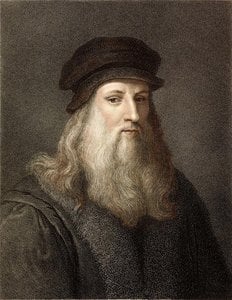
1452 - 1519 , Italy

Elevate your home with exquisite, hand-painted Renaissance reproductions by Da Vinci and Michelangelo. WahooArt offers museum-quality oil paintings, bespoke commissions, and expert art consultation for the discerning collector. Experience timeless luxury with our 100% satisfaction guarantee.

 Preview
 Send
Send Share
Share
 Details
 Guide
Guide

 Download
 Similars
 X-Ray
X-Ray Diaporama
 Stats
Stats
 Read More









 Glass option is only available in size under 110 CM


