PreviewPreview AR previewAR preview Switch to Print Switch to PrintSwitch to Digital Image Switch to Digital Image SendSend
DetailsDetails Add to favorites Add to favorites DownloadDownload SimilarsSimilars X-RayX-Ray DiaporamaDiaporama StatsStats

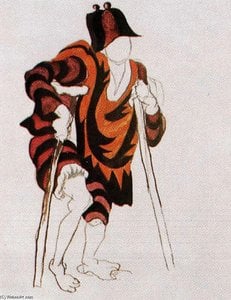
cleopatre danse juive

Experience Léon Bakst's 'Cleopatra Dancing as a Jewess,' a captivating 1910 drawing blending elegance and exoticism. Explore the artist’s unique style, influenced by Russian & European art.

Léon Bakst (1866-1924) was a pioneering Russian painter and designer famed for his opulent sets and costumes for Sergei Diaghilev’s Ballets Russes, blending Art Nouveau with Orientalist influences and revolutionizing theatrical design.

Hand Made Oil Reproduction

Hand-painted oil on canvas in your size and frame, made to order by our artists. (Switch to Print Switch to PrintSwitch to Digital Image Switch to Digital Image)

Standard
custom
CM
INCH

Pick from our preset sizes that match the artwork's original proportions.

width
height

You may enter your own dimensions to fit a specific frame or space. If your selected size does not match the original image's proportions, we will either crop the artwork or extend the painting with additional hand-painted elements. A digital mockup will be sent for your approval before production begins.
Please note that the on-screen preview does not reflect the actual cropping or extension. Only the mockup will accurately show the final composition.
While custom sizes are available, we recommend selecting a dimension from the predefined list to preserve the original proportions.

Examples of what can be changed: Replace face with customer photo; Add pet (e.g., replace cat with dog); Include hidden message in background; Change background landscape or elements.
After order, WahooArt.com team will email client for instructions and provide a mockup preview

Worldwide Delivery () in 3/4 weeks instead of standard 5 weeks. (8 September). No compromise on quality.

why_choose_icon
Free Worldwide Express Shipping
why_choose_icon
High-Quality Linen Canvas
why_choose_icon
Full Shipping Insurance
why_choose_icon
Customs Tax Refund Guarantee
why_choose_icon
True Color Matching Guarantee
why_choose_icon
100-Day Return Policy (Defects Only)
why_choose_icon
100% Money-Back Guarantee
why_choose_icon
Bulk Discount Offer

Total Price

$ 272

reproduction

cleopatre danse juive

Reproduction Medium

Reproduction Size

-

Total Price

$ 272

Quick Facts

  • Notable elements or techniques:
    • Exotic costume design
    • Elegant pose
  • Influences:
    • Russian art
    • European styles
  • Year: 1910
  • Medium: Drawing
  • Movement: Art Nouveau
  • Artist: Léon Bakst

Art Quiz

There is only one correct answer for each question.

Question 1:
What is the title of this artwork by Léon Bakst?
Question 2:
Léon Bakst is best known for his work in which artistic field?
Question 3:
The artwork appears to be a black and white drawing. What does this suggest about the original medium or purpose?
Question 4:
The presence of a bird in the drawing adds what element to the scene?
Question 5:
Léon Bakst was a prominent figure in which artistic movement?

A Glimpse into Bakst's Exotic World: "Cleopatre danse juive"

This captivating black and white drawing, titled “Cleopatre danse juive” (Cleopatra Dances Jewishly), offers a fascinating glimpse into the artistic world of Léon Bakst, a pivotal figure in the early 20th-century art scene. Created around 1910, this work transcends a simple portrait; it’s an evocative study of costume, movement, and cultural fusion, characteristic of Bakst's distinctive style. The subject, likely intended to portray Cleopatra or another regal Egyptian figure, is depicted in a richly detailed costume – a long flowing dress accentuated by a striking gold sash. She holds a parasol, its intricate design adding further elegance to the composition. A small bird perched nearby introduces an element of natural dynamism into the otherwise poised scene.

Style and Technique: The Essence of Modern Orientalism

Bakst was renowned for his contributions to the Ballets Russes, a theatrical company that revolutionized ballet with its lavish productions and innovative artistic collaborations. This drawing reflects that influence, embodying what is often termed "Modern Orientalism." While rooted in European artistic traditions, Bakst infused his work with exotic motifs drawn from Eastern cultures – particularly Russian, Middle Eastern, and Asian aesthetics. The stark black and white palette emphasizes the dramatic interplay of light and shadow, highlighting the textures of the costume and the graceful contours of the figure. His technique demonstrates a mastery of line and form, capturing not just likeness but also an underlying sense of movement and theatricality. The drawing’s fluidity suggests it may have been preparatory work for a larger stage design or costume concept.

Historical Context: The Ballets Russes and Artistic Revolution

To fully appreciate "Cleopatre danse juive," understanding its historical context is crucial. Bakst was a key designer for Sergei Diaghilev's Ballets Russes, which debuted in Paris in 1909. This company challenged conventional ballet aesthetics with its groundbreaking choreography, music (often by Debussy and Stravinsky), and most notably, its opulent costumes and stage designs created by artists like Bakst, Erté, and Picasso. The Ballets Russes sparked a sensation, influencing art, fashion, and design across Europe and beyond. "Cleopatre danse juive," likely conceived during this period of intense artistic experimentation, reflects the era's fascination with exoticism and its embrace of modernism. The "juive" (Jewish) element in the title is intriguing; it suggests a possible blending of cultural identities or perhaps a commentary on societal perceptions – further enriching the work’s complexity.

Symbolism and Emotional Impact

Beyond its aesthetic appeal, “Cleopatre danse juive” carries layers of symbolic meaning. The parasol, often associated with femininity and protection, adds an air of mystery to the subject. The bird could symbolize freedom or a fleeting moment in time. More broadly, the image evokes themes of power, beauty, and cultural exchange. The drawing’s monochromatic palette contributes to its emotional depth; it creates a sense of timelessness and introspection. Viewers are drawn into a world of elegance and intrigue, experiencing a poignant blend of grace and melancholy. The work's enduring appeal lies in its ability to transport us to a bygone era while simultaneously resonating with contemporary sensibilities regarding beauty, identity, and artistic expression.

Artist Biography

Early Life and the Seeds of Artistic Rebellion

Born Leyb-Khaim Izrailevich Rosenberg in 1866, within the pale of settlement in Grodno—a city then part of the Russian Empire—Léon Bakst’s journey toward artistic renown was a compelling narrative woven with both innate talent and societal constraints. His family, though comfortably middle class, possessed connections to the imperial court through his grandfather, a celebrated tailor who enjoyed patronage from the Tsar. This background instilled in young Leyb a keen awareness of cultural nuances alongside an early passion for drawing, vividly demonstrated when he won a contest at just twelve years old. However, this burgeoning artistic inclination initially met with resistance from his parents, hesitant to embrace such an unconventional path. Despite their reservations, Bakst persevered, eventually studying at the prestigious St. Petersburg Academy of Arts as a non-credit student while supplementing his education by working as a book illustrator—a practical necessity that honed his skills and provided financial independence. It was in 1889 that he adopted the surname "Bakst," a pragmatic decision reportedly motivated by concerns that his birth name might hinder career advancement within a society often prejudiced against Jewish individuals, revealing the challenges faced by artists from marginalized communities during that era.

The World of Art and Embracing Modernity

Bakst’s artistic development truly flourished with his involvement in the influential “World of Art” movement. He quickly became a pivotal figure alongside luminaries like Sergei Diaghilev and Alexandre Benois, contributing significantly to the group's eponymous periodical through his striking graphics. This association brought him widespread recognition and established him as a rising star within Russia’s artistic circles. His early works included compelling portraits of prominent figures such as Filipp Malyavin, Vasily Rozanov, Andrei Bely, and Zinaida Gippius, showcasing his ability to capture not only physical likeness but also the intellectual and emotional essence of his subjects. Bakst's style during this period was a fascinating blend of Russian artistic traditions with burgeoning European influences—particularly Orientalism and early Modernism. He embraced vibrant colors, exotic themes, and stylized forms, foreshadowing the revolutionary aesthetic he would later bring to the stage. This willingness to experiment and synthesize diverse influences marked him as an artist attuned to the changing currents of his time. His work began to whisper of a new visual language, one that moved beyond strict representation toward evocative suggestion.

Revolutionizing Ballet with the Ballets Russes

The pivotal moment in Bakst’s career arrived in 1908 when he began designing sets and costumes for theatrical productions—a shift that would forever alter the landscape of stage design. His collaboration with Sergei Diaghilev's Ballets Russes proved transformative, revolutionizing theatrical aesthetics and catapulting both artists to international fame. Bakst’s designs were groundbreaking; they moved away from realistic depictions, embracing stylized forms, bold colors, and a sense of opulent fantasy. Productions like Cleopatra, Scheherazade (1910)—perhaps his most iconic work—Carnaval (1910), Narcisse (1911), and particularly L'Après-midi d'un Faune (1912) became legendary for their visual splendor. L’Après-midi d’un Faune, in particular, was a seminal work that profoundly influenced the development of ballet and stage design, establishing a new aesthetic language for the art form. He didn't merely create backdrops; he constructed immersive worlds that heightened the emotional impact of the choreography and music. The costumes were equally innovative, often incorporating exotic fabrics, shimmering embellishments, and daring silhouettes that challenged conventional notions of theatrical attire.

Legacy and Enduring Influence

Léon Bakst’s legacy extends far beyond his contributions to ballet. He is rightfully considered one of the most important figures in the history of theatrical design, significantly impacting both set and costume creation for generations to come. His designs also contributed to the development of the Art Deco style with their emphasis on stylized forms, rich colors, and exotic themes—a testament to his far-reaching influence on visual culture. Despite facing some criticism during his lifetime for perceived extravagance, Bakst’s work was widely celebrated, and his funeral in 1924 was attended by a remarkable gathering of prominent artists, poets, musicians, dancers, and critics—a poignant demonstration of the esteem in which he was held. Today, his artwork can be found in museums worldwide and continues to inspire through reproductions available on platforms like WahooArt.com, ensuring that his innovative spirit and artistic vision endure for audiences around the globe. Bakst’s ability to synthesize diverse influences, embrace experimentation, and create visually stunning worlds cemented his place as a true visionary of the 20th century.
  • A master of color and composition.
  • Pioneered new approaches to theatrical design.
  • Influenced Art Deco aesthetics.
Léon Bakst

Léon Bakst

1866 - 1924 , Belarus

Quick Facts

  • Artistic Movement Or Style: Art Nouveau, Orientalism
  • Artists Or Movements Influenced By This Artist:
    • Ballets Russes
    • Art Deco
  • Date Of Birth: 1866
  • Date Of Death: 1924
  • Full Name: Léon Bakst
  • Nationality: Russian
  • Notable Artworks:
    • Scheherazade
    • L'Aprés-midi d'un Faune
    • Cleopatra
    • Carnaval
    • Spectre de la Rose
  • Place Of Birth: Grodno, Belarus
Explore artworks organized by themes, styles, and characteristics.