
x


Museum-quality giclée or canvas print with fast production and flexible finish options. ( Buy Hand Made Painting Buy Image)
Pick from our preset sizes that match the artwork's original proportions.

You may enter your own dimensions to fit a specific frame or space. If your selected size does not match the original image's proportions, we will either crop the artwork or extend the image with a mirrored or solid-fill edge. A digital mockup will be sent for your approval before production begins.
Please note that the on-screen preview does not reflect the actual cropping or extension. Only the mockup will accurately show the final composition.
While custom sizes are available, we recommend selecting a dimension from the predefined list to preserve the original proportions.
Worldwide Delivery () in 2 weeks instead of standard 4/5 weeks. (30 August)


Circular Plate for Ben Uri
Reproduction Size
In the delicate interplay of light and shadow upon its carved surface, the Circular Plate for Ben Uri stands as a profound testament to the enduring spirit of Jewish cultural identity. Created in 1915 by the visionary Lazar Berson, this piece is far more than a mere decorative object; it is a narrative vessel, etched into wood with an intimacy that speaks to the soul. As one gazes upon the intricate circular design, the eye is immediately drawn into a rhythmic dance of figures and symbols, each meticulously rendered to tell a fragment of a larger, sacred story. The craftsmanship reveals a mastery of woodworking, where every notch and groove serves to elevate the medium from simple timber to a complex stage for historical and spiritual drama.
The artistry of Berson is deeply rooted in his unique synthesis of Lithuanian heritage and the mystical depths of Kabbalistic thought. Within this circular composition, at least thirteen distinct figures emerge, creating a celestial or communal assembly that feels both ancient and immediate. The technique employed here relies on the depth of the carving to create natural highlights and shadows, giving the wooden surface a sculptural quality that changes as the viewer moves around it. This tactile dimension makes the piece an extraordinary choice for collectors who appreciate art that possesses a physical presence—a work that demands attention not just through its imagery, but through its very texture.
To understand this plate is to understand the turbulent era of its birth. Created during the height of the First World War, the piece embodies the resilience of a community seeking to preserve its essence amidst global upheaval. Berson, having moved to London, sought to establish a permanent visual language for Jewish art through the founding of the Ben Uri association. This plate serves as an early manifestation of that ambition, acting as a bridge between the traditional shtetl life of his youth and the burgeoning modern Jewish art movement in London. The symbols etched into the wood are not merely ornamental; they are coded messages of continuity, faith, and the preservation of memory.
For the discerning interior designer or art enthusiast, this reproduction offers a unique opportunity to introduce a sense of historical gravity and warmth into a contemporary space. The organic nature of the wood provides a grounding element, while the complexity of the carvings invites long periods of contemplation. Whether placed as a focal point in a curated gallery wall or used to add a layer of sophisticated storytelling to a study, the Circular Plate for Ben Uri brings with it an emotional weight that is rare in modern decor. It is an invitation to connect with a legacy of artistry that refuses to be forgotten, making it a timeless acquisition for any collection dedicated to the beauty of human heritage.

The life of Lazar Berson remains a captivating tapestry of light and shadow, much like the mystical traditions that fueled his creative spirit. Born in 1882 in the village of Škupiškyi, within the heart of a Lithuanian shtetl, Berson’s early years were steeped in the rich, rhythmic textures of Jewish life. While precise biographical details from his formative era are often obscured by the passage of time, the essence of his upbringing is etched into every line of his work. He carried with him the profound spiritual weight of the shtetl and a deep-seated connection to Jewish tradition, which would later serve as the foundation for a revolutionary artistic mission in the bustling urban centers of Europe.
Berson’s artistic journey was one of grand movement and intellectual expansion. His pursuit of mastery led him from the cultural renaissance of St. Petersburg to the prestigious halls of the École des Beaux-Arts in Paris. In the vibrant, bohemian atmosphere of Paris, Berson found himself immersed in a "prayer quorum" of Jewish émigré artists, living amidst the legendary La Ruche. It was here, surrounded by the energy of modernism and peers such as Marc Chagall and Léon Bakst, that his unique visual language began to coalesce. He sought to bridge the gap between the ancient and the avant-garde, blending the formal training of Western academic painting with the soulful, symbolic depth of Jewish folk art and the esoteric mysteries of Kabbalah.
To encounter a work by Lazar Berson is to enter a world where geometry meets divinity. His aesthetic was not merely decorative; it was a deliberate attempt to manifest spiritual truths through visual form. Berson’s compositions are often characterized by an intricate dance of patterns, where the mathematical precision of geometric shapes provides a vessel for profound religious symbolism. He frequently utilized motifs that resonated with the cosmic order, such as:
This fusion of Kabbalistic mysticism and decorative design allowed Berson to create art that functioned as a bridge between worlds. His work often featured circular, mandala-like structures—such as his notable 1915 designs—that invited the viewer into a state of contemplation, mirroring the cyclical nature of life and faith.
Perhaps Berson’s most enduring achievement was not found solely on canvas or wood, but in the community he built. In 1915, amidst the upheaval of the First World War, Berson moved to London and founded The Jewish-National Decorative Art Association, known today as the Ben Uri Arts Society. This institution was born from a visionary desire to cultivate a thriving ecosystem for Jewish artistry within the East End community. Through this society, Berson championed the importance of decorative arts and design, aiming to elevate Jewish culture and identity through aesthetically compelling and culturally resonant creations.
Though his personal history contains moments of sudden and mysterious disappearance from the London capital in 1916, his impact remained indelible. He successfully fostered a spirit of collaboration between artists and craftsmen, ensuring that the beauty of the diaspora would be preserved through tangible, exquisite objects. Today, Berson is remembered not just as a painter or a designer, but as a pioneer who provided a voice for a culture in transition, leaving behind a legacy of resilience, identity, and profound spiritual beauty.

1882 - 1954 , Lithuania
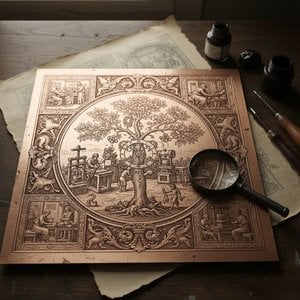
Explore the intricate world of etching and intaglio printmaking. Discover how masters use acid and metal to create profound textures and lines, from Romanticism to modern era, through an expert lens of art history and technical mastery.


Stay updated with the latest art news, exclusive offers, and decoration ideas.
Tell us about your project and our art experts will provide you with 3 personalized art suggestions.
Let Us Curate 3 Options Just for You - Free!


 Send
Send Share
Share
 Details

 Download
 Similars
 Diaporama


 Read More




































 Glass option is only available in size under 110 CM


