


Museum-quality giclée or canvas print with fast production and flexible finish options. ( Buy Hand Made Painting Switch to Digital Image)
Pick from our preset sizes that match the artwork's original proportions.

Type the width and the height you need, to fit your frame or your wall. A print can only be cut, never made bigger than the picture, so a size with a different shape loses a part of the image. We send you a digital mockup to approve before we print anything. The picture shown on this page does not show the real cut — only the mockup does.
Worldwide Delivery () in 2 weeks instead of standard 4/5 weeks. (20 November)
Landscape
Reproduction Size

Franklin De Haven was born in Bluffton, Indiana, on December 26, 1856. His early years in the American Midwest preceded a life spent largely within the artistic circles of the East Coast. In 1902, he married Elizabeth Woodcock, who hailed from Jersey City.
His presence in the New York art scene was marked by a steady involvement in local institutions. He eventually took on a leadership role, serving as the president of the Salmagundi Club between 1926 and 1927. This period of his life saw him deeply embedded in the professional community of painters in the city.
The end of his life came in New York City. After suffering from an infection that required the amputation of his right foot, Franklin De Haven passed away on January 10, 1934. He died in Presbyterian Hospital in New York.
His presence in the New York art community was marked by steady recognition from established circles. In 1902, the Salmagundi Club awarded him the Inness Prize. This recognition preceded his leadership within the same institution, where he served as president from 1926 to 1927.
The years that followed brought further honors for his specific approach to light and form. He was awarded a Silver Medal by the National Arts Club in 1921. Later, in 1930, he received the Brown-Bigelow Gold Medal from the Allied Artists of America for his painting "Nocturne".
Franklin De Haven was a Tonalist painter. In the 1880s, his work focused on poetic landscapes. As the years passed, his approach shifted. By 1900, his canvases began to show a different kind of movement, gaining a gestural power and a sinuous energy. He moved away from quiet stillness toward a more active way of handling the brush.
In his later years, the way he applied paint changed the emotional weight of his scenes. He used flourishes of paint marks to define form. This method gave his work a charged quality. He often balanced soft-edged masses against sharp linear contours. You can see this tension in his depictions of swaying trees or the heavy, roiling shapes of thunderclouds.
His brushwork often captured the movement of the natural world, from the heavy spray of the sea to the quiet shifts of light. In 1893, he painted Crashing waves, a work that focused on the force of water. By 1901, he had produced October Morning, a piece that reflects the specific atmosphere of that season. His ability to handle light and shadow is perhaps most evident in Nocturne, a painting that earned him the Brown-Bigelow Gold Medal from the Allied Artists of America in 1930.
The passage of time appears in his later compositions, such as Autumn Stream, which he painted about 1918. These works show a focus on the textures of the outdoors. He also produced a work titled Landscape, a piece that captures a sense of place through its composition. Each canvas reveals a specific moment of observation, whether it is the roiling clouds of a storm or the steady presence of a quiet field.

1856 - 1934 , United States

Explore the rich history of landscape art with WahooArt. Discover renowned artists, movements like Impressionism & tonalism, and expert guidance for collecting timeless pieces. Find your perfect serene escape today!

Journey through 10 Romantic landscape masterpieces by Friedrich, Turner & Cole. Explore emotional art, sublime nature scenes & iconic 19th-century paintings. Find museum-quality reproductions for your home at WahooArt.com – discover the full collection online!
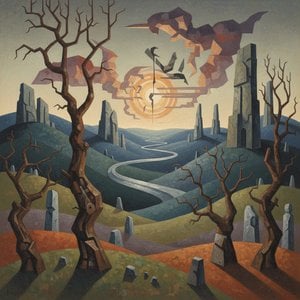
Explore the evocative landscapes & poignant war art of Paul Nash (1889-1946), a key figure in British Modernism. Discover his unique style and lasting impact on art history with WahooArt.

Explore the captivating landscapes of Jasper Francis Cropsey, a leading figure of the Hudson River School & Luminism movement. Discover his signature style and idyllic American scenes. Own a hand-painted reproduction today!

Explore the captivating watercolors of Charles Burchfield, an American visionary whose art captured nature’s spiritual essence & the soul of a nation. Discover his unique style and legacy at WahooArt.
 Preview

 Send
 Share
 Details
 Guide


 Download
 Similars
 X-Ray
 Diaporama
 Q&A

 Stats


 Read More






































 Glass option is only available in size under 110 CM


