x


Hand-painted oil on canvas in your size and frame, made to order by our artists. ( Buy Print Buy Image)
Pick from our preset sizes that match the artwork's original proportions.

You may enter your own dimensions to fit a specific frame or space. If your selected size does not match the original image's proportions, we will either crop the artwork or extend the painting with additional hand-painted elements. A digital mockup will be sent for your approval before production begins.
Please note that the on-screen preview does not reflect the actual cropping or extension. Only the mockup will accurately show the final composition.
While custom sizes are available, we recommend selecting a dimension from the predefined list to preserve the original proportions.
Worldwide Delivery () in 3/4 weeks instead of standard 5 weeks. (30 August). No compromise on quality.


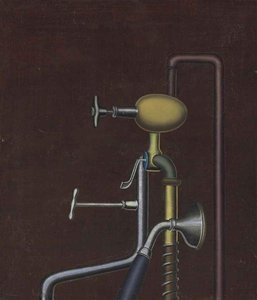
The fanatic
Reproduction Size

In the quiet intersection where the precision of industrial machinery meets the irrationality of a dream, lies the singular world of Konrad Klapheck. Born in Düsseldorf on February 10, 1935, to a lineage of esteemed art historians, Klapheck was destined for a life steeped in aesthetic contemplation. His early years at the Kunstakademie Düsseldorf, studying under the guidance of Bruno Goller, provided him with a rigorous foundation in craftsmanship. Yet, beneath this disciplined training, a more subversive spirit was brewing—one that would eventually reject the purely abstract in favor of a hauntingly realistic yet profoundly distorted vision of the everyday.
Klapheck’s artistic evolution is a fascinating journey from magic realism to a highly idiosyncratic blend of Surrealism and Pop Art. While his mid-1950s works adhered to more traditional modes, a transformative shift occurred when he first turned his gaze toward the typewriter. This was not merely a change in subject matter, but a revolution in perception. By isolating these mechanical objects and presenting them with an almost obsessive clarity, he stripped them of their utility and imbued them with a psychological weight. These machines became characters in a silent, surreal drama, bathed in vibrant, often unsettling hues that challenged the viewer's sense of reality.
To look upon a Klapheck painting is to experience a strange sense of alienation within the familiar. He possessed a remarkable ability to take the most utilitarian items—objects we touch and use without thought—and transform them into monumental icons of mystery. His repertoire of subjects expanded from his iconic typewriters to include a parade of mechanical and domestic artifacts:
This technique was never merely about photographic accuracy. Instead, Klapheck utilized a masterful manipulation of color and scale to inject an element of the absurd. His work often carries a subtle, biting wit, layered with political commentary and even sexual innuendo. By enlarging these small, domestic objects to a monumental scale, he forced a confrontation between the viewer and the inanimate, making the mechanical feel alive, and the living feel strangely mechanical.
The historical significance of Konrad Klapheck lies in his ability to bridge the gap between the conceptual provocations of Marcel Duchamp and the vibrant, consumer-driven energy of Pop Art. He drew deep inspiration from the avant-garde masters—Man Ray, Max Ernst, and René Magritte—yet he applied their surrealist logic to a much more modern, industrial landscape. His work mirrors the tension of the mid-20th century: the fascination with technological progress clashing with the underlying anxiety of an increasingly automated world.
Through his precise lines and dreamlike compositions, Klapheck achieved a rare feat in contemporary art: he made the inanimate speak. He left behind a body of work that serves as a profound meditation on alienation, fascination, and the hidden life of objects. Even decades after his passing, his paintings continue to haunt the galleries of the world, reminding us that within the most ordinary machine, there may lie an extraordinary, unsettling truth.

1935 - 1979

Unlock your creative potential with WahooArt Digital Licensing. Transform your digital masterpieces into a sustainable passive income stream by leveraging our global platform of collectors and professionals. Turn your vision into a timeless legacy today.

Elevate your digital artistry with our expert guide to mastering collage. Learn professional techniques for layering textures, blending imagery, and creating profound visual narratives through advanced digital composition and modern creative workflows.
Embark on a curated journey through Pop Surrealism, where vibrant cultural icons collide with the profound depths of the subconscious. An authoritative exploration for discerning collectors seeking to masterfully integrate dreamlike landscapes and bold aesthetics into modern interiors.

Elevate your digital portfolio with exclusive, unrepeatable original artist NFTs at WahooArt. Discover a curated selection of premium digital masterpieces and generative abstractions designed for the discerning collector seeking true scarcity and artistic prestige.


Stay updated with the latest art news, exclusive offers, and decoration ideas.
Tell us about your project and our art experts will provide you with 3 personalized art suggestions.
Let Us Curate 3 Options Just for You - Free!

 Preview
 Send
Send Share
Share
 Details

 Download
 Similars
 X-Ray
X-Ray Diaporama
 Read More




































 Glass option is only available in size under 110 CM