Museum-quality giclée or canvas print with fast production and flexible finish options. ( Buy Hand Made Painting Switch to Digital Image)
Pick from our preset sizes that match the artwork's original proportions.

You may enter your own dimensions to fit a specific frame or space. If your selected size does not match the original image's proportions, we will either crop the artwork or extend the image with a mirrored or solid-fill edge. A digital mockup will be sent for your approval before production begins.
Please note that the on-screen preview does not reflect the actual cropping or extension. Only the mockup will accurately show the final composition.
While custom sizes are available, we recommend selecting a dimension from the predefined list to preserve the original proportions.
Worldwide Delivery () in 2 weeks instead of standard 4/5 weeks. (26 September)


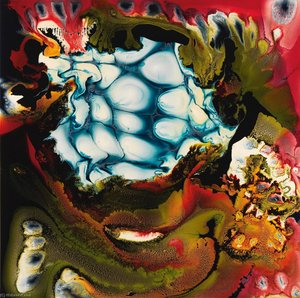
Mathematical Nature Painting (Nested)
Reproduction Size

In the vast, interconnected landscape of contemporary art, few figures navigate the delicate boundary between scientific rigor and creative spontaneity as masterfully as Keith Tyson. Born Keith Thomas Bower in 1969 in the quiet town of Ulverston, Cumbria, his early life was marked by a profound transformation of identity, adopting his stepfather’s surname at a young age. This early shift mirrors the very essence of his artistic philosophy: a rejection of fixed identities and a fascination with how systems—whether biological, mathematical, or personal—evolve through interaction and randomness. His formative years, shaped by the rugged landscapes of Northern England and an early professional stint as a fitter and turner, instilled in him a foundational respect for craftsmanship and the mechanical precision that would later serve as a backdrop for his explorations of chaos.
Tyson’s ascent to international prominence was nothing short of meteoric. The year 2002 stands as a watershed moment in his career when he was awarded the prestigious Turner Prize. This recognition did not merely celebrate a single style, but rather a revolutionary way of thinking about the studio as a laboratory. To witness a Tyson exhibition is to enter a space where the boundaries between researcher and creator dissolve. His work does not simply present an image; it presents a process. Through his celebrated Artmachine—a complex system utilizing computer programs, flow charts, and books to generate chance combinations of ideas—he pioneered a method of "artificial randomness." This period of his career challenged the traditional sanctity of the artist's hand, suggesting instead that art could be an emergent property of structured systems and unpredictable inputs.
As his practice matured, Tyson’s work transitioned from the algorithmic logic of the Artmachine toward a more direct, tactile engagement with the physical world. While his early investigations were deeply rooted in causality and the mechanics of how things come into being, his later works began to weave together disparate threads of human knowledge: mathematics, poetry, mythology, and natural history. This evolution saw him moving from complex installations that functioned as self-contained ecosystems toward a profound exploration of painting and drawing. In these more recent endeavors, he has embraced the tradition of still life, yet he imbues it with a contemporary tension, using subjects like flowers to explore the fleeting nature of existence and the stories that emerge from the intersection of life and decay.
The brilliance of Tyson’s oeuvre lies in its ability to make the abstract tangible. Whether he is working with massive, immersive installations or delicate, intricate drawings, there is a persistent dialogue between order and entropy. His work often reflects:
Ultimately, Keith Tyson remains a pivotal figure in the history of contemporary art because he refuses to provide easy answers. His work serves as a mirror to our own complex universe—a place where scientific certainty and poetic mystery coexist. By treating the act of creation as an ongoing experiment, he invites the viewer not just to observe, but to participate in the grand, unpredictable unfolding of meaning itself.

 Preview
 Send
Send Share
Share
 Details
 Guide
Guide

 Download
 Similars
 X-Ray
X-Ray Diaporama
 Stats
Stats Read More




































 Glass option is only available in size under 110 CM