Purchase a high-resolution, enhanced digital image, far superior to the online preview.
Each file is meticulously prepared by our in-house specialists using advanced tools and expert manual retouching. We ensure every image has exceptional clarity, precise color accuracy, and fine detail.
The final file is delivered via email within 72 hours, optimized for immediate use in professional, editorial, and print environments. This is the same quality trusted by top-tier design studios, publishers, and galleries.
Download a high-resolution file for personal display, printing, and creative projects. ( Switch to Print Buy Hand Made Painting)
When you choose WahooArt.com, you're not just getting an image - you're receiving a professionally enhanced digital artwork, crafted with precision and backed by a satisfaction guarantee. Here's everything that comes with your order, automatically:

Your high-resolution digital image file will be emailed to you within 72 hours of ordering - ready for immediate use.

Your artwork is professionally optimized using advanced AI tools and manual editing, ensuring maximum detail, clarity, and color accuracy.

Accidentally deleted or lost your file? No worries - we'll resend it to you anytime, free of charge.

Enjoy your artwork instantly with zero customs, duties, or delivery fees - digital downloads are always tax-free.

We ensure your digital image reflects the original colors as closely as possible using professional tools and color management.

If you're not satisfied with your digital image, we'll revise it or refund 100% within 100 days - no questions asked.

Not satisfied? Get a full refund within 100 days of receiving your digital file - no questions asked.

Buy 3 images, save 10% - Buy 5, save 15% - Buy 10+, save 20%. Great for creative projects, galleries, and agencies.
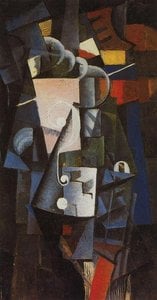
“Vanily Case,” a deceptively simple painting by Kazimir Malevich, offers a profound meditation on form, color, and the very nature of perception. Executed around 1917, this work represents a crucial step in Malevich’s radical journey toward pure abstraction, a movement he would later codify as Suprematism. The image itself – a commonplace scene of cups, spoons, and tables – is rendered with an almost obsessive attention to detail, yet simultaneously stripped down to its most essential elements. The black background acts not merely as a backdrop but as a contained void, intensifying the vibrancy of the red cup and silver spoon, drawing the viewer’s eye into a carefully constructed dialogue between object and space.
‘Vanily Case’ emerged during a period of intense artistic experimentation in Russia, fueled by the influence of European avant-garde movements like Cubism and Futurism. However, Malevich was seeking something beyond mere imitation; he aimed to create a completely new visual language – one that rejected representational illusion entirely. This work anticipates the core tenets of Suprematism, a movement founded by Malevich in 1915, which advocated for art based solely on geometric forms and pure color. The painting’s reductionist approach—focusing on basic shapes and colors—reflects this philosophical shift, moving away from depicting reality to expressing an inner truth.
Malevich’s technique in ‘Vanily Case’ is characterized by meticulous brushwork and a precise rendering of form. The surfaces are built up with thin layers of paint, creating subtle variations in tone and texture that enhance the objects' three-dimensional appearance. The composition itself is deceptively simple, yet carefully balanced. The placement of the cups—one on the left, another towards the top right—creates a dynamic tension within the confined space, guiding the viewer’s eye across the canvas. The use of negative space – the areas around and between the objects – is equally important, contributing to the painting's overall sense of depth and spatial awareness.
Beyond its formal qualities, ‘Vanily Case’ possesses a subtle symbolic resonance. The objects themselves—cups and spoons—represent the everyday rituals of life, yet their isolation within the black void suggests a detachment from worldly concerns. The painting evokes a sense of quiet contemplation and perhaps even melancholy, inviting viewers to reflect on the nature of existence and the search for meaning in a world increasingly dominated by abstraction. This piece is not merely a depiction of objects; it’s an exploration of perception, reality, and the potential of art to transcend the limitations of language and representation.


1878 - 1935 , Ukraine

 Preview
 Send
Send Share
Share
 Details
 Guide
Guide

 Download
 Similars
 X-Ray
X-Ray Diaporama
 Stats
Stats

 Read More