PreviewPreview AR previewAR preview Buy Hand Made Painting Buy Hand Made PaintingSwitch to Digital Image Switch to Digital Image SendSend
DetailsDetails Add to favorites Add to favorites DownloadDownload SimilarsSimilars X-RayX-Ray DiaporamaDiaporama StatsStats

Reciter

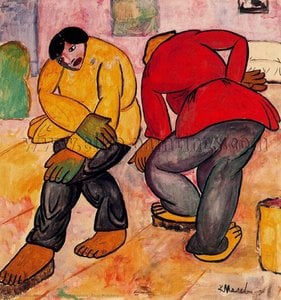
Explore Kazimir Malevich’s ‘Reciter,’ a striking Expressionist work featuring geometric abstraction & symbolic elements. Bold lines & hand-drawn texture evoke contemplation. A unique piece for art collectors.

Kazimir Malevich (1878-1935): Ukrainian founder of Suprematism & pioneer of abstract art. Explore iconic works like Black Square, geometric forms, & pure feeling's impact on 20thC art.

Giclée / Art Print

Museum-quality giclée or canvas print with fast production and flexible finish options. (Buy Hand Made Painting Buy Hand Made PaintingSwitch to Digital Image Switch to Digital Image)

P118B $10
P118H $10
P118W $10
P438Z $10
P508JH $12
P508YH $12
P805H $10
P805Z $10
P919BZ $10
P919G $10
P919XJ $10
P959ZH $10
P968JZ $12
W106C $8
W218G $10
W218JH $8
W218Y $10
W307PJ $10
W316G $10
W316PJ $8
W316Y $10
W398PJ $8
W4111J $10
W500HY $15
W500JH $15
W692G $12
W849H $8
W940BG $15
W953PJ $8

Standard
custom
CM
INCH

Pick from our preset sizes that match the artwork's original proportions.

width
height

You may enter your own dimensions to fit a specific frame or space. If your selected size does not match the original image's proportions, we will either crop the artwork or extend the image with a mirrored or solid-fill edge. A digital mockup will be sent for your approval before production begins.
Please note that the on-screen preview does not reflect the actual cropping or extension. Only the mockup will accurately show the final composition.
While custom sizes are available, we recommend selecting a dimension from the predefined list to preserve the original proportions.

Worldwide Delivery () in 2 weeks instead of standard 4/5 weeks. (9 September)

why_choose_icon
Free Worldwide Express Shipping
why_choose_icon
High-Quality Linen Canvas
why_choose_icon
Full Shipping Insurance
why_choose_icon
Customs Tax Refund Guarantee
why_choose_icon
True Color Matching Guarantee
why_choose_icon
100-Day Return Policy (Defects Only)
why_choose_icon
100% Money-Back Guarantee
why_choose_icon
Bulk Discount Offer

Total Price

$ 69

reproduction

Reciter

Giclée / Art Print

Reproduction Size

-

Total Price

$ 69

Quick Facts

  • influences: Impressionism, Symbolism, Fauvism, Cubism
  • title: Reciter
  • year: Unknown
  • movement: Expressionism, Suprematism, Art Deco
  • medium: Ink on paper
  • artist: Kazimir Severinovich Malevich

Art Quiz

There is only one correct answer for each question.

Question 1:
Kazimir Malevich is best known as the founder of what art movement?
Question 2:
The artwork 'Reciter' utilizes which primary technique for creating texture and shading?
Question 3:
Based on the description, how would you characterize the composition of 'Reciter'?
Question 4:
The symbolic element of a card in 'Reciter' might suggest themes related to…?
Question 5:
Which artistic style, alongside Expressionism, is noted as influencing 'Reciter'?

Kazimir Malevich’s ‘Reciter’: A Glimpse into Early Suprematist Thought

This striking work by Kazimir Malevich, titled ‘Reciter,’ offers a fascinating window into the artist's pivotal transition towards his groundbreaking Suprematist style. Created at an unknown date, likely in the years leading up to 1915, it showcases Malevich’s exploration of form and abstraction while still retaining vestiges of figurative representation. The artwork presents a solitary figure – seemingly absorbed in contemplation as they hold a small object, perhaps a playing card – rendered with bold lines and a deliberately flattened perspective.

Deconstructing the Form: Style & Technique

‘Reciter’ is executed primarily in black ink on paper, utilizing a dynamic interplay of line drawing, hatching, and cross-hatching to create texture and suggest volume. The composition is notably asymmetrical; the figure is positioned off-center, contributing to a sense of unease or anticipation. Geometric simplification is key here – forms are reduced to their essential shapes, foreshadowing the pure abstraction that would soon define Malevich’s most famous works like ‘Black Square.’ While elements of Expressionism and even Art Deco can be detected in its stylized aesthetic, it's clear this piece represents a departure from traditional representation. The limited depth and diffuse lighting further emphasize the two-dimensional quality, pushing the artwork towards non-objectivity.

Symbolism & Interpretation: Chance, Fate, and the Individual

The symbolism within ‘Reciter’ is open to interpretation, adding layers of intrigue. The figure's downward gaze and the object held in their hand – likely a card – suggest themes of chance, fate, or introspection. Are they reading a destiny? Contemplating a decision? The solitary nature of the figure reinforces a sense of individual experience and perhaps even alienation. Malevich often sought to convey pure feeling through his art, stripping away narrative elements in favor of emotional resonance. This piece feels like a precursor to that ambition – a moment of quiet contemplation before the full explosion of abstract form.

Historical Context: The Road to Suprematism

Kazimir Malevich (1878-1935) was a Ukrainian avant-garde artist who revolutionized 20th-century art with his development of Suprematism. Born into a rural, multiethnic environment, he initially experimented with various styles – Impressionism, Symbolism, Cubism – before forging his own path. His 1912 visit to Paris exposed him to the latest artistic trends, but ultimately, he sought to transcend representation altogether. ‘Reciter’ occupies a crucial position in this evolution. It demonstrates Malevich's willingness to deconstruct form and explore abstraction while still acknowledging the remnants of the visible world. He was deeply influenced by his contemporaries and followers like Lazar Khidekel, who further developed Suprematist principles into architectural designs.

Emotional Impact & Aesthetic Appeal

‘Reciter’ evokes a mood of quiet intensity and thoughtful contemplation. The stark contrast between black ink and white paper, combined with the bold lines and simplified forms, creates a visually arresting image. Its understated elegance makes it suitable for a variety of interior settings – from modern minimalist spaces to more eclectic collections. This artwork is not merely a historical artifact; it’s a powerful expression of human emotion and a testament to Malevich's visionary genius. It invites viewers to pause, reflect, and consider the deeper questions about existence and perception that lie at the heart of abstract art. The piece resonates with a sense of melancholy and mystery, prompting introspection in those who view it – much like Chaplin’s call to Smile, even amidst sorrow.

Collecting & Reproduction

As an important work within Malevich's oeuvre, high-quality reproductions of ‘Reciter’ are highly sought after by collectors and art enthusiasts alike. Its unique blend of figurative suggestion and abstract form makes it a compelling addition to any collection or interior space. Museums such as the Vitebsk Museum of Modern Art, the Museum Ludwig, and the State Russian Museum hold significant collections of Malevich’s work, offering opportunities for further study and appreciation.

Artist Biography

Kazimir Malevich: A Pioneer of Abstract Art

Early Life and Influences

  • Born in Kyiv Oblast, Ukraine in 1878 to a Polish family, Kazimir Severinovich Malevich’s early life was shaped by the rural Ukrainian landscape and its rich folk culture.
  • His upbringing instilled in him an appreciation for traditional artistic expressions that would later subtly influence his work.
  • Formal training began in Kyiv, but Malevich quickly sought broader artistic horizons, moving towards Moscow and eventually engaging with the burgeoning avant-garde movements of Europe.
  • Key Influences: Early exposure to folk art, combined with a desire for modern expression, formed the foundation of his unique style.

Artistic Development & Key Movements

  • Initially, Malevich explored various styles including Impressionism, Symbolism, Fauvism, and Cubism. A pivotal trip to Paris in 1912 exposed him to the latest developments in European art.
  • He gradually moved away from representational forms, seeking a purely artistic language based on geometric shapes and color.
  • This led to the development of Suprematism around 1915 – an abstract movement focused on “the supremacy of pure feeling” in art.
  • Suprematism rejected any attempt to depict objects from the visible world, instead prioritizing basic geometric forms like squares, circles, and rectangles.

Major Achievements & Notable Works

  • Black Square (1915): Arguably his most famous work, it represents a radical departure from traditional art and is considered a foundational piece of abstract painting.
  • White on White (1918): A series exploring the purity of form and color, featuring white geometric shapes against a white background – pushing abstraction to its limits.
  • Stroyuschiysya dom [House under Construction] (1916): An early example of Suprematism showcasing his unique perspective on Ukrainian culture through abstract forms.
  • He also wrote extensively on art theory, articulating the philosophical principles behind Suprematism and advocating for a new artistic consciousness.

Historical Significance & Legacy

  • Malevich’s work profoundly impacted the development of 20th-century abstract art, influencing movements like Minimalism and Constructivism.
  • He challenged conventional notions of representation and paved the way for non-objective art.
  • His ideas about pure feeling and geometric abstraction continue to resonate with artists today.
  • Despite facing political persecution under Stalin – initially supported, then suppressed – Malevich persevered in his practice and teaching.
  • Influence on Later Artists: He directly influenced artists like El Lissitzky and indirectly shaped countless others through the enduring legacy of Suprematism.

Later Life & Death

  • In his later years, Malevich revisited figurative painting, attempting to synthesize his abstract principles with representational forms.
  • He continued to teach and write about art until his death in Leningrad (now St. Petersburg) in 1935.
  • His work remained relatively obscure for decades after his death but experienced a resurgence of interest in the latter half of the 20th century, solidifying his place as one of the most important figures in modern art history.
Kazimir Malevich

Kazimir Malevich

1878 - 1935 , Ukraine

Quick Facts

  • Artistic Movement Or Style: Suprematism, Abstract Art
  • Artists Or Movements Influenced By This Artist:
    • Minimalism
    • Constructivism
    • El Lissitzky
  • Artists Who Influenced This Artist:
    • Cubism
    • Fauvism
    • Impressionism
  • Date Of Birth: 1878
  • Date Of Death: 1935
  • Full Name: Kazimir Severinovich Malevich
  • Nationality: Ukrainian/Russian
  • Notable Artworks:
    • Black Square
    • White on White
    • House under Construction
  • Place Of Birth: Kyiv, Ukraine
Explore artworks organized by themes, styles, and characteristics.