Get a print-ready file that goes far beyond the web preview. Every digital image we sell comes from a high-resolution master in our stock database — usually 5,000 to 15,000 pixels wide — so you can print large, crop tightly, or reproduce fine detail with confidence.
No file leaves our studio untouched. A digital expert checks the colors against the original painting and corrects them if needed, then improves clarity and detail with professional retouching tools — always staying faithful to the artist's brushwork and style. The result is an image that looks like the painting, not like a filtered scan.
You approve before you're done: our expert sends the image by e-mail within 72 hours for your review. Not satisfied? Ask for improvements or corrections, or request a refund if the quality falls short.
This is the quality relied on by publishers, design studios, galleries and print shops.
Download a high-resolution file for personal display, printing, and creative projects. ( Switch to Print Buy Hand Made Painting)
When you choose WahooArt.com, you're not just getting an image - you're receiving a professionally enhanced digital artwork, crafted with precision and backed by a satisfaction guarantee. Here's everything that comes with your order, automatically:
Your high-resolution digital image file will be emailed to you within 72 hours of ordering - ready for immediate use.
Your artwork is professionally optimized using advanced AI tools and manual editing, ensuring maximum detail, clarity, and color accuracy.
Accidentally deleted or lost your file? No worries - we'll resend it to you anytime, free of charge.
Enjoy your artwork instantly with zero customs, duties, or delivery fees - digital downloads are always tax-free.
We ensure your digital image reflects the original colors as closely as possible using professional tools and color management.
If you're not satisfied with your digital image, we'll revise it or refund 100% within 100 days - no questions asked.
Not satisfied? Get a full refund within 100 days of receiving your digital file - no questions asked.
Buy 3 images, save 10% - Buy 5, save 15% - Buy 10+, save 20%. Great for creative projects, galleries, and agencies.
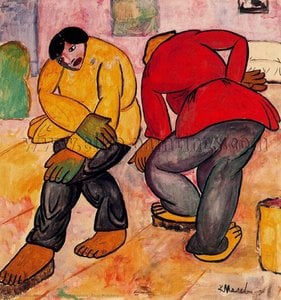
To step before Kazimir Malevich's 1932 Composition is to enter a realm where the noise of the material world falls into a profound, rhythmic silence. This horizontal masterpiece does not seek to mirror the landscapes or faces of our daily existence; instead, it invites the viewer into a universe of pure artistic sensation. As a pinnacle of his mature Suprematist style, the work functions as a visual symphony, where color and form dance in a carefully orchestrated tension. It is an exploration of the non-objective, stripping away the skin of reality to reveal a skeletal truth composed entirely of energy, weight, and movement.
The painting is defined by a captivating interplay of layered, rectangular stripes that vary in width and intensity. These are not merely flat bands of pigment but are perceived as dynamic planes existing within a shallow, compressed pictorial space. By deliberately minimizing traditional perspective, Malevich pushes the composition forward, demanding an immediate, visceral engagement from the observer. The eye is drawn into a rhythmic pulse created by the overlapping edges, where the boundaries between shapes become sites of subtle conflict and unexpected harmony.
The emotional resonance of the piece is anchored in its masterful use of color. Malevich employs a bold palette—dominated by deep reds, vibrant greens, cool blues, sun-drenched yellows, and grounding blacks—not to mimic nature, but to evoke a spectrum of human feeling. The juxtaposition of these hues creates a sense of kinetic energy; certain stripes seem to vibrate against their neighbors, while others provide moments of structural stability. This chromatic tension is further heightened by the artist's signature impasto technique. The thick, deliberate application of oil paint lends the canvas a rugged, tactile quality that transforms the surface into a sculptural landscape of its own.
For the discerning collector or interior designer, this texture offers a profound sense of authenticity and presence. The visible brushstrokes serve as a poignant reminder of the artist’s hand, ensuring that the work feels deeply personal rather than mechanically produced. When placed within a modern architectural setting, the interplay of light across these raised ridges of paint creates a living composition that changes with the time of day, offering a sophisticated focal point that embodies both strength and elegance.
Understanding Composition requires a glimpse into the revolutionary spirit of its era. Emerging from the transformative atmosphere of the Russian avant-garde, Malevich sought to create an art form that reflected a new, utopian world order. Through Suprematism, he believed that geometric abstraction could transcend political and social boundaries to express a universal spirituality. This work represents a radical break from centuries of representational tradition, standing as a monument to the courage of the modern spirit.
Today, this painting remains a cornerstone of abstract art history, offering endless inspiration for those who appreciate the beauty of structural order and emotional depth. Whether serving as a bold statement in a minimalist gallery or adding a layer of intellectual complexity to a curated residential space, Malevich’s Composition continues to captivate. It is more than a painting; it is an invitation to experience the sublime power of pure form.
The creation of "Composition" by Kazimir Malevich is dated 1932.
"Composition" by Kazimir Malevich is in the public domain - its copyright has expired. Copyright terms are measured from the artist's death, and Kazimir Malevich died in 1935.
"Composition" was made in 1932, within the Constructivism movement.


1878 - 1935 , Ukraine

 Preview
 Send
Send Share
Share
 Details
 Guide
Guide

 Download
 Similars
 X-Ray
X-Ray Diaporama
 Stats
Stats

 Read More