Museum-quality giclée or canvas print with fast production and flexible finish options. ( Buy Hand Made Painting Switch to Digital Image)





























Pick from our preset sizes that match the artwork's original proportions.

Type the width and the height you need, to fit your frame or your wall. A print can only be cut, never made bigger than the picture, so a size with a different shape loses a part of the image. We send you a digital mockup to approve before we print anything. The picture shown on this page does not show the real cut — only the mockup does.
Worldwide Delivery () in 2 weeks instead of standard 4/5 weeks. (12 November)
Phoenix
Reproduction Size
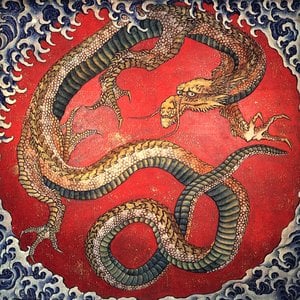
Katsushika Hokusai's 'Phoenix,' a captivating depiction of the mythical bird, transcends mere illustration; it is a profound meditation on rebirth, resilience, and the cyclical nature of existence. This artwork, echoing the master’s signature style yet imbued with a uniquely poignant sensibility, invites viewers into a world where ancient symbolism dances with delicate brushwork. The painting immediately draws the eye to the central phoenix, its wings spread in a glorious arc of color – fiery reds and oranges blending seamlessly with softer hues of gold and cream. The bird's elongated beak, a characteristic feature of Hokusai’s depictions, adds an element of dignified power, while the surrounding foliage, rendered in meticulous detail, creates a vibrant circle that reinforces the theme of wholeness and completion.
‘Phoenix’ firmly establishes itself within the rich artistic tradition of Edo-period Japan. Hokusai's influence is undeniable, drawing heavily from the established conventions of Japanese woodblock printing – *Ukiyo-e*. However, this reproduction goes beyond a simple imitation; it demonstrates a nuanced understanding of perspective and composition, hallmarks of Hokusai’s mature style. The use of layered washes of color, characteristic of *sumi-e* (ink wash painting), lends the artwork an ethereal quality, softening the edges and creating a sense of depth. Notice the careful attention to detail in the smaller birds scattered throughout the scene – each one rendered with remarkable precision, contributing to the overall complexity and dynamism of the composition. The oriental style is particularly evident in the circular arrangement of leaves, a motif frequently employed in Japanese art to symbolize eternity and the cosmos.
The phoenix itself carries immense symbolic weight within both Eastern and Western cultures. In Japan, it represented not just fire but also immortality, renewal, and the triumph of good over evil. The act of rising from ashes is a potent metaphor for overcoming adversity and embracing transformation – a theme deeply resonant with Hokusai’s own life journey. The surrounding foliage further amplifies this symbolism; leaves represent growth, fertility, and the continuous cycle of life and death. The inclusion of multiple smaller birds suggests a multitude of opportunities for rebirth and reinforces the idea that hope can be found in even the smallest of forms. This artwork is more than just a beautiful image; it’s a carefully constructed narrative brimming with spiritual significance.
Born in Tokyo around 1760, Katsushika Hokusai lived through a period of immense social and artistic change in Japan. His career spanned nearly nine decades, during which he produced an astonishing body of work that continues to captivate audiences worldwide. While best known for his iconic *Thirty-Six Views of Mount Fuji*, works like ‘Phoenix’ demonstrate the breadth of his talent and his ability to adapt and innovate within established traditions. This hand-painted reproduction offers a unique opportunity to own a piece of art history, allowing you to experience firsthand the genius of one of Japan's greatest masters. Its timeless themes and exquisite execution make it an ideal addition to any collection or a stunning focal point for interior design.
The contrast level of "Phoenix" by Katsushika Hokusai is bold.
"Phoenix" is associated with a tranquil feeling. The emotional tone describes the impression the work gives.
"Phoenix" carries a tranquil emotional tone within the Japanese Ukiyo-e movement.

In the bustling streets of Edo, the son of a mirror maker begins to draw. By the age of six, the boy is already sketching, driven by a hunger that his father, Nakajima Ise, recognizes but cannot fully direct. This is not a life of comfort. It is a steady, gritty climb through the social strata of the Tokugawa shogunate. By twelve, he enters the studio of Katsukawa Shunshō, learning the demanding precision of ukiyo-e woodblock printing. He is not there to mimic his master. Instead, he absorbs the techniques of the "floating world"—the depictions of actors and courtesans—and begins to pull at the threads of the genre, seeking something more expansive.
His career is a series of reinventions. He changes his name over thirty times, a practice that marks his shifting affiliations and his refusal to remain static. He moves from illustrating books to the creation of single-sheet prints, a transition that allows his vision to expand. He is a man of constant movement, a restless spirit who views art as a lifelong evolution rather than a destination.
The focus shifts. The urban scenes of Edo give way to the immense scale of the natural landscape. Around 1831, the series Thirty-six Views of Mount Fuji emerges, fundamentally altering the scope of Japanese printmaking. In The Great Wave off Kanagawa, the ocean is a towering, claw-like force, a study in tension and perspective that captures the terrifying power of the sea against the fragility of human vessels. This is not merely a landscape; it is a confrontation with the sublime. He uses Prussian blue, a pigment imported from Europe, to lend a new depth to the water and the sky, creating a visual language that feels both ancient and startlingly modern.
His observations extend beyond the grand to the minute. The Hokusai Manga collections reveal a mind obsessed with the mechanics of life. He sketches everything: the curve of an animal's spine, the frantic movement of a crowd, the strange anatomy of mythical creatures. His line is bold and decisive. He captures the ephemeral—the spray of a wave, the sudden movement of a traveler—with a precision that bridges the gap between the seen and the felt.
As Japan opens its borders in the late 19th century, his influence travels across the oceans. The phenomenon of Japonisme takes hold in Europe. His compositions, characterized by unconventional perspectives and flattened planes, reach the eyes of Claude Monet and Vincent van Gogh. They see in his work a way to break from traditional Western realism. The impact is profound. His ability to find meaning in the everyday and the monumental alike leaves a permanent mark on the trajectory of modern art.
He remains a student until the end. Even in his eighties, he refers to himself as Gakyō Rōjin, the "Old Man Crazy to Paint." He dies in 1849, leaving behind a vast body of work that spans nearly nine decades of constant experimentation. He did not just document the world; he reconfigured how the world is seen.

1760 - 1849 , Japan

Explore the profound beauty of Japanese Ukiyo-e art. Discover the legacy of Hokusai and the Utagawa school through an expert exploration of Edo-period aesthetics, seasonal motifs, and the enduring global influence of Japan's 'Floating World' on fine art history.

Explore the profound beauty of Japanese landscape painting. From Hokusai's iconic vistas to Zen-inspired compositions, discover the spiritual depth and historical mastery of Ukiyo-e art in this expert cultural retrospective.
 Preview
 Send
Send Share
Share
 Details
 Guide
Guide

 Download
 Similars
 X-Ray
X-Ray Diaporama
 Q&A
Q&A
 Stats
Stats

 Read More









 Glass option is only available in size under 110 CM