Museum-quality giclée or canvas print with fast production and flexible finish options. ( Buy Hand Made Painting Switch to Digital Image)





























Pick from our preset sizes that match the artwork's original proportions.

You may enter your own dimensions to fit a specific frame or space. If your selected size does not match the original image's proportions, we will either crop the artwork or extend the image with a mirrored or solid-fill edge. A digital mockup will be sent for your approval before production begins.
Please note that the on-screen preview does not reflect the actual cropping or extension. Only the mockup will accurately show the final composition.
While custom sizes are available, we recommend selecting a dimension from the predefined list to preserve the original proportions.
Worldwide Delivery () in 2 weeks instead of standard 4/5 weeks. (22 September)


Hotei
Reproduction Size
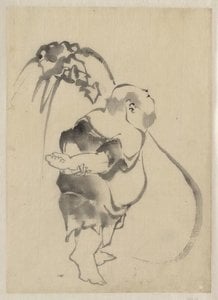
Katsushika Hokusai’s “Hotei,” a captivating black and white ink wash painting from the Edo period, transcends mere visual representation; it embodies a profound philosophical resonance that continues to captivate audiences centuries later. Created around 1830-1850 during Japan's Meiji Restoration, this artwork stands as a testament to Hokusai’s mastery of Sumi-e—a Japanese monochrome painting technique prioritizing subtle tonal variations and expressive brushstrokes—and offers a glimpse into the spiritual ideals prevalent in Victorian Japan.
The painting's composition deliberately emphasizes harmony and balance. Above Hotei’s head floats a bird—a common motif in Buddhist iconography signifying freedom from earthly concerns and aspiration for enlightenment—further reinforcing the artwork’s spiritual core. A cup positioned at the bottom right corner subtly hints at shared sustenance and communal well-being, reflecting Confucian values of filial piety and social responsibility.
“Hotei” emerged during a period marked by significant societal shifts—the gradual opening of Japan to Western influences—yet it retains an unwavering connection to traditional Buddhist beliefs. Hokusai’s depiction of Hotei aligns perfectly with the burgeoning interest in benevolent deities and moral virtues that characterized the era, offering solace amidst uncertainty.
More than just a beautiful image, “Hotei” communicates an enduring message of compassion and optimism. Its understated elegance invites contemplation on themes of familial love, spiritual aspiration, and the importance of fostering harmony within oneself and one’s surroundings. Hokusai's influence extends far beyond Japan; his innovative approach to landscape painting paved the way for Impressionist artists like Monet and Van Gogh, demonstrating the enduring power of artistic vision to transcend cultural boundaries.


1760 - 1849 , Japan

Embark on a journey through the ephemeral beauty of Ukiyo-e. Explore the profound mastery of Japanese woodblock prints, from Hokusai to the masters of the Edo period. Discover museum-quality reproductions and bespoke commissions curated for the discerning global collector.

Explore the profound beauty of Japanese Ukiyo-e art. Discover the legacy of Hokusai and the Utagawa school through an expert exploration of Edo-period aesthetics, seasonal motifs, and the enduring global influence of Japan's 'Floating World' on fine art history.

Explore the ephemeral beauty of Japanese Ukiyo-e art. From the dynamic warriors of Kuniyoshi to serene landscapes, discover the profound history, masterful techniques, and global influence of these iconic woodblock prints in our deep cultural retrospective.

Embark on a journey through the 'Floating World' with our expert guide to Ukiyo-e. Discover the profound history, legendary masters like Hokusai and Harunobu, and the enduring influence of Japanese woodblock prints on global art history.

 Preview
 Send
Send Share
Share
 Details
 Guide
Guide

 Download
 Similars
 X-Ray
X-Ray Diaporama
 Stats
Stats
 Read More







 Glass option is only available in size under 110 CM