Mixed MediaWallArtAbstract Art
 1998Modern
 50.0 x 50.0 cm
 USI Università della Svizzera italiana
The artwork displayed on this page is protected by copyright law, which means we cannot legally create or sell an identical reproduction. This protection is enforced under international agreements such as the Berne Convention and by national laws, including those outlined by the U.S. Copyright Law - Title 17.
This method fully complies with copyright regulations because it does not involve copying or duplicating the protected artwork. Instead, it is a creative reinterpretation - a new painting that is influenced by the original but not identical to it.
Museum-quality giclée or canvas print with fast production and flexible finish options. ( Buy Hand Made Painting Switch to Digital Image)





























Pick from our preset sizes that match the artwork's original proportions.

Type the width and the height you need, to fit your frame or your wall. A print can only be cut, never made bigger than the picture, so a size with a different shape loses a part of the image. We send you a digital mockup to approve before we print anything. The picture shown on this page does not show the real cut — only the mockup does.
Worldwide Delivery () in 2 weeks instead of standard 4/5 weeks. (24 October)
Untitled
Reproduction Size
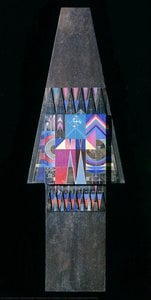
To stand before this untitled work by Karl Schmid is to encounter a vibrant dialogue between raw emotion and meticulous structure. Executed in 1998, this piece transcends mere decoration; it functions as a visual treatise on form, color theory, and the inherent beauty found within abstraction. The immediate impact of the composition is one of energetic collision—a carefully orchestrated chaos where distinct geometric shapes vie for attention against a rich, underlying field of red and brown tones. It speaks to an artist deeply engaged with the interplay between the tangible and the conceptual.
Schmid’s approach here suggests a masterful handling of collage or mixed media, giving the illusion that disparate elements have been layered upon one another over time. The visible juxtaposition of the large red square, the assertive pink triangle, the grounded brown diamond, and the ethereal white circle creates a palpable sense of depth. These primary shapes are not merely placed; they interact. Notice the subtle gleam of the gold accents—the delicate gold triangle nestled near the bold forms, and the structural gold square—these metallic touches catch the light, suggesting an added layer of preciousness or perhaps a nod to ancient mosaic work. The technique itself is a celebration of boundaries, where sharp edges meet soft gradients, inviting the viewer's eye to trace the invisible lines connecting each segment.
Given Schmid’s background—a life marked by observation and an apprenticeship in craftsmanship—this abstract work likely draws its symbolic weight from foundational principles. The geometry itself can be interpreted as a mapping of human experience: the solid red might represent passion or vitality; the white circle, purity or wholeness; while the contrasting angles suggest tension or necessary change. It is a visual rhythm. For the collector or designer, this piece offers more than just color; it offers a focal point for contemplation—a place where one can pause and consider the balance between order (the defined shapes) and impulse (the vibrant colors). The overall effect is invigorating, suggesting that beauty often arises from the successful negotiation of opposing forces.
For those considering bringing this piece home, remember that its power lies in its versatility. Because it is so self-contained in its visual narrative, it acts as a magnificent anchor for any room's décor. It complements both minimalist modernism—allowing the shapes to speak volumes against clean lines—and richly textured spaces, where its collage nature can harmonize with antique furnishings. Reproducing this work allows one to own a piece of Schmid’s late-career brilliance, capturing that unique moment when rigorous artistic discipline meets unrestrained chromatic joy.
"Untitled" depicts abstract, geometric shapes, collage art, red background, gold accents, modern design, while Karl Schmid's recorded themes are geometric abstraction influences art, exploration of form and color, post-war modern decorative style. Comparing the two shows how the work relates to the artist's usual subjects.
"Untitled" by Karl Schmid is proportioned as a square work of 50 x 50 cm.
The image of "Untitled" by Karl Schmid can be downloaded from the artwork's Download page: a high-resolution digital image download.

The life of Karl Schmid was a profound testament to the ability of the human spirit to find beauty amidst hardship. Born in Zurich in 1914, his early years were shadowed by personal tragedy and instability; the loss of his father during the Great War and the complex mental health struggles of his mother created an environment that demanded immense resilience. Yet, it was within this crucible of adversity that Schmid developed a uniquely keen eye for the intricacies of existence. His formative training was not found in a traditional studio alone, but through the tactile, disciplined world of craftsmanship. An apprenticeship as a cabinetmaker and carpenter instilled in him a fundamental respect for material and structure—a precision that would later become the backbone of his sculptural and anatomical works.
As he matured, Schmid’s journey took him toward the intersection of art and science. His time spent in the sanatoriums of Davos, while necessitated by illness, proved to be a period of immense intellectual and creative expansion. It was here that he moved within the orbits of giants such as Oskar Kokoschka and Ernst Ludwig Kirchner. These encounters were more than mere social connections; they were profound artistic dialogues that helped shape his understanding of expressionism and the human condition. This period of shared vulnerability and creative exploration allowed Schmid to weave the raw emotion of his personal history into a sophisticated artistic language.
Schmid’s oeuvre is characterized by a remarkable fluidity, moving seamlessly between the rigid demands of scientific accuracy and the liberated movements of modern abstraction. He possessed a rare ability to bridge the gap between the empirical and the spiritual. In his anatomical illustrations, one finds a meticulous dedication to the truth of the human body, where every line serves the purpose of biological clarity. However, he never allowed science to strip away the soul of his subjects; instead, he infused his studies with an artistic grace that elevated them from mere diagrams to works of profound beauty.
This duality is perhaps most evident in his transition through various stylistic movements:
Karl Schmid remains a singular figure in Swiss art history, a polymath whose contributions spanned painting, sculpture, engraving, and teaching. He did not merely exist within a single movement; rather, he acted as a conduit between the tactile world of the artisan and the intellectual world of the avant-garde. His ability to collaborate with luminaries like Hans Arp and Kokoschka speaks to his standing within the European artistic community, yet his work remains deeply personal, rooted in his own observations of life, death, and the biological wonders of the natural world.
Today, Schmid is remembered not just for the technical mastery of his woodcarvings or the precision of his engravings, but for his ability to find a unified truth in the fragmented pieces of the human experience. His legacy continues to inspire those who seek to find the harmony between the analytical mind and the creative heart, proving that art can be both a rigorous study of reality and a transcendent escape from it.

1914 - 1998 , Switzerland

Explore the profound evolution of Neo-Abstract art. Discover how bold geometric forms, vibrant chromatic depth, and tactile textures redefine modern expression for the discerning collector seeking sophisticated, high-impact masterpieces for contemporary interiors.

Explore the profound spiritual depth of geometric abstraction. From Malevich's Suprematism to modern masters, our expert guide reveals how pure form and color command presence in fine art collections.

Embark on a visual journey through the world's most radiant masterpieces. Discover how gold leaf, impasto textures, and gilded tones define luxury in fine art, from Byzantine icons to modern abstracts. Explore the eternal allure of gold in curated, museum-quality art collections.

 Preview
 Send
Send Share
Share
 Details
 Guide
Guide

 Download
 Similars
 X-Ray
X-Ray Diaporama
 Stats
Stats Read More









 Glass option is only available in size under 110 CM