

 Oil On CanvasWallArtBarbizon School
 187019th Century
 54.0 x 74.0 cm
 Hermitage Museum
Hand-painted oil on canvas in your size and frame, made to order by our artists. ( Switch to Print Switch to Digital Image)





























Pick from our preset sizes that match the artwork's original proportions.

Type the width and the height you need, to fit your frame or your wall. This is hand-painted, so for a size with a different shape the artist can paint a bit more around the picture, or cut a bit — you choose. We send you a digital mockup to approve before the painting starts. The picture shown on this page does not show the real result — only the mockup does.
Worldwide Delivery () in 3/4 weeks instead of standard 5 weeks. (24 October). No compromise on quality.
Landscape with Cows
Reproduction Size
In the quietude of Jules Dupré’s Landscape with Cows, one finds more than just a depiction of pastoral life; one encounters a profound meditation on the enduring peace of the natural world. Painted in 1870, this oil on canvas masterpiece invites the viewer into a realm where time seems to decelerate. The scene is anchored by a magnificent, ancient tree, its lush foliage rendered in a rich tapestry of greens and earthy browns that suggest the gentle transition of seasons. Beneath the protective canopy of this arboreal sentinel, a small herd of cows grazes with unhurried grace. Their varied coats—some deep and dark, others light and dappled—add a rhythmic vitality to the foreground, grounding the composition in a sense of lived, breathing reality. The rolling hills in the distance, bathed in the soft, melancholic hues of blue and gray, stretch toward an expansive sky filled with drifting clouds, creating a sense of infinite depth that draws the eye deep into the heart of the French countryside.
For the discerning collector or interior designer, this work offers a masterclass in the Barbizon School technique. Dupré, a pivotal figure of this movement, moved away from the polished, idealized landscapes of the past to embrace a more visceral, observational realism. His brushwork is both meticulous and emotive, capturing the tactile quality of bark, the softness of grass, and the heavy, moisture-laden atmosphere of a cloudy day. The artist’s true genius lies in his manipulation of light and shadow; a subtle illumination, seemingly emanating from the left, dances across the backs of the cattle and highlights the textured leaves of the great tree. This interplay of light creates a three-dimensional presence that makes the landscape feel less like a window and more like an immersive environment, perfect for adding a sense of organic warmth and structural depth to a sophisticated interior.
Beyond its technical brilliance, Landscape with Cows carries a heavy emotional weight, characteristic of Dupré’s unique artistic soul. While many of his contemporaries sought only the lyrical beauty of nature, Dupré was known for his ability to capture the more tempestuous and dramatic facets of the elements. Yet, in this particular work, that intensity is channeled into a state of profound tranquility. There is a palpable sense of solitude without loneliness—a quiet dignity found in the simple act of grazing under an expansive sky. The muted palette of somber blues, soft grays, and deep greens fosters a harmonious atmosphere that can soothe the spirit, making it an ideal centerpiece for spaces designed for reflection, study, or relaxation.
To possess a reproduction of this caliber is to bring a piece of art history into the modern home. It serves as a bridge to the 19th-century French landscape tradition, embodying the radical shift toward direct experience and emotional honesty. Whether placed in a sunlit gallery or a moody, contemporary study, Dupré’s vision remains timeless. The painting does not merely decorate a wall; it breathes life into a room, offering a perennial escape to a pastoral idyll where the only movement is the slow drift of clouds and the gentle rhythm of nature itself.
Overall, "Landscape with Cows" is recorded as shadow. Perceived brightness describes how light or dark the work appears.
A reproduction of "Landscape with Cows" by Jules Dupré is recommended for accent. This suggestion follows from the work's subject, mood and colors.
The palette of "Landscape with Cows" by Jules Dupré is described as earthy. It is a compact description of the work's colors.

Jules Dupré (1811–1889) stands as a cornerstone figure within the Barbizon School, an artistic movement that championed raw observation and emotional resonance in landscape painting. Unlike his contemporaries like Corot who often sought lyrical beauty and tranquil stillness, Dupré wrestled with the darker, more tempestuous side of nature. He possessed a unique ability to capture the fury of storms, the melancholic grandeur of twilight, and the relentless energy of the elements, conveying these experiences with unparalleled intensity. Born in Nantes, France, Dupré’s artistic journey began amidst a burgeoning fascination for the natural world and its capacity to evoke profound, often turbulent, human feelings.
His early life provided a foundation of meticulous attention to detail and an appreciation for craftsmanship, qualities honed by his father’s porcelain manufacturing business. This formative experience would later translate into his own artistic endeavors, particularly evident in his early works exploring the intricacies of ceramic decoration. As an apprentice porcelain decorator, he learned the discipline of fine lines and textures, a skill set that would eventually evolve into his masterful handling of atmospheric depth and organic forms.
The trajectory of Dupré’s career was irrevocably shaped by his encounter with the groundbreaking canvases of John Constable. This exposure to English landscape traditions ignited a desire to capture the essence of nature’s dynamism—the relentless push and pull of wind-driven foliage and the dramatic interplay of light and shadow during the most volatile hours of the day. Traveling to Great Britain in 1831, Dupré made profound studies of these English masters, returning to France with a portfolio of imagery that would redefine his approach to the landscape.
He found particular inspiration in the coastal districts around Southampton and Plymouth. These vast expanses of water, reflecting turbulent skies, provided him with the perfect laboratory to study the tempestuous motion of storm clouds and the movement of seas. His paintings from this period are not merely depictions of scenery; they are visceral expressions of mood and feeling, imbued with a palpable sense of drama and even sorrow. By embracing the Barbizon aesthetic, Dupré prioritized expressive color palettes and bold brushstrokes over idealized or polished representations, allowing the texture of the paint itself to mirror the ruggedness of the earth.
As a key figure in the Barbizon group, Dupré developed close ties with other legendary painters, including Théodore Rousseau. His rise within the French art establishment was marked by significant milestones, such as his acceptance into the Salon and receiving official recognition through medals for his landscapes. His work became synonymous with a certain sonorous and resonant color harmony, where the light of a setting sun or the gloom of an approaching gale could be felt by the viewer as much as seen.
Today, Jules Dupré is remembered as one of the most influential 19th-century French landscape artists. His contribution to art lies in his ability to bridge the gap between pure observation and romantic emotion. Through works such as La Petite Charrette, Cows Crossing a Ford, and his evocative depictions of river landscapes, he taught generations of artists that nature is not just a subject to be painted, but a powerful force to be experienced. His legacy remains etched in the heavy, atmospheric textures and the dramatic, breathing skies that continue to captivate the modern imagination.

1811 - 1889 , France
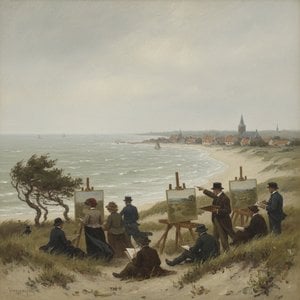
Explore the ethereal beauty of the Hague School art movement. Discover how masters like Jan Weissenbruch captured the atmospheric grey light of the Dutch landscape through unparalleled technique and emotive, misty compositions.

Explore the profound legacy of the Barbizon School. Discover how masters like Corot and Monet revolutionized landscape painting through plein air techniques and the soulful depiction of nature's light and shadow in this expert art history guide.

 Preview
 Send
Send Share
Share
 Details
 Guide
Guide

 Download
 Similars
 X-Ray
X-Ray Diaporama
 Stats
Stats Read More









 Glass option is only available in size under 110 CM


