

 PaintingContemporary Realism
 Contemporary
 40.0 x 38.0 cm
 Canberra Museum and Gallery
The artwork displayed on this page is protected by copyright law, which means we cannot legally create or sell an identical reproduction. This protection is enforced under international agreements such as the Berne Convention and by national laws, including those outlined by the U.S. Copyright Law - Title 17.
This method fully complies with copyright regulations because it does not involve copying or duplicating the protected artwork. Instead, it is a creative reinterpretation - a new painting that is influenced by the original but not identical to it.
Museum-quality giclée or canvas print with fast production and flexible finish options. ( Buy Hand Made Painting Switch to Digital Image)





























Pick from our preset sizes that match the artwork's original proportions.

Type the width and the height you need, to fit your frame or your wall. A print can only be cut, never made bigger than the picture, so a size with a different shape loses a part of the image. We send you a digital mockup to approve before we print anything. The picture shown on this page does not show the real cut — only the mockup does.
Worldwide Delivery () in 2 weeks instead of standard 4/5 weeks. (28 October)
Interior 183 (Caitlin)
Reproduction Size
In the quietude of Interior 183 (Caitlin), the viewer is invited into a profound moment of stillness. The Australian painter Jude Rae, a master of capturing the delicate intersection between the physical and the spiritual, presents us with a portrait that transcends mere likeness. Here, the subject—Caitlin—is captured in a state of repose, her eyes gently closed as if retreating from the clamor of the external world into the sanctuary of her own thoughts. This painting is not merely a study of a face, but an exploration of the interiority that exists within every human soul when the distractions of sight are removed.
The technique employed by Rae is one of masterful realism, where every subtle nuance of light and shadow serves to deepen the emotional resonance of the piece. Through a delicate application of paint, she renders the soft contours of the subject's features, creating a tactile quality that makes the moment feel palpably present. The background, rendered with a soft, impressionistic blur, performs a vital compositional role; by dissolving the surrounding environment into an ethereal haze, Rae forces our gaze to settle entirely upon the subject. This creates an intimate, almost voyeuristic connection, as if we are sharing a private, sacred breath with the sitter.
The decision to depict her subjects with closed eyes is perhaps the most poignant element of Rae’s Interiors series. In an era defined by constant visual stimulation, the act of closing one's eyes becomes a powerful symbol of vulnerability and autonomy. As the artist suggests, if the eyes are indeed the "windows to the soul," then closing them serves to seal that window, protecting the inner sanctum from outside intrusion. In Interior 183 (Caitlin), this closure transforms the subject from an object of our gaze into a complete, self-contained entity. She is no longer performing for the viewer; she is simply being.
For collectors and lovers of fine art, this piece offers more than just aesthetic beauty; it offers a meditative experience. The painting captures the tension between being seen and being hidden, making it a profound addition to any collection focused on psychological depth or contemporary portraiture. It serves as a reminder of the beauty found in rest, the dignity found in solitude, and the richness of the worlds we carry within us.
For interior designers and connoisseurs of fine decor, Interior 183 (Caitlin) represents a sophisticated choice for creating atmosphere. The painting’s muted palette and soft textures lend themselves beautifully to serene environments, such as a quiet study, a master bedroom, or a contemplative gallery space. Its ability to command attention through subtlety rather than spectacle makes it an ideal centerpiece for a room designed around themes of tranquility and elegance.
Owning a high-quality reproduction of this work allows one to bring the evocative power of Jude Rae’s vision into their personal sanctuary. Whether placed in a modern minimalist setting or a more classical, richly textured room, the painting acts as an anchor of peace, inviting anyone who encounters it to pause, breathe, and rediscover the beauty of the quiet moment.
The overall mood of "Interior 183 (Caitlin)" by Jude Rae is calm. The mood describes the general atmosphere of the work.
Works similar to "Interior 183 (Caitlin)" are listed on the artwork's Similars page.
A Stats page exists for "Interior 183 (Caitlin)". It charts the monthly visits of the artwork and of the artist's other works, with country and language breakdowns.

Born in Sydney in 1956, Jude Rae emerged from a lineage deeply rooted in the traditions of realist painting. As the daughter of David Rae, a painter whose works are held within the esteemed collection of the Art Gallery of New South Wales, her artistic foundation was laid amidst the textures and tones of classical observation. Her education began early, attending the Julian Ashton Art School from the age of eleven or twelve, following in the footsteps of both her parents who were also trained at the same institution. This rigorous early immersion in the fundamentals of light and form provided the scaffolding for a career that would eventually span Australia and New Zealand, marked by a profound ability to capture the delicate intersection between the physical and the spiritual.
Rae’s academic journey further refined her technical prowess, as she pursued a Bachelor of Arts in Fine Arts with a focus on Art History at the University of Sydney. Her scholarly pursuits were complemented by advanced training, including a Graduate Diploma in Professional Art Studies from the University of New South Wales and a Master of Arts in Painting from the University of Canterbury in Christchurch, New Zealand. This blend of historical knowledge and technical mastery allowed her to develop a style that is both deeply informed by the past and intensely personal in its execution.
The work of Jude Rae is celebrated for its evocative power, particularly within her large-scale interiors, portraits, and still life paintings. She has gained significant recognition for a unique approach to portraiture that subverts traditional expectations. In her celebrated series of interiors, which captures the essence of Canberra’s artistic community, Rae often depicts her subjects with their eyes gently closed. By intentionally obscuring the gaze, she challenges the age-old adage that the eyes are the windows to the soul; instead, she suggests that true intimacy and the richness of one's inner life are discovered when those windows are shuttered, allowing the viewer to contemplate the vast, unseen landscapes of the mind.
Her technique is a masterclass in subtle nuance and atmospheric depth. Utilizing a sophisticated layering technique, likely employing oils on canvas, Rae builds a rich, tactile surface where every crease, contour, and soft texture is articulated through deliberate, expressive brushwork. Her color palettes are often intentionally subdued, dominated by harmonious blends of earthy browns, muted greens, and soft greys. This restrained chromatic range, paired with soft, diffused lighting, ensures that the viewer's focus remains entirely on the emotional weight and psychological landscape of her subjects. Whether she is rendering a moment of deep contemplation in Interior 180 (Anna) or exploring the sanctuary of thought in Interior 167 (David), her paintings transcend mere likeness to become explorations of human interiority.
Since beginning to exhibit in the 1980s, Jude Rae has established a significant presence in the Australian and New Zealander art scenes. Her career has been marked by prestigious accolades and inclusion in major surveys of contemporary art. Notable achievements include:
Beyond her studio practice, Rae has contributed to the academic community through her teaching roles at institutions such as the Australian National University. Her exhibitions, ranging from solo shows like Jude Rae: Still Lifes to group displays across Australia and New Zealand, continue to invite viewers into a profound space of stillness, making her a vital voice in contemporary realist painting.

1956 - , Australia
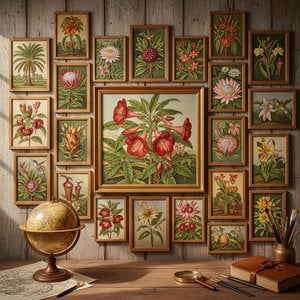
Journey through the vibrant world of Marianne North’s botanical paintings! Explore 25 iconic artworks from this Victorian artist, celebrating exotic flora & travel. Find museum-quality reproductions and curated decor ideas at WahooArt.com.

Explore the rich history of formal portraiture & its enduring power to capture identity and shape perception. Discover investment-worthy artworks, expert appraisals, and custom reproduction services at WahooArt.
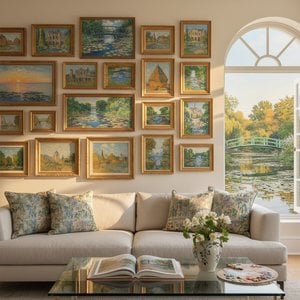
Journey through 25 iconic Claude Monet masterpieces! Explore Impressionism’s beauty, from Water Lilies to Rouen Cathedral. Discover stunning art reproductions & curated decor ideas – explore the full collection online at WahooArt.com.
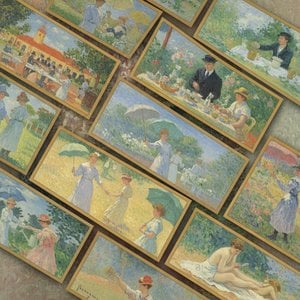
Explore 25 iconic Pierre-Auguste Renoir paintings! Discover the stories behind Impressionist masterpieces like 'Dance at Le Moulin de la Galette' & 'Luncheon of the Boating Party'. Find museum-quality art reproductions and elevate your home decor with WahooArt.com.

Find peace with 10 serene masterpieces! Explore calming landscapes by Monet & Van Gogh, tranquil Japanese art like Hokusai’s Great Wave, and more. Discover the stories behind these iconic paintings & bring museum-quality art to your home with . Explore the full collection online.

 Preview
 Send
Send Share
Share
 Details
 Guide
Guide

 Download
 Similars
 X-Ray
X-Ray Diaporama
 Q&A
Q&A Stats
Stats Read More









 Glass option is only available in size under 110 CM


