

Purchase a high-resolution, enhanced digital image, far superior to the online preview.
Each file is meticulously prepared by our in-house specialists using advanced tools and expert manual retouching. We ensure every image has exceptional clarity, precise color accuracy, and fine detail.
The final file is delivered via email within 72 hours, optimized for immediate use in professional, editorial, and print environments. This is the same quality trusted by top-tier design studios, publishers, and galleries.
Download a high-resolution file for personal display, printing, and creative projects. ( Switch to Print Buy Hand Made Painting)
When you choose WahooArt.com, you're not just getting an image - you're receiving a professionally enhanced digital artwork, crafted with precision and backed by a satisfaction guarantee. Here's everything that comes with your order, automatically:

Your high-resolution digital image file will be emailed to you within 72 hours of ordering - ready for immediate use.

Your artwork is professionally optimized using advanced AI tools and manual editing, ensuring maximum detail, clarity, and color accuracy.

Accidentally deleted or lost your file? No worries - we'll resend it to you anytime, free of charge.

Enjoy your artwork instantly with zero customs, duties, or delivery fees - digital downloads are always tax-free.

We ensure your digital image reflects the original colors as closely as possible using professional tools and color management.

If you're not satisfied with your digital image, we'll revise it or refund 100% within 100 days - no questions asked.

Not satisfied? Get a full refund within 100 days of receiving your digital file - no questions asked.

Buy 3 images, save 10% - Buy 5, save 15% - Buy 10+, save 20%. Great for creative projects, galleries, and agencies.

DeForrest Hale Judd (1916-1993) was a painter deeply entwined with the spirit of his native Texas. Born and largely remaining within the borders of the Lone Star State, Judd’s artistic journey wasn't one of dramatic stylistic shifts or cosmopolitan exploration, but rather a sustained, intimate observation of the natural world around him. He spent most of his life in Dallas, forging a career as both an artist and educator at Southern Methodist University, where he imparted his passion for capturing the subtleties of light, form, and atmosphere to generations of students.
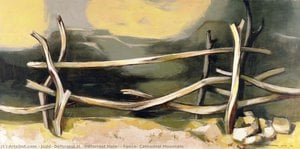
Judd’s work is characterized by a quiet realism, eschewing grand narratives or overt symbolism. Instead, he focused on the inherent beauty found in the landscapes of Big Bend National Park, the bayous of Caddo Lake, and the rolling plains that define so much of Texas. His paintings aren't simply depictions of places; they are evocations of feeling—the stillness of a desert afternoon, the humid mystery of a swamp, the vastness of the open sky. He possessed an exceptional ability to translate the nuances of these environments onto canvas, utilizing watercolor and crayon with remarkable sensitivity.
While specific early influences remain somewhat undocumented, it’s clear that Judd's artistic sensibility was shaped by a deep connection to the American Regionalist movement. Artists like Thomas Hart Benton and John Steuart Curry, who sought to depict rural life and landscapes with authenticity and emotional resonance, likely played a role in his development. However, Judd diverged from the often-didactic social commentary of some Regionalists, choosing instead to focus on the purely aesthetic qualities of nature.
His technique evolved over time, but consistently prioritized direct observation. He wasn’t interested in recreating photographic realism; rather, he aimed to capture the *essence* of a place—its light, its color, its mood. Watercolor became his primary medium, allowing for fluidity and transparency that perfectly suited his atmospheric style. The addition of crayon provided texture and depth, adding another layer of richness to his compositions. He often worked en plein air, sketching directly from nature before refining his paintings in the studio.
The landscapes of Texas are undeniably central to Judd’s oeuvre. Big Bend National Park, with its dramatic canyons, rugged mountains, and stark desert beauty, appears frequently in his work. He was captivated by the play of light on the rock formations, the subtle shifts in color throughout the day, and the sense of timelessness that pervades the region. Caddo Lake, a sprawling cypress swamp in East Texas, also held a special appeal for Judd.
His paintings of Caddo Lake are often shrouded in mist and shadow, evoking a feeling of mystery and tranquility. The gnarled trees, draped with Spanish moss, create an ethereal atmosphere that is both haunting and beautiful. Beyond these specific locations, Judd frequently depicted scenes of rural Texas—fields, pastures, and small towns—capturing the quiet dignity of everyday life.
DeForrest Hale Judd’s work represents a significant contribution to American Regionalism, albeit one that is often overlooked. While he didn't achieve widespread fame during his lifetime, his paintings have gained increasing recognition in recent years as collectors and art historians rediscover the beauty and subtlety of his vision.
His legacy extends beyond his artwork through his teaching at Southern Methodist University. He instilled in his students a deep appreciation for observation, technique, and the importance of finding inspiration in their surroundings. Judd’s paintings serve as a testament to the enduring power of nature and the ability of art to capture its fleeting beauty. His work reminds us to slow down, to look closely, and to appreciate the quiet wonders that surround us.
1916 - 1993 , United States of America

 Preview
 Send
Send Share
Share
 Details
 Guide
Guide

 Download
 Similars
 X-Ray
X-Ray Diaporama
 Stats
Stats

 Read More


