Museum-quality giclée or canvas print with fast production and flexible finish options. ( Buy Hand Made Painting Switch to Digital Image)
Pick from our preset sizes that match the artwork's original proportions.

Type the width and the height you need, to fit your frame or your wall. A print can only be cut, never made bigger than the picture, so a size with a different shape loses a part of the image. We send you a digital mockup to approve before we print anything. The picture shown on this page does not show the real cut — only the mockup does.
Worldwide Delivery () in 2 weeks instead of standard 4/5 weeks. (12 November)
Grenoble
Reproduction Size

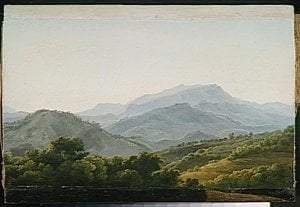
To look at a landscape by Joseph Pierre Xavier Bidauld is to see a specific, disciplined interpretation of the Mediterranean. He did not merely paint scenery; he constructed it through a lens of clarity and tonal balance. His work avoids the messy emotionalism that would later define the Romantic movement, opting instead for a structured, neo-classical approach to the natural world. This preference for order is what makes his output so distinct from the more chaotic landscape traditions of his era.
His technical foundation was built on a rigorous apprenticeship under his brother, Jean-Pierre-Xavier, in Lyon. This early training provided the discipline required for his later, more complex compositions. By the time he reached Paris in 1783, his ability to handle light and perspective was already evident. He was not a self-taught amateur; he was a technician of the landscape, focused on the way light interacts with topographical features.
The defining period of Bidauld’s career occurred during five years spent in Italy, specifically in Rome. Supported by the art dealer and perfume seller Dulac, Bidauld moved beyond the provincial styles of his youth to master the atmospheric perspective of the Italian countryside. He did not just copy the masters; he internalized the way the Tuscan hills and the Roman Campagna could be organized into a coherent visual narrative. His sketches, often executed en plein air on paper, reveal a directness that his finished oil paintings later refined.
His return to Paris in 1790 marked his entry into the official art establishment. He became a regular presence at the Salon, exhibiting consistently between 1791 and 1844. His success was not merely a matter of popularity but of institutional recognition. He achieved a rare distinction for a landscape painter:
Bidauld’s later years illustrate the friction between established academic standards and the rising tide of naturalism. As a member of the Salon jury, he was perceived as a barrier to the new generation of landscape painters, including figures like Théodore Rousseau. This position, while a mark of his authority, ultimately led to his professional decline. The press was harsh, and his refusal to pivot toward the more spontaneous, unrefined styles of the younger artists left him isolated.
By the time of his death in 1846, the artist who had once been a pillar of the French Academy found himself in near penury. His legacy is not one of revolutionary change, but of technical mastery and the preservation of a specific, structured vision of nature. He remains a vital link in the evolution of French landscape painting, representing the moment when the landscape moved from a background element to a subject of serious, academic study.

1758 - 1846
 Preview
 Send
Send Share
Share
 Details
 Guide
Guide

 Download
 Similars
 X-Ray
X-Ray Diaporama
 Q&A
Q&A
 Stats
Stats
 Read More






































 Glass option is only available in size under 110 CM