Preview AR preview Switch to Print Switch to Digital Image Send
Details Guide Add to favorites Download Similars X-Ray Diaporama Stats

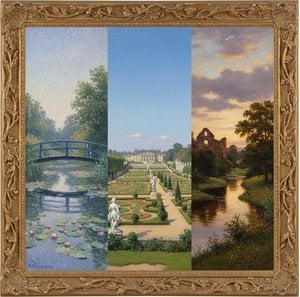
My Garden in Spring

Discover "My Garden in Spring" by Joseph Delattre – a serene impressionistic landscape of vibrant flowers & charming architecture. Explore this beautiful 1900s French painting.

Joseph Delattre (1858-1912): Explore the landscapes of the Rouen School painter, bridging Barbizon & Impressionism. Discover his plein air style and influence on artists like Pinchon!

Hand Made Oil Reproduction

Hand-painted oil on canvas in your size and frame, made to order by our artists. ( Switch to Print Switch to Digital Image)

P118B $10
P118H $10
P118W $10
P438Z $10
P508JH $12
P508YH $12
P805H $10
P805Z $10
P919BZ $10
P919G $10
P919XJ $10
P959ZH $10
P968JZ $12
W106C $8
W218G $10
W218JH $8
W218Y $10
W307PJ $10
W316G $10
W316PJ $8
W316Y $10
W398PJ $8
W4111J $10
W500HY $15
W500JH $15
W692G $12
W849H $8
W940BG $15
W953PJ $8

Standard
custom
CM
INCH

Pick from our preset sizes that match the artwork's original proportions.

width
height

You may enter your own dimensions to fit a specific frame or space. If your selected size does not match the original image's proportions, we will either crop the artwork or extend the painting with additional hand-painted elements. A digital mockup will be sent for your approval before production begins.
Please note that the on-screen preview does not reflect the actual cropping or extension. Only the mockup will accurately show the final composition.
While custom sizes are available, we recommend selecting a dimension from the predefined list to preserve the original proportions.

Examples of what can be changed: Replace face with customer photo; Add pet (e.g., replace cat with dog); Include hidden message in background; Change background landscape or elements.
After order, WahooArt.com team will email client for instructions and provide a mockup preview

Worldwide Delivery () in 3/4 weeks instead of standard 5 weeks. (23 September). No compromise on quality.

why_choose_icon
Free Worldwide Express Shipping
why_choose_icon
High-Quality Linen Canvas
why_choose_icon
Full Shipping Insurance
why_choose_icon
Customs Tax Refund Guarantee
why_choose_icon
True Color Matching Guarantee
why_choose_icon
100-Day Return Policy (Defects Only)
why_choose_icon
100% Money-Back Guarantee
why_choose_icon
Bulk Discount Offer

Total Price

$ 272

reproduction

My Garden in Spring

Reproduction Medium

Reproduction Size

-

Total Price

$ 272


Artist Biography

A Normandy Son: The Life and Art of Joseph Delattre

Joseph Delattre, born in the tranquil setting of Deville-les-Rouen in 1858, stands as a pivotal figure bridging the established traditions of Barbizon landscape painting with the burgeoning freedom of Impressionism. Though perhaps not a household name like Monet or Renoir, his contribution to the artistic landscape of Normandy – and specifically, the Rouen School – was profoundly influential. Delattre’s journey wasn't one of radical departure, but rather a subtle evolution, a delicate negotiation between honoring the past and embracing the innovative spirit of his time. He possessed an innate sensitivity to the nuances of light and atmosphere, qualities that would define his artistic vision and resonate through the work of generations of painters who followed in his footsteps. His early exposure to the Barbizon school instilled within him a deep respect for direct observation of nature, a commitment to portraying rural life with honesty and detail. However, Delattre was not content merely to replicate existing styles; he yearned to explore new avenues of expression, forging strong bonds with Impressionist pioneers like Charles Angrand and Claude Monet who encouraged his artistic experimentation.

From Barbizon Roots to a Liberated Brushstroke

Delattre’s initial works clearly reflect the influence of the Barbizon masters – tonal painting dominating, forms rendered with meticulous detail. Yet, even in these early pieces, hints of his future direction are visible: a softening of edges, a growing interest in capturing fleeting moments of light. Over time, this inclination blossomed into a more liberated approach to form and brushwork. He began to simplify shapes, allowing color to take precedence over precise representation, and subtly fading contours to create an impressionistic haze. This stylistic shift wasn’t universally appreciated; many viewers accustomed to the conventional norms of academic painting struggled to comprehend his departure. But Delattre remained steadfast in his artistic convictions, driven by a desire to capture not just *what* he saw, but *how* he perceived it – the emotional resonance of a landscape, the ephemeral quality of light dancing on water. Plein air painting became central to his practice, allowing him to immerse himself directly in nature and translate its ever-changing moods onto canvas. His landscapes are not merely depictions of places; they are evocations of atmosphere, imbued with a sense of tranquility and poetic beauty.

The Académie Libre and a Legacy of Mentorship

In 1895, Delattre cemented his role as an artistic leader by founding the *Académie libre* (Free Academy) in Rouen. This workshop quickly became a vital hub for a new generation of independent artists associated with the École de Rouen. Unlike traditional academies that emphasized rigid instruction and adherence to established rules, the Académie Libre fostered a spirit of experimentation and collaboration. Delattre led his students on outdoor excursions to locations like Pré-aux-Loups and Côte Sainte-Catherine, encouraging them to embrace plein air painting and develop their own unique artistic voices. Among his most notable pupils were Pierre Dumont and Robert Antoine Pinchon, both of whom would become significant figures in the Rouen School, carrying forward Delattre’s legacy of innovation and independent thought. His mentorship wasn't about imposing a specific style; it was about nurturing individual talent and fostering a deep connection to the natural world.

“Les Trois Mousquetaires” and Artistic Exploration

Towards the end of the 1880s, Delattre formed a particularly close working relationship with Léon Jules Le Maître and Charles Frechon. Inspired by the Pointillist techniques pioneered by Camille Pissarro, this trio became affectionately known as “les trois mousquetaires” for their shared exploration of divided brushstrokes and optical mixing. They sought to achieve greater luminosity and vibrancy in their paintings through the meticulous application of small dots of pure color. However, Delattre’s engagement with Pointillism was always tempered by his own artistic sensibilities. He didn't adhere rigidly to the technique; instead, he integrated it into his evolving style, using it as a means to enhance the atmospheric effects and subtle nuances of light in his landscapes. This willingness to experiment and adapt demonstrates Delattre’s intellectual curiosity and his commitment to pushing the boundaries of his art.

A Lasting Impression: Historical Significance and Enduring Appeal

Though not always widely recognized during his lifetime, Joseph Delattre is now celebrated as a pivotal figure in the Rouen School and a crucial link between traditional landscape painting and Impressionism. His dedication to plein air work, his commitment to artistic independence, and his profound influence on younger artists have secured his place in French art history. He understood that true artistry lay not in slavishly copying nature, but in interpreting it through the lens of personal experience and emotion. Today, streets in several towns surrounding Rouen – Barentin, Canteleu, Maromme Le Mesnil-Esnard, Pavilly, and Rouen itself – bear his name, a testament to the enduring respect he commands within his native region. His own modest assessment of his contribution – “Je n’aurai donné qu’un petit son de flûte mais il aura été juste” (“I will have given only a small flute sound but it will have been just”) – speaks volumes about his humility and artistic integrity. Joseph Delattre's paintings continue to captivate viewers with their serene beauty, atmospheric depth, and subtle poetic sensibility, offering a glimpse into the heart of Normandy and the soul of a dedicated artist.
Joseph Delattre

Joseph Delattre

1858 - 1912 , France

Quick Facts

  • Artistic Movement Or Style: Rouen School, Impressionism
  • Artists Or Movements Influenced By This Artist:
    • Pierre Dumont
    • Robert Pinchon
  • Artists Who Influenced This Artist:
    • Charles Angrand
    • Claude Monet
  • Date Of Birth: 1858
  • Date Of Death: 1912
  • Full Name: Joseph Delattre
  • Nationality: French
  • Notable Artworks:
    • Farm at Déville
    • The Lake
    • Port of Rouen
    • Prairie Saint-Gervais
  • Place Of Birth: Deville-les-Rouen, France
Explore artworks organized by themes, styles, and characteristics.